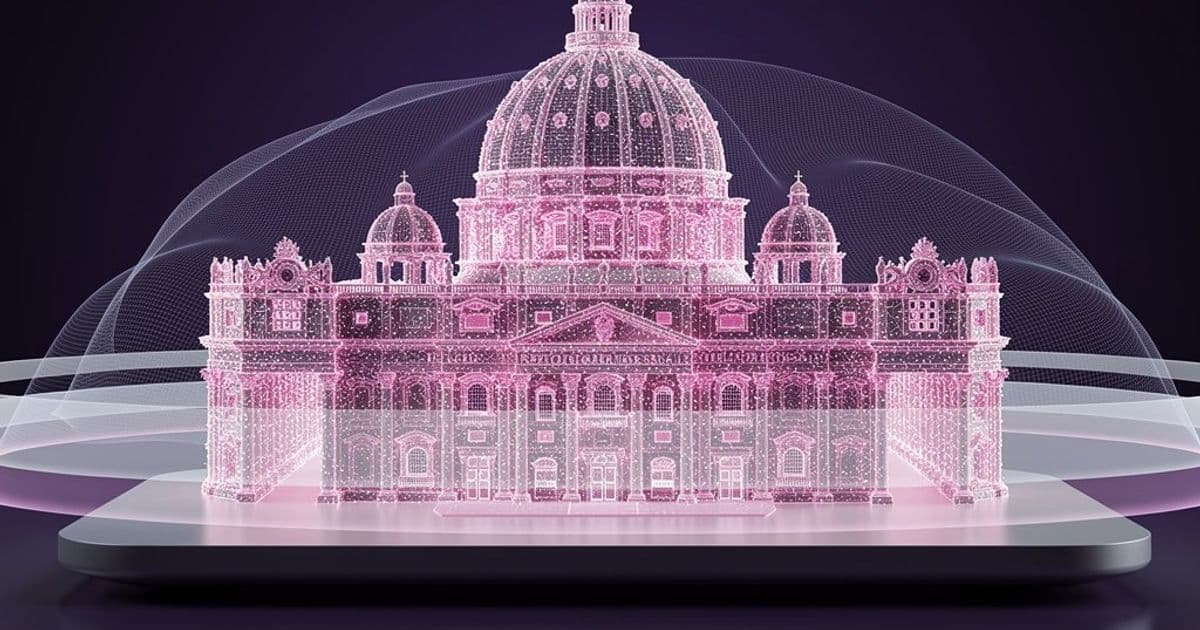
Valorem Reply's partnership with the Vatican demonstrates how cloud infrastructure can democratize access to cultural heritage while supporting preservation. By creating a digital twin from 400,000 high-definition images on Azure, they've solved the dual challenge of managing pilgrimage demand during the 2025 Jubilee year while making the iconic site accessible to billions of Catholics worldwide.
The 2025 Jubilee year presented the Vatican with a logistical and ethical challenge that has echoed through centuries of Catholic tradition. With over two billion Catholics worldwide and pilgrimage to Rome as a central tenet of the Holy Year, the Vatican faced the reality that most faithful could never make the journey. More critically, those who did make the pilgrimage risked damaging one of Christianity's most sacred sites through overcrowding and wear.
Valorem Reply, a Microsoft partner specializing in digital transformation, was tasked with creating something unprecedented: a complete digital twin of Saint Peter's Basilica that could serve both as a preservation tool and a global accessibility platform. The project required processing 400,000 high-definition images into an interactive experience that could handle global traffic while maintaining the spiritual and educational value of physically visiting the Basilica.
From Physical Pilgrimage to Digital Access
The challenge extended beyond simple 3D scanning. The Vatican needed a solution that could:
- Preserve physical integrity: Reduce foot traffic during the Jubilee while maintaining the pilgrimage experience
- Scale globally: Serve potentially billions of users without performance degradation
- Maintain authenticity: Provide meaningful educational and spiritual content, not just visual replication
- Ensure accessibility: Work across devices and connection speeds worldwide
Ryan McCamy, Lead of Tech for Social Impact at Valorem Reply, explained the scope: "The Vatican recognized that there are two billion Catholics in this world, most of whom were not coming to the Jubilee. And they wanted to have a unique and immersive experience for the world and for the people who can't actually make it to the Basilica and walk through for themselves. Nothing like this had ever been done before."
Azure Architecture for Cultural Heritage
The digital twin solution leverages Azure's cloud infrastructure to process, store, and serve massive amounts of visual data while maintaining performance across global distribution. The architecture addresses several technical challenges:
Data Processing at Scale
Converting 400,000 high-definition images into a navigable 3D model requires significant computational power. Azure's scalable compute resources allow for:
- Parallel processing of image datasets
- Photogrammetry operations that stitch images into coherent 3D geometry
- Quality assurance and optimization for web delivery
Without cloud elasticity, this processing would require months on local infrastructure or prohibitively expensive hardware investments.
Global Content Delivery
The web experience includes multiple components:
- Historical storytelling: Educational content about the Basilica's origins and significance
- Virtual tour: 30-40 points of interest covering art and architecture
- Interactive 3D model: The complete digital twin for exploration
Azure's global CDN network ensures that users in remote locations experience the same responsive interface as those in Rome. This is critical for a project designed specifically to serve those who cannot travel.
Storage and Accessibility
High-definition imagery requires substantial storage, but the real challenge is making it accessible without compromising quality. The solution balances:
- Progressive loading: Users can begin exploring while high-resolution assets stream in
- Adaptive quality: Adjusts based on connection speed and device capability
- Persistent availability: Ensures the experience remains accessible throughout the Jubilee year and beyond
Business Impact: Beyond the Vatican
This case study demonstrates a pattern that extends to any organization managing high-value physical assets:
Preservation Through Digitization
Museums, historical sites, and cultural institutions face similar pressures: increasing visitor numbers, physical deterioration, and limited capacity. A digital twin approach allows:
- Reduced physical wear: Virtual visitors don't contribute to degradation
- Enhanced security: Digital access reduces the need for physical security measures during peak times
- Documentation: Creates a permanent digital record for restoration reference
Democratizing Access
The Vatican project shows how cloud infrastructure can remove geographic and economic barriers:
- No travel costs: Users access the experience from anywhere
- No time constraints: The experience is available 24/7
- Universal accessibility: Works across devices, from smartphones to high-end VR setups
New Revenue and Engagement Models
While the Vatican project serves a religious mission, the technical pattern applies commercially:
- Museums: Virtual tours as paid experiences or membership benefits
- Real estate: Digital twins for property viewing and facility management
- Education: Interactive learning environments for history and architecture
Technical Trade-offs and Considerations
Creating a digital twin of this scale involves critical decisions:
Fidelity vs. Performance: The 400,000-image dataset provides photorealistic detail, but requires careful optimization. Too much detail creates latency; too little diminishes the spiritual and educational value. Azure's processing capabilities allow for iterative refinement.
Static vs. Dynamic: The Basilica is largely static, but lighting changes, seasonal variations, and restoration work create evolution. The digital twin must be updatable without rebuilding from scratch.
Open vs. Controlled Access: The Vatican wants broad access but must prevent misuse. Authentication and rate limiting balance openness with security.
Implementation Timeline and Scale
The project was completed in time for the 2025 Jubilee, demonstrating Azure's ability to accelerate development:
- Imaging: Partner vendor captured 400,000 images across the Basilica
- Processing: Azure compute resources converted images to 3D models
- Development: Valorem Reply built the web experience with multiple entry points
- Deployment: Global launch with CDN distribution
Broader Implications for Cloud Strategy
This case study illustrates why multi-cloud and cloud-native strategies matter for enterprise:
Provider Comparison: Azure's strength in this project came from its mature ecosystem for AI/ML services, global network infrastructure, and enterprise-grade SLAs. Organizations evaluating cloud providers for similar projects should consider:
- AI/ML capabilities for image processing
- Global CDN performance
- Storage costs for massive datasets
- Developer tools and SDKs for 3D/web development
Migration Considerations: Organizations with physical assets considering digitization should evaluate:
- Data ingestion pipelines from scanning equipment
- Processing time vs. cost trade-offs
- Long-term storage strategies
- Integration with existing digital platforms
Lessons for Cloud Architects
The Vatican project provides several architectural patterns:
- Start with the constraint: The primary constraint was physical preservation, which drove the digital-first approach
- Scale on demand: Cloud elasticity matched unpredictable user load during Jubilee events
- Global by default: Design for worldwide access from the beginning
- Preserve the experience: Technology should enhance, not replace, the core mission
Conclusion
Valorem Reply's digital twin of Saint Peter's Basilica represents more than a technical achievement—it shows how cloud infrastructure can solve real-world problems of access, preservation, and scale. For the Vatican, it means maintaining tradition while embracing modernity. For cloud architects and business leaders, it demonstrates a repeatable pattern: when physical constraints limit mission fulfillment, cloud-native digitization can provide the bridge.
The project's success during the 2025 Jubilee creates a foundation for ongoing access and preservation, proving that digital transformation in service of cultural heritage is both technically feasible and spiritually meaningful.
Learn more about Azure for digital transformation Explore Valorem Reply's case studies Microsoft Partner Community case studies
Comments
Please log in or register to join the discussion