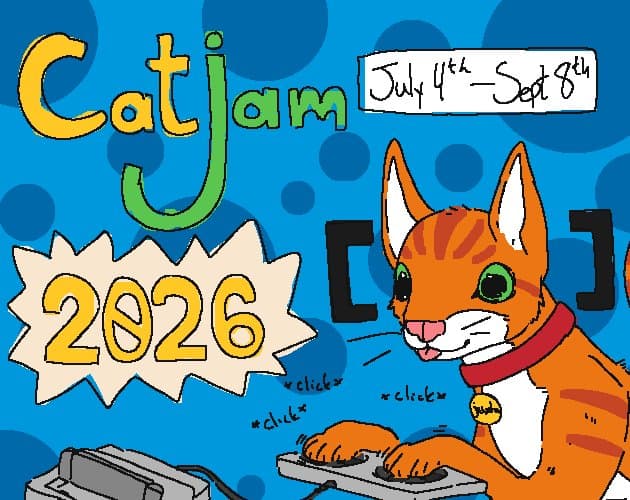
A sparse itch.io jam page points toward something larger: small creative constraints remain one of the most durable engines for experimental software culture.
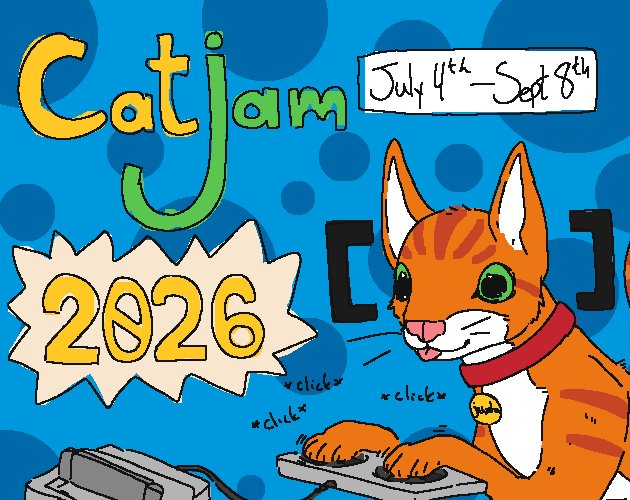
Thesis
Catjam 2026, presented through an itch.io page whose visible extracted text reveals little beyond its title and platform shell, is best understood less as a conventional news event than as a signal from a recurring software subculture: the game jam as a compact laboratory for design, code, collaboration, and taste. On itch.io, game jams are not merely contests attached to a distribution site. They are temporary institutions, small worlds with rules, deadlines, themes, and social rituals, where developers compress the full arc of software creation into days or weeks.
That compression matters. A jam asks creators to make decisions before certainty arrives. It turns programming into negotiation between ambition and time, art into a constraint system, and community into a feedback loop. Even a minimal listing such as Catjam 2026 points to the broader endurance of this format: in an era when large software projects often grow heavier, slower, and more mediated by platforms, jams preserve a mode of making where the distance between idea, prototype, release, and audience is still short.
Key Arguments
The first argument is that game jams make software visible as a process, not only as a finished product. A conventional game release hides much of its history. The player encounters polish, branding, onboarding, pricing, and platform packaging. A jam entry, by contrast, often carries the evidence of its own making. The rough edge, the clever shortcut, the strange mechanic that almost works, and the missing feature all become part of the artifact. This is not a failure of professionalism. It is the educational value of the form.
itch.io has become especially important to that culture because its game jam infrastructure supports lightweight participation: hosts can define rules, themes, submission windows, voting criteria, and community pages without needing to build their own event software. The platform’s creator documentation for game jams reflects the same philosophy as the site itself, which is to give small creators enough structure to coordinate without forcing them into the assumptions of a large commercial marketplace.
The second argument is that constraints create originality by narrowing the field of possible choices. This sounds paradoxical only if creativity is imagined as pure freedom. In practice, software projects are shaped by engines, libraries, file formats, control schemes, available time, team skill, and distribution targets. A game jam makes those limits explicit. If Catjam 2026 follows the familiar jam pattern, its real creative force will not come from the name alone, but from whatever limits it asks participants to accept: a theme, a time box, a mood, a joke, a mascot, a control rule, or a technical restriction.
This is why jams so often produce interesting design. A developer who has three days cannot build every system. They must choose the one interaction that carries the experience. A platformer might become a study of one jump. A puzzle game might become a meditation on one verb. A narrative game might reduce itself to a single room and a few consequential choices. In larger projects, features accumulate until the original idea can become hard to see. In jams, the idea must remain close to the surface because there is rarely time to bury it.
The third argument is that small jams are cultural memory machines. The name Catjam 2026 suggests an event organized around an image, mood, or community in-joke, and that matters because software communities do not live by code alone. They live by shared references. A jam theme can be silly, affectionate, absurd, or intensely specific, yet still produce technically meaningful work. Participants may experiment with Godot, Unity, Unreal Engine, LÖVE, Ren’Py, PICO-8, or browser-native stacks like HTML Canvas, but the technical choice is filtered through the event’s social premise.
That mixture of technical practice and shared play is easy to underestimate. A jam gives beginners permission to publish imperfect work, gives experienced developers a space to test mechanics without the burden of product strategy, and gives communities a way to renew themselves through repeated creation. The result is a form of software culture that resists pure optimization. Not every artifact is meant to scale. Not every project is a startup seed. Some code exists to answer a small question quickly: can this mechanic feel good, can this joke become interactive, can this visual style carry a scene, can strangers make something together before the timer ends?
Implications
The practical implication for developers is that Catjam 2026 should be treated as an opportunity to practice judgment under pressure. The strongest jam entries usually do not come from teams that attempt a miniature version of a commercial game. They come from teams that understand scope as a design material. A small finished loop is more persuasive than an ambitious menu of incomplete systems. A toy that teaches itself through interaction is usually stronger than a tutorial-heavy prototype. A striking constraint, honored consistently, can make a modest entry memorable.
For toolmakers, jams remain a demanding test environment. Engines and frameworks are often evaluated under idealized conditions, but jam development exposes a different truth: how quickly can a project start, how clear are the export paths, how painful is asset import, how forgiving is the scripting model, how easy is it to publish a browser build, and how much time is lost to configuration rather than creation. A developer using Godot or LÖVE for a jam is not only making a game. They are stress-testing the ergonomics of the toolchain.
For platforms, the implication is more philosophical. itch.io’s value is not only that it hosts downloads. Its deeper role is that it lowers the ceremony around releasing software. That has consequences for the kinds of work that can exist. Many jam games would never survive the expectations of a major storefront, not because they lack value, but because their value is experimental, communal, temporary, or strange. A platform that allows those works to be uploaded, played, rated, archived, and discussed gives software culture a wider memory than commercial rankings alone can provide.
For readers and players, Catjam 2026 is a reminder to approach jam games with a different critical lens. The right question is not whether an entry competes with a polished studio release. The better question is what the entry discovers inside its limits. A jam game may be technically uneven and still contain a brilliant mechanic. It may be visually simple and still reveal a powerful interaction. It may last five minutes and still teach something about timing, interface, narrative, or player expectation.
Counter-perspectives
There are real limits to the jam format. Deadlines can reward unhealthy work habits when organizers and participants romanticize exhaustion. Short events can privilege people with free weekends, prior engine knowledge, stable hardware, and fewer caregiving or work obligations. Voting systems can also distort incentives, favoring immediately legible humor or spectacle over subtler experiments. If Catjam 2026 wants to be more than a charming page on itch.io, its rules and moderation choices will matter.
There is also the question of preservation. Jam pages can be fragile records. Extracted page text that contains only navigation and a title shows how easily context can disappear when metadata, descriptions, rules, and community discussion are not captured clearly. For an event built around creative software, the archive is part of the work. Dates, rules, submission criteria, theme announcements, and post-jam showcases help future readers understand not only what was made, but why those works took the forms they did.
A final counter-perspective is that not every jam needs grand interpretation. Some are simply gatherings for people who want to make playful things together. That modesty should be respected. Yet even that modesty has meaning. In a software culture often dominated by scale, monetization, platform control, and artificial urgency, the small jam remains a stubbornly humane format. It says that making can be local, temporary, weird, and still worth doing.
Catjam 2026 may ultimately be a small event, but small events are often where software remembers how to experiment. The page may be sparse, but the form behind it is dense with implication: a deadline, a community, a set of constraints, a publishing path, and a shared invitation to turn code into play before overthinking can harden into inertia.
Comments
Please log in or register to join the discussion