
Despite the industry's obsession with JWT and stateless APIs, the most secure systems on the planet still trust traditional sessions. The reason isn't nostalgia, it's physics: when you need instant revocation and centralized control, stateless architectures hit a wall that tokens can't climb over.
The web was designed to forget. Every HTTP request is an isolated event, a stateless transaction with no memory of what came before. This architectural decision made the early web simple to scale but created a fundamental problem: how do you know who's on the other side?
For decades, the answer has been stateful sessions. Not because developers are stuck in the past, but because this model solves security problems that modern alternatives struggle with. Let's examine why.
The State Problem
HTTP's stateless nature means servers have no inherent way to track users across requests. Early solutions required re-authentication on every page load, which was impractical. The session model emerged as a server-side trust bridge: store critical data on the server, send an opaque identifier to the client, and let that identifier serve as a pointer to the authoritative state.
This isn't a legacy pattern clinging to relevance. It's a deliberate architectural choice with specific trade-off characteristics that matter in security-critical applications.
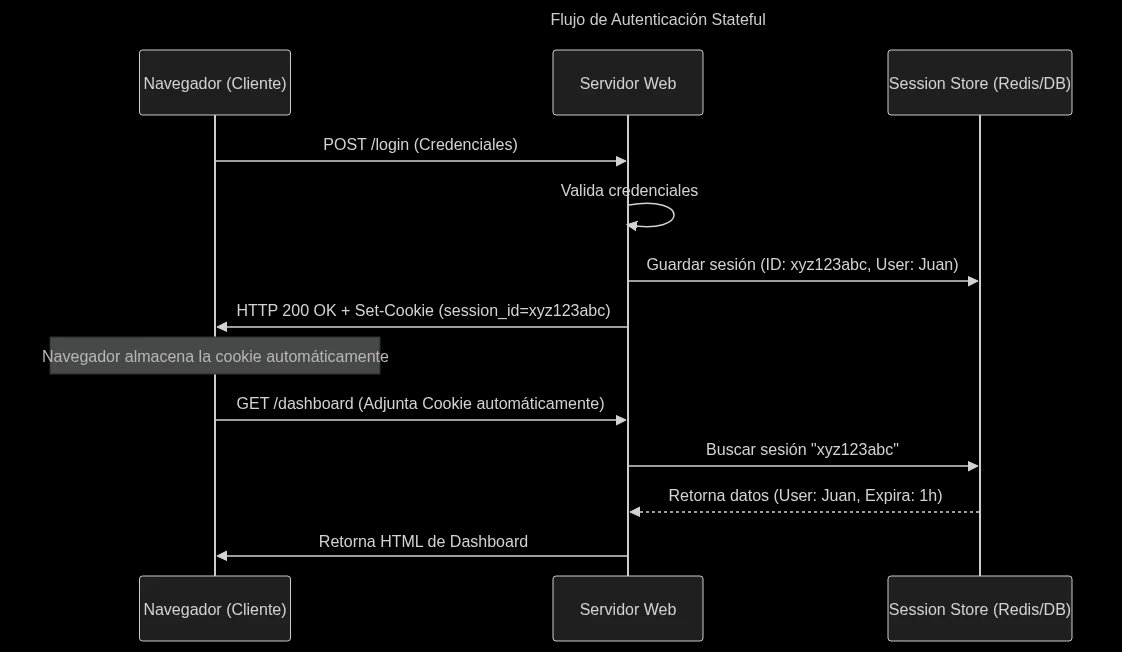
How Stateful Authentication Actually Works
Think of a stateful session like a bank's internal ledger. When you open an account, the bank creates an entry in their centralized database. You receive an account number, which is meaningless on its own, but points to your complete financial state in their systems. The bank never trusts the account number alone; it always verifies against the authoritative ledger.
In web authentication:
- The server maintains the ledger (session store)
- The client receives an opaque session ID (like an account number)
- The session ID is stored in a secure HTTP cookie
- The browser automatically attaches this cookie to every request
- The server validates the ID against its store on each request
The critical distinction: the session ID itself carries zero information about the user. It's a cryptographic pointer, not a claim. The server does a lookup, validates the session metadata (expiration, IP binding, user agent), and only then grants access.
The Session Store Decision
Where you store session state determines your system's reliability and performance characteristics. This is a distributed systems problem with real implications.
In-Memory Store (Application RAM)
Fast, but fundamentally broken for production. Server restarts destroy all sessions. Horizontal scaling is impossible because Session A on Server 1 doesn't exist on Server 2. Use this only for local development.
Relational Database (PostgreSQL, MySQL)
Persistent and transactional, but introduces a SQL query on every HTTP request. Under high traffic, this becomes a bottleneck. The latency compounds quickly when you're doing disk-based lookups per request.
Distributed In-Memory Store (Redis)
The recommended approach. Redis provides microsecond read/write latency with persistence guarantees. More importantly, multiple application servers can share a single Redis cluster, enabling horizontal scaling without sticky sessions. This is where stateful sessions become practical at scale.
The key insight: stateful doesn't mean "stored locally." Modern stateful architectures externalize session state to distributed caches, solving the scaling problem while retaining the revocation benefits.

Security: Where Sessions Shine
The strongest argument for stateful sessions is instant revocation. When a user reports a compromised account, the server deletes the session record. Done. The next request fails immediately. No token expiry waiting period, no revocation lists, no distributed invalidation problems.
This matters more than most developers realize. In a JWT-based system, once a token is issued, it remains valid until it expires. If you need to revoke access mid-session (security incident, account suspension, privilege change), you need additional infrastructure: token blocklists, short expiry times with refresh tokens, or centralized validation endpoints that reintroduce statefulness.
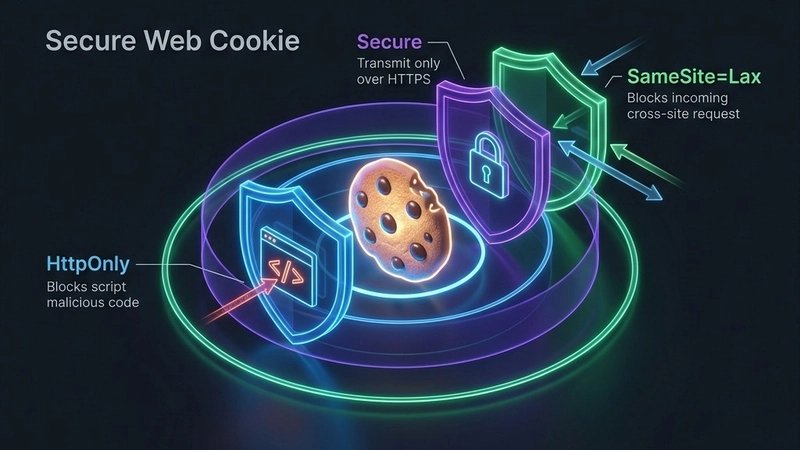
Cookie Security Flags
Since sessions depend entirely on cookie integrity, these configurations are non-negotiable in production:
- HttpOnly: Blocks JavaScript access to the cookie, neutralizing XSS attacks that attempt to steal session IDs
- Secure: Restricts transmission to HTTPS only, preventing man-in-the-middle interception
- SameSite=Lax: Prevents CSRF attacks by limiting cross-origin cookie transmission while allowing normal navigation
The Scalability Trade-off
Stateful sessions have a real cost: the session store becomes a critical dependency. If Redis goes down, authentication breaks. This is a single point of failure that stateless tokens avoid by design.
But this trade-off is often misunderstood. Stateless tokens solve availability at the cost of revocation capability. Stateful sessions solve revocation at the cost of store availability. The right choice depends on your threat model:
- Security-critical applications (banking, healthcare, admin panels): Stateful sessions with high-availability Redis clusters. The revocation capability is worth the operational complexity.
- Public APIs with short-lived access: Stateless tokens may be appropriate. You're optimizing for availability and simplicity.
- Mixed workloads: Use stateful sessions for web UIs (where instant revocation matters) and tokens for machine-to-machine APIs (where stateless operation matters).
The "stateless is always better" narrative ignores that most production JWT implementations reintroduce state through token refresh endpoints, blocklists, or short expiry times. You're not eliminating state; you're just hiding it.
Session Lifecycle: The Complete Flow

- Login: User submits credentials via POST
- Session Creation: Server validates credentials, generates a cryptographically random session ID, creates a session record in the store with metadata (user ID, creation time, expiration, IP)
- Cookie Injection: Server responds with
Set-Cookie: session_id=<random>; HttpOnly; Secure; SameSite=Lax - Automatic Attachment: Browser stores the cookie and attaches it to all subsequent requests to the same domain
- Validation: Server reads the session ID, performs a store lookup, validates metadata, and processes the request
- Logout: Server deletes the session record; browser clears the cookie
This flow is predictable, auditable, and debuggable. You can inspect the session store, trace session creation, and verify expiration. With JWTs, debugging token contents requires decoding base64 and trusting the claims without server-side verification.
Production Checklist
Before deploying stateful sessions:
- Use CSPRNG for session IDs: Cryptographically secure random number generators prevent prediction attacks
- Minimum 128-bit entropy: 16 bytes of randomness makes brute-force attacks infeasible
- Dual expiration strategy: Idle timeout (30 minutes) plus absolute timeout (7 days) prevents both stale sessions and indefinite access
- Garbage collection: Configure TTLs in Redis or cron jobs to clean expired sessions
- Regenerate session IDs on auth state changes: Prevents session fixation attacks where an attacker sets a known session ID before the victim logs in
The Verdict
Stateful sessions remain the default choice for web applications where security and control matter. The ability to revoke sessions instantly, audit session activity, and maintain centralized control over authentication state are features, not limitations.
The scalability challenges are real but solved. Redis clusters handle millions of sessions with sub-millisecond latency. The operational complexity of managing a session store is minimal compared to the security benefits.
The industry's shift toward "stateless everything" often reintroduces state through the back door. Token refresh endpoints, refresh token rotation, blocklists, and short-lived tokens are all mechanisms to regain control that stateless architecture explicitly gave up.
For most web applications, stateful sessions with Redis are the pragmatic choice. They're not sexy, but they work, they scale, and they let you sleep at night knowing you can revoke access the moment something goes wrong.
Comments
Please log in or register to join the discussion