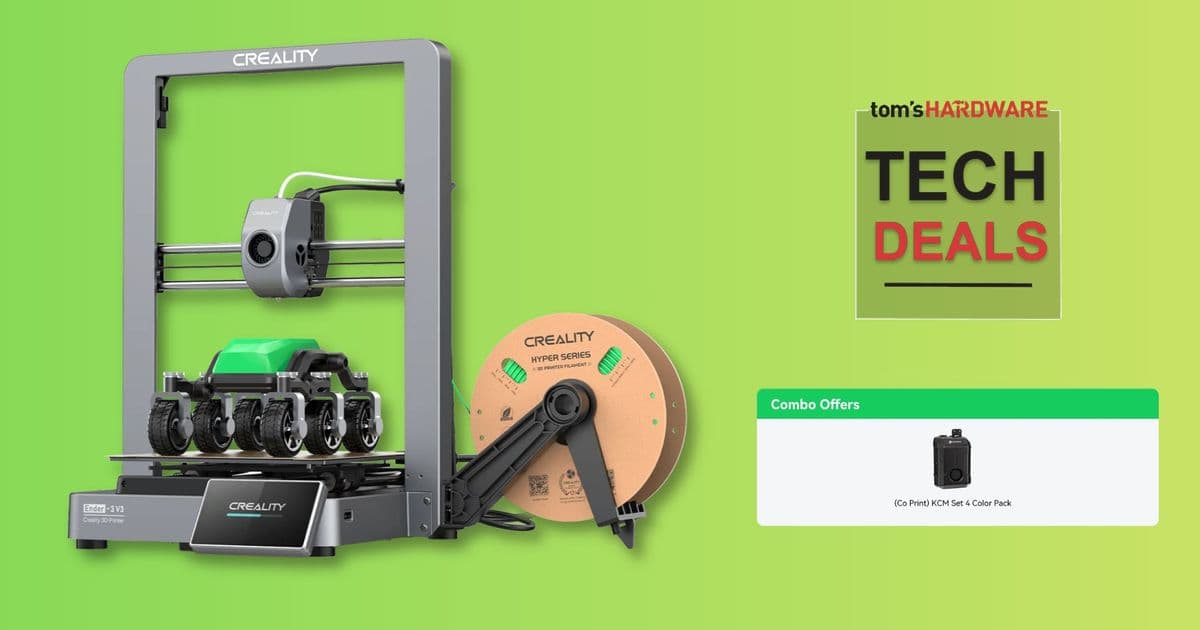
Creality's Ender-3 V3 introduces advanced CoreXZ motion system to consumer segment, delivering unprecedented speeds at entry-level pricing while challenging established market dynamics.
The 3D printing industry is undergoing significant technological disruption as Creality introduces advanced motion control systems to the budget segment. The company's Ender-3 V3 printer, featuring the innovative CoreXZ kinematics architecture, represents a notable shift in accessible manufacturing technology, combining high-end performance with consumer-friendly pricing.
CoreXZ Kinematics: Technical Breakthrough
The Ender-3 V3's CoreXZ motion system represents a significant evolution from traditional Cartesian and CoreXY architectures. This configuration utilizes three linear motors (X, Y, and Z axes) working in concert with a rotating gantry, enabling smoother motion profiles and reduced vibration during printing. The technical advantages manifest in impressive performance metrics: maximum speeds reaching 600mm/s and acceleration rates of 20,000mm/s², making it the fastest bed slinger architecture currently available in the consumer market.
The CoreXZ system distributes mechanical stress more evenly across the printer frame, allowing for higher precision at increased speeds. This kinematic approach eliminates the typical trade-off between speed and precision that has constrained previous generations of budget 3D printers. The rotating gantry, constructed from die-cast aluminum, provides rigidity while maintaining the flexibility required for high-speed movement.
Manufacturing Excellence at Scale
Creality's manufacturing approach demonstrates how sophisticated engineering can be democratized through efficient production methods. The Ender-3 V3 arrives mostly pre-assembled, reducing the barrier to entry for new users while maintaining build quality. The 300°C high-flow hotend with Creality's tri-metal "Unicorn" nozzle addresses material limitations that have historically constrained consumer-grade printers.
The integration of Klipper firmware with root access represents another significant advancement. This open-source approach allows the community to contribute to and improve the printer's capabilities, creating a development cycle that mirrors successful software models. The 4.3-inch HD touch screen, previously reserved for Creality's premium K1 line, further bridges the gap between entry-level and professional equipment.
Market Implications and Supply Chain Dynamics
The Ender-3 V3's pricing strategy—currently bundled with a Co-Print multicolor upgrade kit at $419—signals a shift in market positioning. When compared to the $250 standalone cost of the multicolor upgrade kit, this bundle represents a compelling value proposition that challenges established competitors in the sub-$500 segment.
The multicolor capability, once the exclusive domain of high-end systems, now becomes accessible to a broader market. This expansion of capabilities at lower price points accelerates adoption across educational institutions, small businesses, and hobbyist workshops. The ability to print with up to four different filaments simultaneously removes a significant limitation that has constrained creative applications in consumer-grade 3D printing.
From a supply chain perspective, Creality's approach demonstrates how vertical integration can maintain quality control while reducing costs. The company's manufacturing scale allows for aggressive pricing without compromising on technical specifications. The limited restocking of this particular model suggests a strategic approach to inventory management, potentially creating artificial scarcity to drive immediate purchasing decisions.
Competitive Landscape and Future Trajectories
The introduction of CoreXZ kinematics in the budget segment forces competitors to either match these capabilities or differentiate through other means. This technological advancement raises the performance baseline for the entire consumer 3D printing market, potentially accelerating innovation cycles across the industry.
The Ender-3 V3 represents a case study in how sophisticated engineering can be made accessible without compromising on performance. As 3D printing continues to evolve from niche hobby to mainstream manufacturing tool, products like this will play a crucial role in expanding the technology's reach and applications.
For manufacturers and potential users, the Ender-3 V3 demonstrates that high-performance 3D printing is no longer exclusive to professional workshops. The convergence of advanced kinematics, open-source firmware, and accessible pricing signals a new era in democratized manufacturing technology.
Comments
Please log in or register to join the discussion