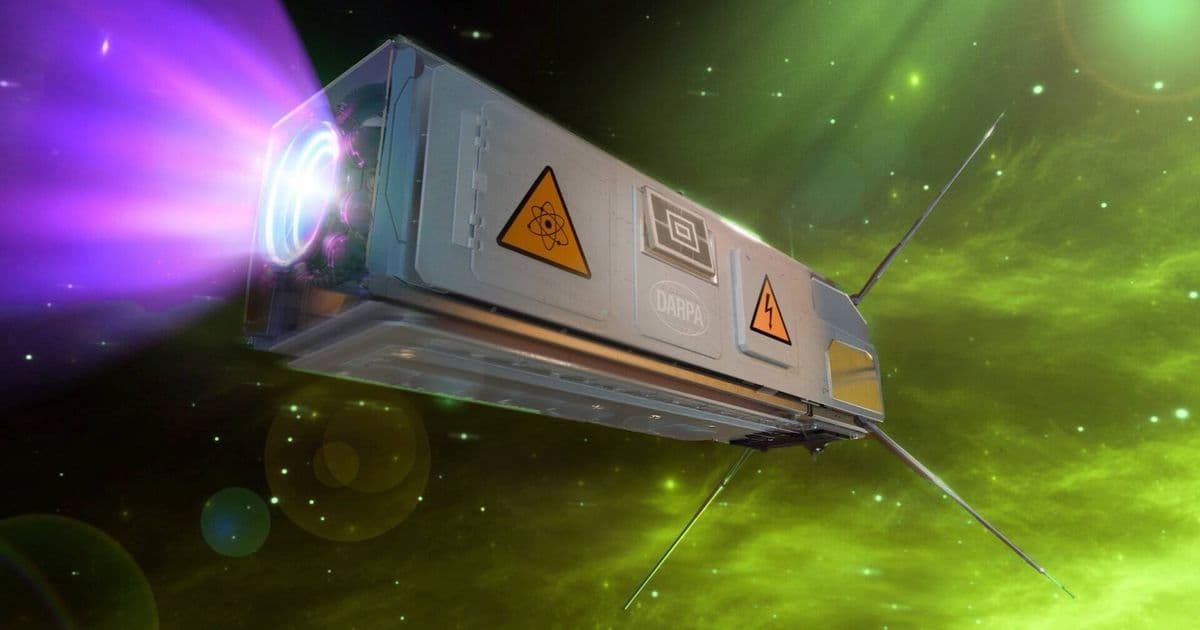
DARPA has awarded Avalanche Energy $5.2 million to develop alphavoltaic batteries delivering 10 watts per kilogram - a 400x power density improvement over existing nuclear batteries. The technology could power laptops for months while supporting the company's portable fusion reactor ambitions.
What if your laptop could run for months without recharging? DARPA is betting on nuclear decay to make that possible, awarding a Washington state fusion startup $5.2 million to develop radioactive batteries with unprecedented power density.
The Power Problem: Why Nuclear Batteries Matter
Modern lithium-ion batteries pack about 200-300 watt-hours per kilogram, but they need frequent recharging. Radioactive batteries, which convert decay particles from isotopes into electricity, can last decades but produce only microwatts to milliwatts of power - nowhere near enough for modern devices.
The Mars rovers illustrate this limitation perfectly. Perseverance and Curiosity each carry 100-pound radioisotope thermoelectric generators producing just 110 watts total - roughly 2.5 watts per kilogram. That's enough for basic operations but far from laptop-class computing.
DARPA's Ambitious Target
Through its Rads to Watts program, DARPA wants Avalanche Energy to deliver batteries exceeding 10 watts per kilogram - a roughly 400-fold improvement over current nuclear battery technology. The goal: power a laptop for months from a device weighing only a few kilograms.
This isn't just about convenience. The military needs reliable power sources for space missions and extreme environments where traditional batteries fail or require frequent replacement. A laptop that runs for months without recharging could be invaluable for field operations, remote sensing, or space exploration.
The Alpha Advantage
Avalanche's approach uses alphavoltaic technology, capturing alpha particles (helium nuclei) from radioactive decay rather than the beta particles used in medical devices and pacemakers. Alpha particles carry more energy but are more harmful to humans - though that's less concerning for space applications where shielding is already required.
"The very same fusion machines that produce high-energy alpha particles will also produce high-energy neutrons," Avalanche explained. "The neutrons produced are also efficient at creating the same radioisotopes needed for the Rads to Watts program, creating a reinforcing supply-and-technology flywheel around Avalanche's core fusion platform."
Fusion Connection
This radioactive battery work isn't Avalanche's primary focus - it's developing portable fusion reactors. The company's flagship Orbitron design aims to create 1-100 kWe compact fusion machines small enough to sit on a desk. These would serve remote locations, defense applications, transportation, micro-grids, and even lunar surface power.
Interestingly, the technologies overlap. Avalanche is developing solid-state, micro-fabricated chips to capture radioactive decay and convert it to electricity. These "degradation-resilient" chips will first capture alpha particles for the DARPA batteries, but the same technology applies to their fusion reactor design.
The Reality Check
While the radioactive battery technology shows promise, Avalanche's fusion ambitions remain more speculative. The company reports demonstrator units of the Orbitron have been built and tested over the past two years, but hasn't achieved net-positive energy gain - the holy grail of fusion power.
Industry experts suggest practical, portable fusion reactors remain 30 years away, despite periodic announcements of breakthroughs. The radioactive battery work, while still challenging, represents a more achievable near-term goal that could provide valuable revenue and technological development for the company's fusion efforts.
What This Means for the Future
If successful, DARPA's radioactive battery program could revolutionize portable power for military and space applications. The technology would eliminate the need for frequent battery swaps in remote locations, reduce logistical burdens, and enable longer-duration missions.
For consumers, the implications are equally exciting - though likely further out. Imagine laptops, phones, or wearables that never need plugging in, powered by safe, long-lasting nuclear batteries. The technology could also enable new categories of devices that are currently impractical due to power constraints.
The Regulatory Hurdle
One significant challenge remains: regulatory approval. While radioactive batteries are already used in pacemakers and space applications, scaling up to laptop-class power output with alpha particles will require careful safety assessments and potentially new regulations.
However, given the military and space applications, DARPA and Avalanche may find regulatory pathways more accessible than for consumer products. The technology's potential benefits for national security and space exploration could accelerate approval processes.
As Avalanche Energy works to bridge the gap between nuclear decay and practical power, one thing is clear: the future of portable energy may be radioactive. Whether that future arrives in months or decades depends on whether this ambitious project can overcome the technical and regulatory challenges ahead.
Comments
Please log in or register to join the discussion