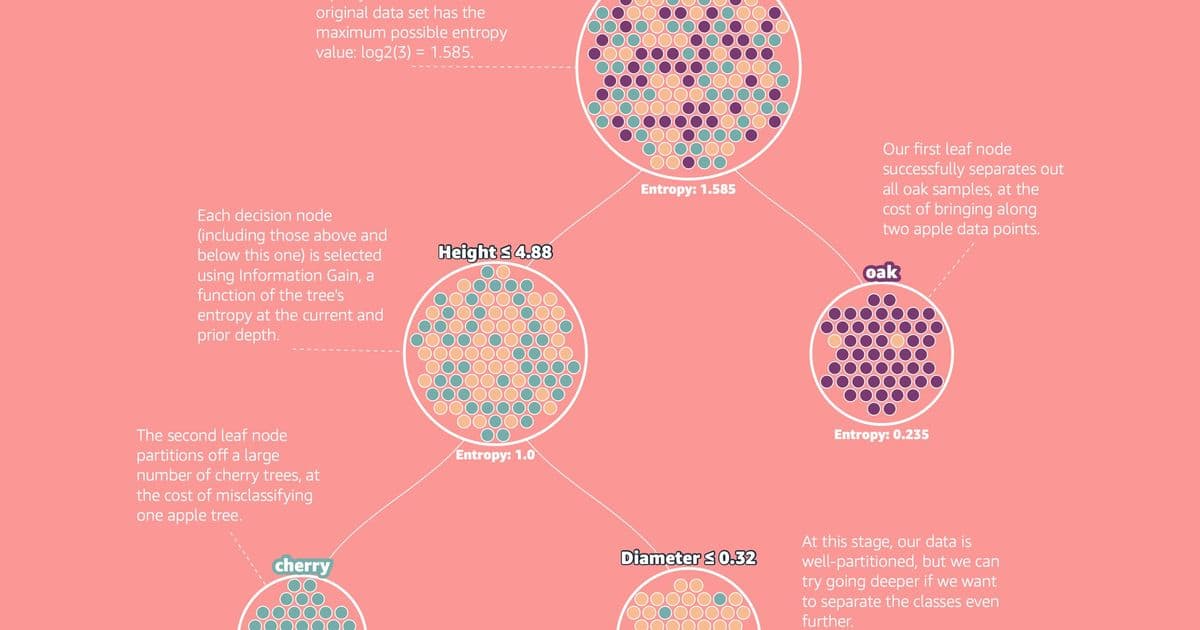
Decision trees offer an intuitive approach to classification problems by creating nested decision rules. This article explores how decision trees work through a practical farming example, demonstrating how to build a tree that classifies trees by type based on diameter and height measurements.
Decision trees are one of the most intuitive and powerful machine learning algorithms available. At their core, they work by creating a series of nested decision rules that partition data into increasingly specific categories. This approach makes them particularly valuable for both classification and regression tasks, as they can handle complex relationships while remaining interpretable to humans.
The Basic Concept
The fundamental idea behind decision trees is remarkably simple: start with all your data, then ask a series of yes/no questions to split it into smaller and more homogeneous groups. Each question represents a decision node, and the answers lead to either more questions or final classifications (leaf nodes).
What makes decision trees so powerful is their ability to automatically discover these decision rules from data. Unlike traditional programming where you explicitly code the logic, decision trees learn the optimal splitting criteria through algorithms like CART (Classification and Regression Trees) or ID3.
A Practical Example: Classifying Trees
Let's consider a practical scenario that illustrates how decision trees work. Imagine you're a farmer with a new plot of land, and you need to identify different types of trees based on just two measurements: diameter and height. Your task is to distinguish between Apple, Cherry, and Oak trees.
Building the Tree Step by Step
The process begins with all your data points on a plot, with diameter on one axis and height on the other. The first decision is crucial - where to place the initial split?
Looking at the data, you notice that almost every tree with a diameter greater than or equal to 0.45 units is an Oak tree. This observation becomes your first decision node, creating a vertical split. Everything above this diameter threshold gets classified as Oak, creating your first leaf node.
But what about the trees on the left side of this split? You continue the process, examining the remaining data to find the next best split. You discover that creating a horizontal division at height less than or equal to 4.88 units nicely separates out a cluster of Cherry trees. This becomes your second decision node.
With two splits, you've already created three distinct regions: Oak trees (large diameter), Cherry trees (smaller diameter but short height), and a mixed region containing both Apple and Cherry trees.
The process continues. In the remaining mixed region, you can draw another vertical division to better separate Apple trees from the remaining Cherry trees. Finally, a horizontal split in the last region completes the classification.
The Result
After several iterations, you've created a complete decision tree that can classify any new tree based on its diameter and height measurements. The tree has learned a set of nested decision rules that optimally partition the feature space.
The Danger of Overfitting
However, there's an important caveat to consider. As you continue splitting, you might notice that some regions still contain misclassified points. The natural instinct might be to keep splitting further, creating smaller and smaller regions to capture every single data point correctly.
This is where the concept of overfitting comes into play. If you continue splitting indefinitely, you'll create a tree that's too complex and too specific to your training data. The resulting tree would learn the noise and peculiarities of your specific dataset rather than the general patterns that apply to new, unseen data.
This tradeoff between model complexity and generalization is known as the bias-variance tradeoff. A very deep tree has low bias (it can fit the training data almost perfectly) but high variance (it won't generalize well to new data). Conversely, a very shallow tree might have high bias but low variance.
The key is finding the right balance - a tree deep enough to capture the important patterns but not so deep that it memorizes the training data.
Why Decision Trees Matter
Decision trees offer several compelling advantages that make them valuable tools in machine learning:
Interpretability: Unlike many modern machine learning algorithms, decision trees are highly interpretable. You can literally trace through the decision path and understand exactly why a particular classification was made. This transparency is crucial in domains where explainability matters.
No need for feature scaling: Decision trees don't require normalization or standardization of features, making them easier to use with raw data.
Handling of mixed data types: They can naturally handle both numerical and categorical features without requiring extensive preprocessing.
Non-linear relationships: Decision trees can capture complex, non-linear relationships in data without requiring manual feature engineering.
Robust to outliers: Since splits are based on majority classes in regions, decision trees are relatively robust to outliers.
Limitations and Considerations
Despite their advantages, decision trees have some limitations. They can be unstable - small changes in the data might result in very different trees. They can also create biased trees if some classes dominate. Additionally, single decision trees often don't perform as well as ensemble methods like Random Forests or Gradient Boosted Trees.
Conclusion
Decision trees represent a fundamental and powerful approach to machine learning. Their intuitive nature, combined with their ability to automatically discover decision rules from data, makes them an essential tool in any data scientist's toolkit. Whether used on their own or as part of more complex ensemble methods, understanding decision trees provides valuable insight into how machine learning algorithms can learn from data to make predictions.
The example of classifying trees by diameter and height demonstrates how decision trees transform complex classification problems into a series of simple, interpretable decisions. This nested decision structure is what gives decision trees their name and their power - they build a tree of decisions that leads from general questions to specific classifications.
As with any machine learning algorithm, the key is understanding both the strengths and limitations of decision trees and using them appropriately within the broader context of your data science workflow.
Comments
Please log in or register to join the discussion