A Finnish startup valued at $1.25 billion claimed a 400 Wh/kg solid-state cell charging in five minutes over 100,000 cycles. More than 20 independent battery experts tested the hardware and found a high-nickel lithium-ion cell measuring 298 Wh/kg. Finnish financial and criminal authorities are now investigating.
Donut Lab, a Finnish battery startup that raised $25 million and reached a $1.25 billion valuation on the strength of a "miracle" solid-state battery, has had its central technical claims dismantled by independent testing. A coalition of more than 20 battery experts, organized by Ryan Inis Hughes of the Ziroth YouTube channel, concluded the company's cell is not solid-state at all. It is a repackaged lithium-ion battery using high-nickel NCM chemistry, the same class of cell that powers most electric vehicles on the road today.
The gap between the marketing and the measurements is the story here, and the numbers tell it plainly.
The claims that built a $1.25B valuation
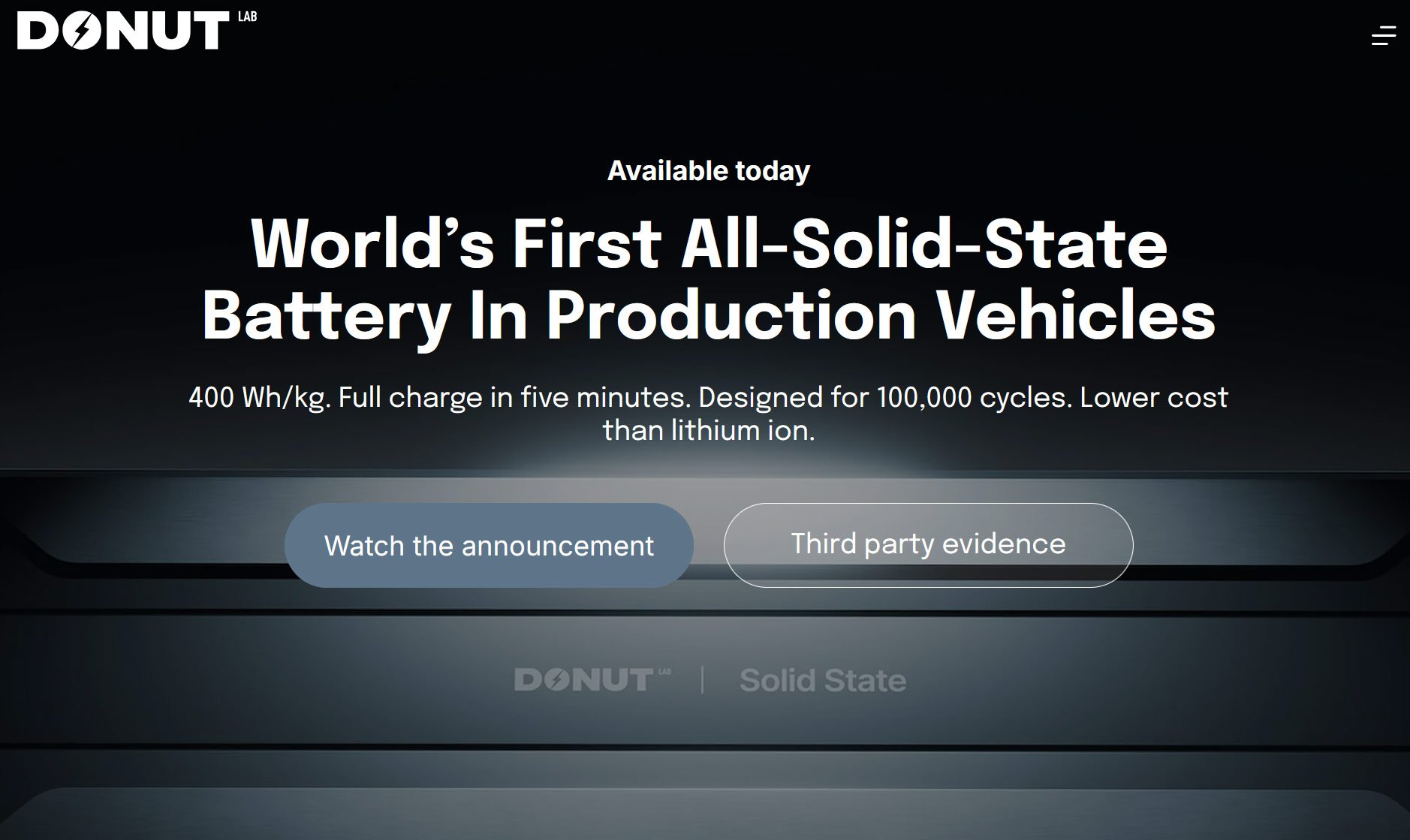
At CES 2026, CEO Marko Lehtimäki announced that Donut Lab's technology was "going to transform the industry." The headline specifications were aggressive: 400 Wh/kg energy density, 100,000 charge cycles, and a five-minute full charge, all from a solid-state pack the company said was already shipping "in production vehicles."
Those figures matter because they sit well beyond what established players have demonstrated. Toyota and Samsung, both of which have invested heavily in solid-state research, are still working toward commercial cells in roughly the same density range, and neither claims a shipping product on consumer timelines. Current commercial lithium-ion EV cells typically land between 250 and 300 Wh/kg at the cell level. A genuine 400 Wh/kg solid-state cell with six-figure cycle life would represent a real generational step, and a startup arriving from outside the established supply chain to deliver it ahead of every major manufacturer was always going to invite scrutiny.
That scrutiny came quickly, and it came before anyone opened a cell.
Cracks in the story before the lab work
Much of the backstory unraveled on its own. A whistleblower identified as the former COO of partner firm Nordic Nano Group came forward to allege that the specifications presented at CES were not accurate. A scientist from the Fraunhofer Research Institute, after speaking with Donut Lab technology provider CT Coatings, reportedly said the people involved had no real understanding of how a battery works.
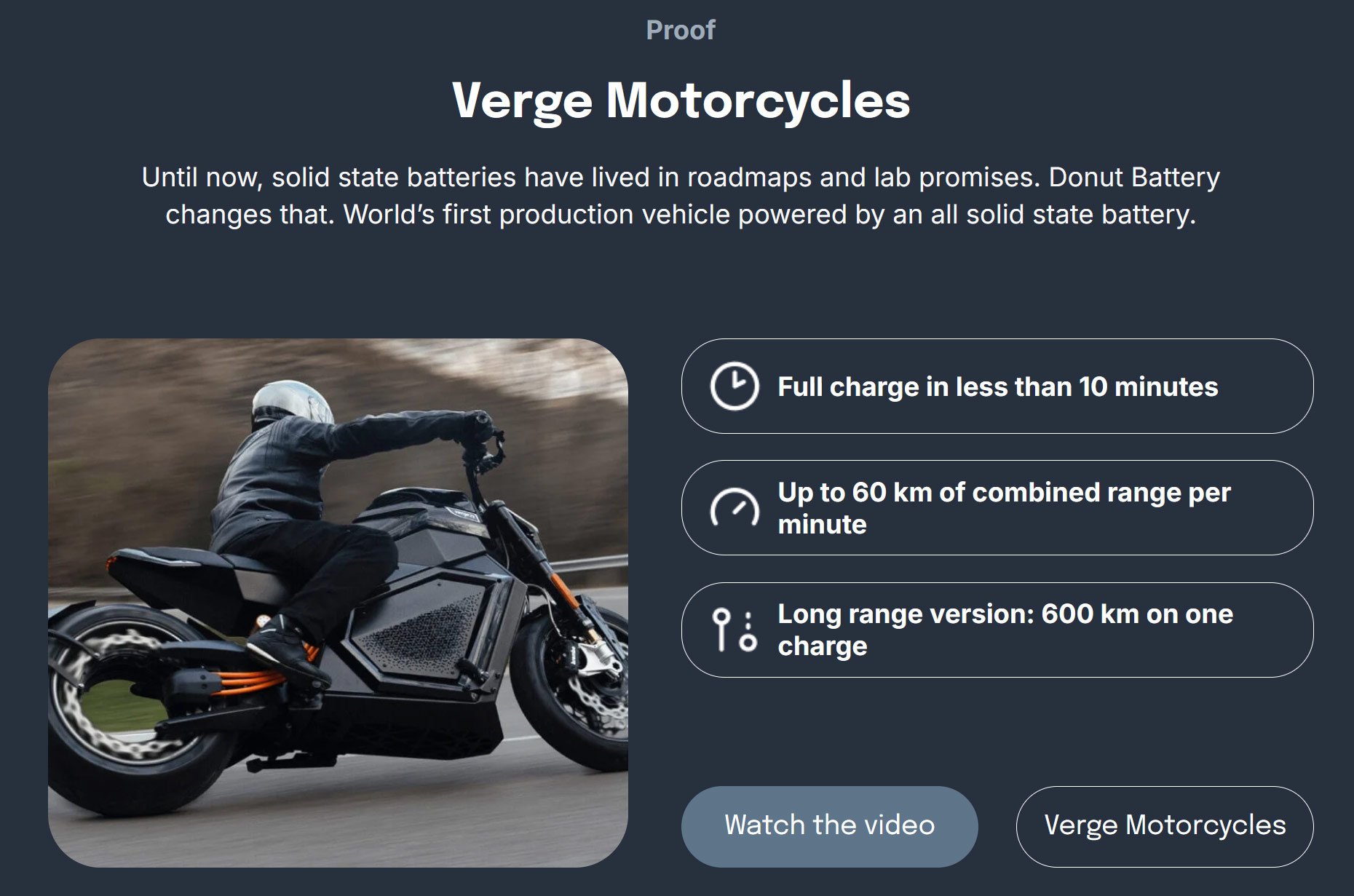
A claimed partnership with a motorcycle manufacturer also fell apart under examination. Donut Lab had presented its cells as powering the "first production motorcycle" at CES and on its website. In reality, the relationship was at the development test phase, and the batteries were not in any production vehicle.
What the testing actually found
The physical analysis is where the case becomes hard to argue with. Researchers from Fraunhofer and several universities confirmed the tested cell is lithium-ion, and two independent lines of evidence point specifically to high-nickel NCM chemistry.
The first is the voltage curve. Every battery chemistry has a characteristic discharge signature, the way its terminal voltage falls as capacity drains. The Donut Lab cell's curve matches a lithium-ion battery precisely. A true solid-state cell with a different electrolyte and electrode structure would not trace the same line.
The second is mechanical. Lithium-ion cells expand and contract as ions move during charging, and that expansion produces a distinctive kink in the dimensional curve around 50 to 70 percent state of charge. Testers observed exactly that kink, exactly where lithium-ion behavior predicts it.
The energy density claim did not survive contact with a scale either. Against the advertised 400 Wh/kg, measurements put the pack at 298 Wh/kg. That is a respectable number for a conventional lithium-ion cell and roughly in line with the best commercial NCM packs, but it is a quarter below the marketed figure and carries none of the solid-state advantages that justified the valuation.
Market implications
The damage extends past one company's credibility. Donut Lab collected its $25 million from more than 1,300 small investors, many of whom put personal savings into the company on the basis of specifications that testing now contradicts. Finnish financial authorities and criminal authorities are reportedly investigating, and the case is already drawing comparisons to Theranos.

There is a broader supply-chain lesson worth holding onto. Solid-state remains one of the most heavily funded targets in energy storage precisely because no one has cracked high-volume, high-density, long-cycle-life production yet. That funding pressure creates an environment where a sufficiently confident claim can outrun verification, especially when the buyers are retail investors rather than the cell qualification engineers an automaker would put on the problem. The chemistry signatures that exposed Donut Lab, voltage curves and expansion kinks, are standard diagnostic tools. They were applied here only after public skepticism forced the issue, not before money changed hands.
For anyone tracking the battery supply chain, the practical takeaway is the same one that governs semiconductor procurement: extraordinary specifications demand independent characterization before capital commitment. A cell that charges in five minutes, lasts 100,000 cycles, and stores 400 Wh/kg is testable. So far, the only numbers that have held up under that testing are the ones consistent with an ordinary lithium-ion pack.
Comments
Please log in or register to join the discussion