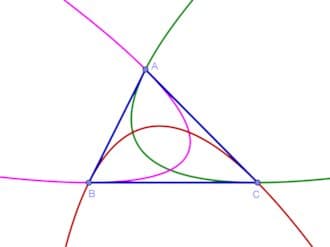
An exploration of the mathematical problem of finding parabolas that pass through two specified points with given slopes, including the solution algorithm and its geometric significance in triangle geometry.
The mathematical problem of finding a parabola that passes through two given points with specified slopes represents an elegant intersection of algebra and geometry. This challenge, while seemingly straightforward, requires a sophisticated approach that reveals deeper connections within mathematical theory.
Mathematical Background
The general form of a conic section is given by the equation ax² + bxy + cy² + dx + ey + f = 0. For this equation to represent a parabola, it must satisfy the constraint b² = 4ac. This condition distinguishes parabolas from other conic sections (ellipses and hyperbolas) and reduces the degrees of freedom in the problem.
A general conic section has six parameters (a, b, c, d, e, f), but these are determined only up to a scaling factor. Multiplying both sides of the equation by any non-zero constant yields the same conic section, effectively reducing the degrees of freedom to five. The parabola condition b² = 4ac further constrains the solution space, leaving us with four degrees of freedom.
When we specify that the parabola must pass through two particular points, we introduce two additional constraints, reducing the degrees of freedom to two. Finally, specifying the slopes at these two points consumes the remaining degrees of freedom, suggesting that a unique solution should exist for this problem.
The Solution Approach
The solution involves solving a system of equations derived from the given conditions. For a parabola passing through points (x₁, y₁) and (x₂, y₂) with slopes m₁ and m₂ respectively, we can derive a system of equations based on these conditions.
The implementation provided elegantly solves this problem by computing the coefficients of the parabola equation. The algorithm begins by calculating differences between the given points and then proceeds to compute intermediate values that ultimately determine the coefficients of the parabola equation.
Code Analysis
The Python function solve(x1, y1, m1, x2, y2, m2) implements the mathematical solution to this problem. Let's examine its structure:
- First, it calculates the differences in x and y coordinates: Δx = x₂ - x₁ and Δy = y₂ - y₁
- It then computes a parameter λ that incorporates the slope information and coordinate differences
- The parameter k represents a combination of the coordinates
- Finally, it calculates each coefficient of the parabola equation using these intermediate values
The algorithm efficiently computes all six coefficients of the parabola equation, with the understanding that the solution is unique only up to a scaling factor. This means that any non-zero multiple of the resulting coefficients would define the same parabola.
Geometric Significance: Artzt Parabolas
The mention of Artzt parabolas in the Wikipedia article on triangle geometry suggests a connection to triangle geometry that deserves further exploration. While the original spelling may have varied ("Artz" vs. "Artzt"), these parabolas appear to be associated with pairs of vertices of a triangle, with tangents parallel to the sides.
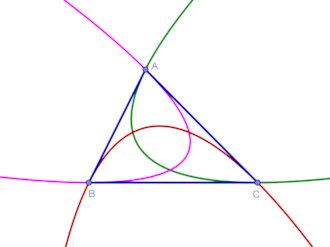
This geometric interpretation places the problem within a rich mathematical context. In triangle geometry, parabolas that pass through vertices with specific slope conditions may have special properties or serve as important constructions in various geometric theorems.
Mathematical Implications
The solution to this problem demonstrates several important mathematical principles:
- Constraint Satisfaction: The problem illustrates how constraints systematically reduce the solution space in mathematical equations.
- Parameter Interdependence: The coefficients of the resulting parabola are deeply interconnected, with each coefficient depending on multiple input parameters.
- Geometric-Algebraic Duality: The problem bridges geometric properties (points and slopes) with algebraic representations (equation coefficients).
Potential Applications
While this specific problem may seem purely theoretical, it has potential applications in various fields:
- Computer Graphics: Generating smooth curves that pass through specified points with desired tangents
- Path Planning: Creating trajectories that satisfy boundary conditions in robotics and aerospace
- Geometric Modeling: Constructing curves with specific properties in CAD systems
- Mathematical Education: Serving as an excellent example of solving constrained systems of equations
Extensions and Further Exploration
Several natural extensions to this problem suggest themselves:
- Finding parabolas through more than two points with specified slopes
- Generalizing the solution to other conic sections
- Exploring the properties of Artzt parabolas in different triangle configurations
- Developing geometric constructions that visualize the solution process
The algorithm provided offers a practical implementation of the mathematical theory, but deeper geometric understanding may reveal more elegant constructions or proofs.
Conclusion
The problem of finding a parabola through two points with given slopes exemplifies the beauty of mathematical problem-solving. The solution demonstrates how algebraic constraints can be systematically addressed to yield geometric results. While the specific context of Artzt parabolas may remain somewhat obscure due to limited documentation, the mathematical problem itself stands as a valuable exercise in applied algebra and geometry.
For those interested in exploring this further, the implementation provides a concrete starting point. By examining how the coefficients change with different inputs, one can develop intuition about the relationship between the geometric conditions and the resulting algebraic equation.
Comments
Please log in or register to join the discussion