
Adopting Azure is only the first step; organisations must attach measurable outcomes, assign clear ownership, and review leading indicators to turn technical delivery into business value.
From cloud adoption to value realisation
A lot of Azure programmes can answer one question quickly: what did we deploy? Landing zone – done. Workloads migrated – done. Monitoring enabled – done. Tags and budgets configured – done. Security baseline applied – done. Those items are useful and I am not downplaying them. They are part of getting cloud adoption right, but they are not the whole story. The harder question is usually this one: what is measurably better because we adopted Azure? That is where the conversation shifts from cloud adoption to value realisation.
Adoption is not the finish line
The Microsoft Cloud Adoption Framework (CAF) provides a useful map of the journey: Strategy, Plan, Ready, Adopt, Govern, Secure, Manage. Each stage includes technical and organisational activities. The trap many teams fall into is treating the Adopt phase as the finish line. A workload is migrated, a platform is live, a dashboard exists, and the project closes. Value then leaks quietly because the outcome is assumed rather than managed.
Adoption creates the conditions for value; it does not automatically realise it.
The familiar pattern
- Business case approved.
- Platform team builds a solid Azure foundation (landing zone, policies, monitoring, Defender for Cloud, Cost Management).
- Workloads move, governance is applied, the project is technically successful.
- Six months later, someone asks: what did we get for the investment? The answer is hard to find because ownership of the benefit disappeared after go‑live. The team can prove the workload is healthy, but not that the business outcome improved.
Start with the outcome, not the service
A roadmap item that simply says “Migrate application X to Azure” is incomplete. A better phrasing adds the expected benefit, for example:
- Migrate application X to Azure so that recovery time improves, platform risk reduces, and the legacy hosting contract can be retired by Q4.
Embedding the outcome in the work item gives the team something to measure against. Some concrete examples:
| Azure activity | Better value framing |
|---|---|
| Deploy an Azure landing zone | Teams can launch compliant workloads faster, with inherited security and governance controls |
| Migrate virtual machines | Legacy infrastructure risk reduces, recovery improves, old hosting costs can be retired |
| Build a Fabric data platform | Decision latency reduces because trusted data is available at the right cadence |
| Roll out Copilot or Azure AI | A named workflow improves, with human review, quality thresholds, and support ownership |
| Enable Azure Monitor | Teams can act before users are impacted, not only after an incident is raised |
Four questions before calling an Azure roadmap item done
- What business outcome should change?
- Be specific. Reduce time to recover from a priority incident, cut manual reporting effort for finance, improve release confidence, reduce audit preparation effort, increase cost visibility by product, remove dependency on unsupported infrastructure.
- Who owns the value after go‑live?
- Delivery owner (who gets it live), Operational owner (who runs it), Value owner (who proves it was worth doing), Decision owner (who can change course). In small shops these roles may overlap; in larger organisations they are distinct.
- What should move first?
- Lagging measures (annual cost reduction, revenue growth) arrive too late. Identify a leading indicator that gives an early signal – deployment frequency, mean time to restore, manual report preparation time, monthly cost‑by‑product review, repeat‑usage growth after training.
- What gets retired?
- Realising value often means stopping something: a legacy server, a manual reporting process, an old integration path, a support burden, a recurring security exception, or a governance meeting that no longer adds value.
A practical value‑realisation loop
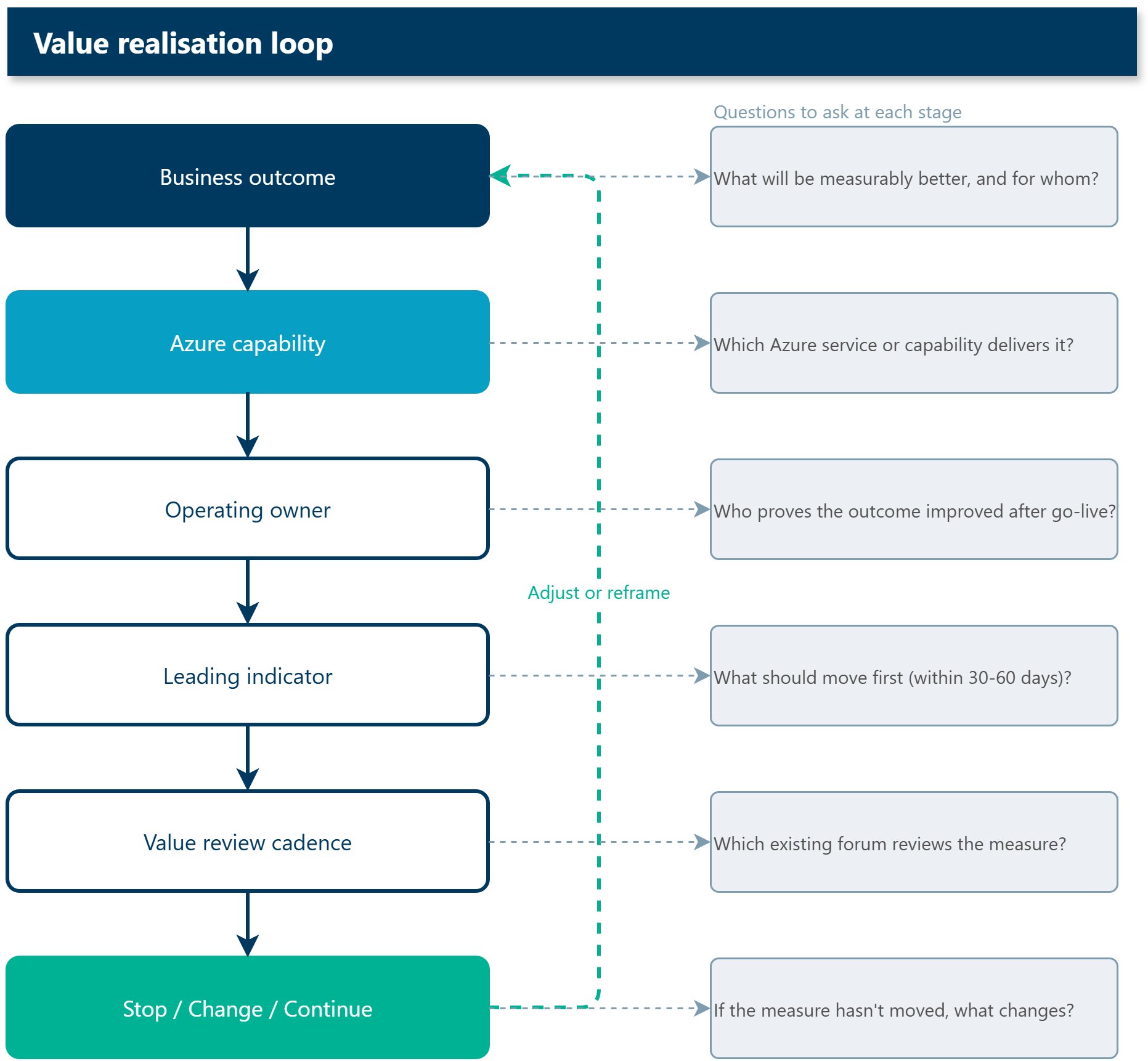
The loop consists of six steps that keep the conversation focused:
- Define the business outcome – name what should improve.
- Identify the Azure capability – the service, pattern, or platform that enables the outcome.
- Assign ownership – delivery, operational, and value owners.
- Set a leading indicator – the earliest signal that the outcome is moving.
- Review on cadence – a scheduled checkpoint where the measure is examined.
- Stop, change, or continue – a decision trigger that holds the work accountable.
If an item cannot pass through this loop, it is probably not ready to be a strategic roadmap epic. It may still be necessary technical work, but it should be flagged as such.
A concrete migration example
| Element | Example |
|---|---|
| Outcome | Claims platform is more resilient and cheaper to operate |
| Azure capability | Landing zone, workload migration, Azure Monitor, Azure Backup, policy baseline |
| Operating owner | Application owner + platform operations |
| Leading indicator | Restore test meets RTO within 30 days; deployment lead time drops from days to hours within 60 days; support tickets down 20 % by month 3 |
| Review cadence | Monthly service review for 3 months post‑go‑live, then quarterly |
| Stop/change/continue | Continue if recovery and deployment measures improve; revisit scope if legacy hosting contract cannot be retired by end of Q3 |
The table itself is not the goal; the goal is that the team now has a shared view of success and a regular forum to discuss it.
Where this fits for Azure teams
Not every technical task needs a full business case. Foundational work, hygiene, and risk reduction are still valuable without a dramatic story. However, the larger the investment, the more important it becomes to attach outcomes, owners, and measures. At a minimum, each major Azure roadmap epic should include:
- A named outcome
- A value owner
- One leading indicator (and a lagging measure if available)
- A review cadence
- A clear statement of what gets retired, reduced, or simplified
- A stop/change/continue trigger
Final thoughts
The best Azure roadmap is not the one with the most services on it. It is the one where every platform decision traces to an outcome, every outcome has an owner, every owner has a measure, and every measure is reviewed after go‑live. Adoption gets you into Azure. Value realisation proves Azure was worth adopting.
Before approving the next wave, ask: What will be measurably better 90 days after this goes live, and who owns proving it?
Comments
Please log in or register to join the discussion