
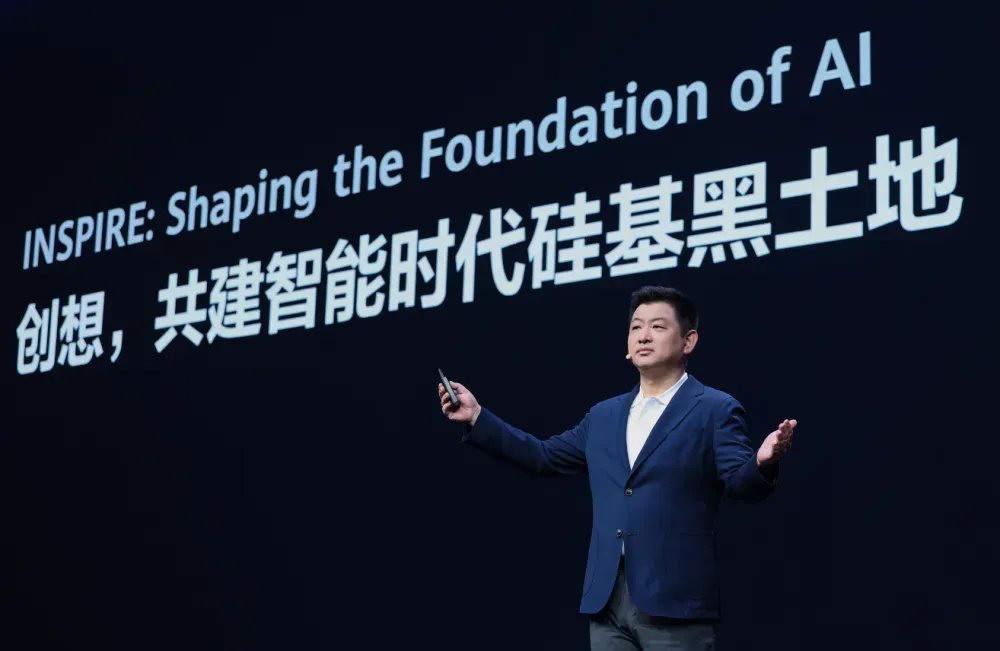
Huawei Cloud unveiled a full‑stack AI offering called “Silicon‑Based Black Soil” at its INSPIRE conference, bundling new hardware, software, and agent‑centric services. The announcement promises domestic‑only compute, open‑source toolchains, and enterprise‑grade agent platforms, but the real impact depends on performance, cost, and ecosystem adoption versus established cloud providers.
What Huawei claims
At the INSPIRE conference Huawei Cloud introduced a suite of products under the banner Silicon‑Based Black Soil. The name evokes an agricultural metaphor: a self‑contained “soil” of chips, toolchains, cloud infrastructure, model training, and industry applications that supposedly lets enterprises grow AI end‑to‑end without relying on foreign components.
Key announcements include:
- AICS Lingqu – an intelligent computing cluster billed at 200 EFLOPS total, supporting up to 100 000 cards and delivering 5 million tokens / s per 1 000 cards with a 99.95 % uptime guarantee.
- AMS Agentic Memory Storage – petabyte‑scale tiered storage aimed at reducing inference costs for long‑running agent tasks.
- CCE Volcano Next – a unified scheduler that claims >30 % better resource utilization across compute, AI, and storage.
- AgentSphere – a sandbox with gateway, identity, and intent protection for running autonomous agents.
- ModelArtsNext, AgentArts, and Industry AI DreamWorks – platforms for model training, agent deployment, and domain‑specific AI services.
- An aggressive open‑source push covering Ascend/Kunpeng hardware description, the CANN toolkit, EulerOS, CCE Volcano, the ModelArts toolchain, and the openJiuwen agent framework.
What is actually new?
Hardware integration – Huawei has been shipping Ascend AI chips and Kunpeng CPUs for several years. What is new is the scale of the integrated cluster (200 EFLOPS) and the claim of a fully domestic supply chain. The performance numbers are comparable to the lower end of offerings from AWS (p4d) or Azure (NDv4), but Huawei does not provide a head‑to‑head benchmark on common workloads such as LLM fine‑tuning or dense retrieval.
Agent‑centric services – The term “agentic AI” has become a buzzword for multi‑step, tool‑using LLMs. Huawei’s AgentArts and AgentSphere are essentially wrappers that add authentication, intent filtering, and persistent memory. Similar capabilities exist in Azure OpenAI’s assistant APIs and Google Cloud’s Vertex AI Agents. Huawei’s differentiator is the claimed PB‑level memory pool, but the cost model for such storage is not disclosed.
Unified scheduling (CCE Volcano Next) – Volcano is an open‑source scheduler that originated in the Linux community. The “Next” version adds cross‑resource arbitration, which could reduce fragmentation when a workload needs both GPU and high‑speed storage. The 30 % utilization gain is plausible in synthetic tests, but real‑world gains depend heavily on workload mix and how tightly the scheduler integrates with Huawei’s proprietary stack.
Open‑source breadth – Open‑sourcing the full Ascend/Kunpeng stack is unprecedented for a Chinese vendor. It lowers the barrier for third‑party developers to compile kernels or build custom runtimes, but the ecosystem is still nascent. Most AI researchers rely on PyTorch/TensorFlow binaries that are tightly coupled to Nvidia/CUDA; Huawei would need to provide drop‑in replacements that match performance and stability.
Limitations and open questions
Performance transparency – The press release lists peak FLOPS and token‑throughput, but no latency or cost per token figures. Enterprises care about total cost of ownership (TCO), not just raw throughput. Without published benchmarks on standard suites (MLPerf Training/Inference, HELM), it is hard to gauge whether the claimed 200 EFLOPS translates into a competitive price‑performance ratio.
Software compatibility – While the open‑source push is welcome, the current AI ecosystem is heavily Nvidia‑centric. Porting large‑scale models (e.g., Llama‑2‑70B) to Ascend GPUs often requires manual graph rewriting or custom kernels. Huawei’s CANN toolkit promises automatic conversion, but early adopters have reported stability issues and longer compile times.
Regulatory and supply‑chain risk – The “fully domestic” angle is appealing for Chinese customers subject to export controls, yet it may limit adoption abroad. Companies with mixed‑region deployments will still need to interoperate with non‑Huawei clouds, raising data‑gravity and latency concerns.
Agent memory economics – PB‑scale memory sounds impressive, but the pricing model (e.g., $/TB‑month) is missing. Persistent agent memory can quickly become a cost sink if not managed with tiered eviction policies. Competitors like AWS provide elastic storage with clear pricing; Huawei’s model will need similar transparency to win enterprise contracts.
Ecosystem lock‑in – Open‑sourcing the stack is a double‑edged sword. It may attract developers, but without a critical mass of community contributions the codebase could stagnate. Huawei will need to fund documentation, tutorials, and reference implementations to make the platform approachable for teams accustomed to PyTorch‑centric pipelines.
Bottom line
Huawei Cloud’s “Silicon‑Based Black Soil” is less a brand new technology than a packaging of existing Huawei assets—Ascend chips, Kunpeng CPUs, the CANN toolkit—into a more cohesive, domestically sourced offering. The real novelty lies in the agent‑focused services and the promise of a unified scheduler that can juggle compute, AI, and storage resources.
For customers whose compliance requirements force a Chinese‑only stack, the announcement could be a decisive factor. For the broader global market, the decisive tests will be transparent benchmarks, clear pricing, and the maturity of the open‑source ecosystem. Until those data points appear, the claim of “silicon‑based black soil” remains an ambitious marketing narrative awaiting empirical validation.
Further reading:
- Huawei’s official INSPIRE 2026 announcement page
- Technical overview of the Ascend AI processor
- Open‑source repository for CANN toolkit
- Independent benchmark of Chinese AI chips on MLPerf
Comments
Please log in or register to join the discussion