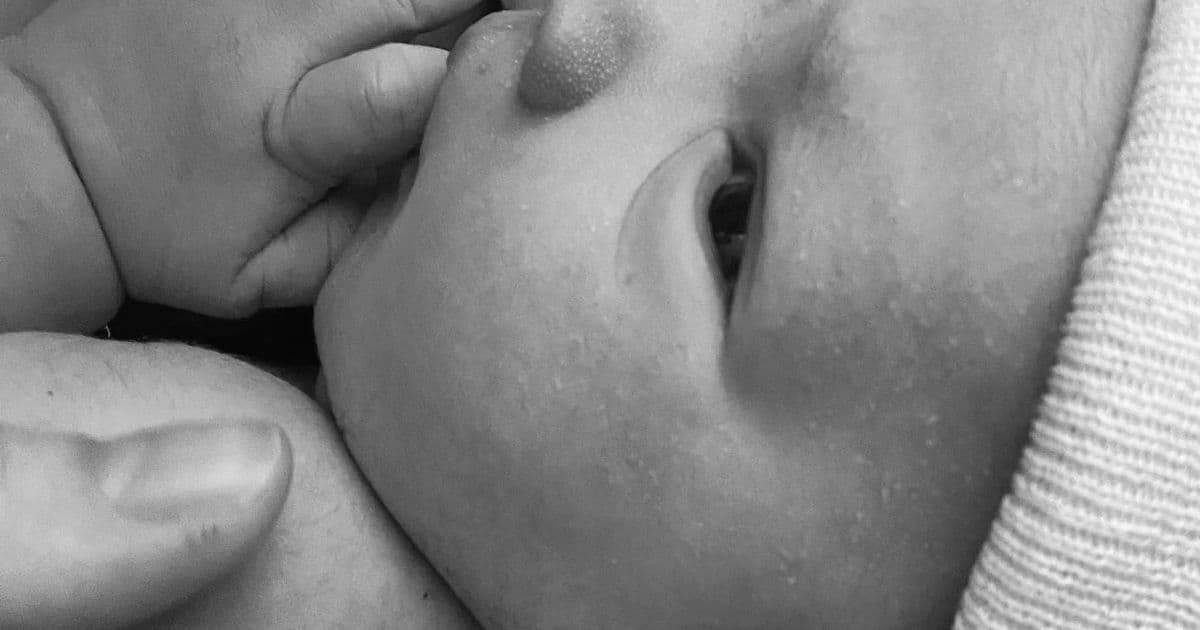
After his newborn son died of a genetic lung disease that the country's top sequencing lab failed to diagnose in time, Daniel McKinnon built a prototype that found the mutation in days. That prototype became Gamow Labs, a startup applying large AI models to the slowest, most expensive part of clinical genomics: human interpretation.
Most startup origin stories are reverse-engineered from a pitch deck. This one starts in a NICU.
Daniel McKinnon's first son, Owen, was born in September 2021 and never came home. He spent eight weeks in the hospital while a care team cycled through treatments for a condition no one could name. The suspected culprit was alveolar capillary dysplasia (ACD), a lethal disorder where the gas-exchange structures in the lungs are malformed at a microscopic level. The standard diagnostic, whole genome sequencing sent to one of the best genetics labs in the country, came back empty. Owen died without an answer. The genetic cause, a missing 91-kilobase stretch of DNA that should have been driving expression of the FOXF1 gene, was only identified afterward, once a researcher agreed to reanalyze the genome by hand.
That detail is the whole company in miniature. The data to diagnose Owen existed. The sequencing worked. What failed was interpretation, the labor-intensive human step of looking at a genome and figuring out which of millions of variants actually explains a sick child. McKinnon learned this the hard way years later, when his second son's prenatal sequencing also came back non-diagnostic. Refusing to wait, he requested the raw genomics files from every lab the family had worked with and built his own analysis pipeline. It confirmed the new baby was healthy. It also found the mutation that had killed Owen, the one the top lab missed.
The problem Gamow Labs is actually solving
The interesting claim here is not "AI for genomics," a phrase that has launched plenty of forgettable companies. It is a narrower and more defensible observation: the sequencing itself is cheap and increasingly commoditized, while most of the cost, delay, and inequality in clinical genomics lives in the interpretation layer. Genetics programs lose money and exist mostly at top-tier hospitals. Expert reanalysis, the kind that eventually solved Owen's case, is rationed because the handful of researchers capable of it are flooded with requests from desperate families and have to triage which cases they can plausibly help.
Gamow Labs, named after the physicist and cosmologist George Gamow, who also made early contributions to genetics, is targeting that bottleneck. The thesis is that frontier models can do the first-pass clinical genetic analysis that currently requires a scarce human expert, turning a service that only elite hospitals can afford into something closer to a default for any NICU admission. McKinnon frames sequencing-on-admission as both life-saving and cost-saving, which is the kind of alignment between economics and outcomes that rarely shows up in healthcare.
Traction, with the appropriate caveats
The early results are the part worth scrutinizing, and they are stronger than most pre-launch biotech claims. Beyond solving his own family's cases, McKinnon partnered with an academic geneticist to run a benchmark across 66 rare-disease cases that clinical labs had left unsolved. According to the company, the system identified every variant since confirmed as causal, produced zero false positives on negative controls, and cracked at least two cases nobody had previously solved, including one driven by a disease mechanism documented only a handful of times. A manuscript is in review.
Those numbers come from the founder ahead of peer review, so the usual discount applies. A retrospective benchmark on previously characterized cases is not the same as prospective performance on fresh, unlabeled genomes, and false-positive behavior in a controlled cohort can look very different in clinical deployment. But the structure of the claim is credible precisely because it is specific: a defined cohort, confirmed causal variants, named controls, and an external academic collaborator rather than internal validation alone. That is more rigor than the category usually offers.
Positioning and what is missing
McKinnon is candid that the NICU is a starting point rather than the market. Newborns are both close to his story and a population heavily enriched for genetic disease, which makes them an ideal test bed before the same interpretation engine expands toward precision medicine more broadly. That is a sensible wedge: a clinically urgent, technically tractable niche where being right matters enormously and the incumbent service is scarce.
What the public story does not yet include is the commercial scaffolding. There is no disclosed funding round, no named investors, and no stated revenue model, though the founder notes that sequencing labs themselves run as healthy businesses, which hints at where the economics could land. The immediate signal is hiring: Gamow is recruiting Members of Technical Staff, specifically computational biologists and AI engineers with a serious interest in genetics. For a company at this stage, the talent pitch is the fundraising pitch.
The skeptic's read is that clinical genomics is a regulated, liability-heavy field where "the model found a variant" is the easy part and validation, reimbursement, and integration into hospital workflows are the hard parts that have sunk better-capitalized efforts. The optimist's read is that interpretation is exactly the kind of pattern-matching-over-vast-context problem where current models have a real edge, and that a founder who has personally lived the failure mode is unusually motivated to build for the actual clinical workflow rather than a demo. Both can be true. What makes this one worth watching is that the founding result, finding a mutation that a national reference lab missed, was reproducible enough to convince an academic collaborator to put a benchmark and a manuscript behind it. That is a harder thing to fake than a landing page.
Comments
Please log in or register to join the discussion