The Nix build service Garnix will cease hosted operations on July 15 2026 following its acquisition by Shopify. The team will open‑source the platform, delete all user data, and invite community members to run their own instances.
Garnix Announces Shutdown and Open‑Source Release After Joining Shopify
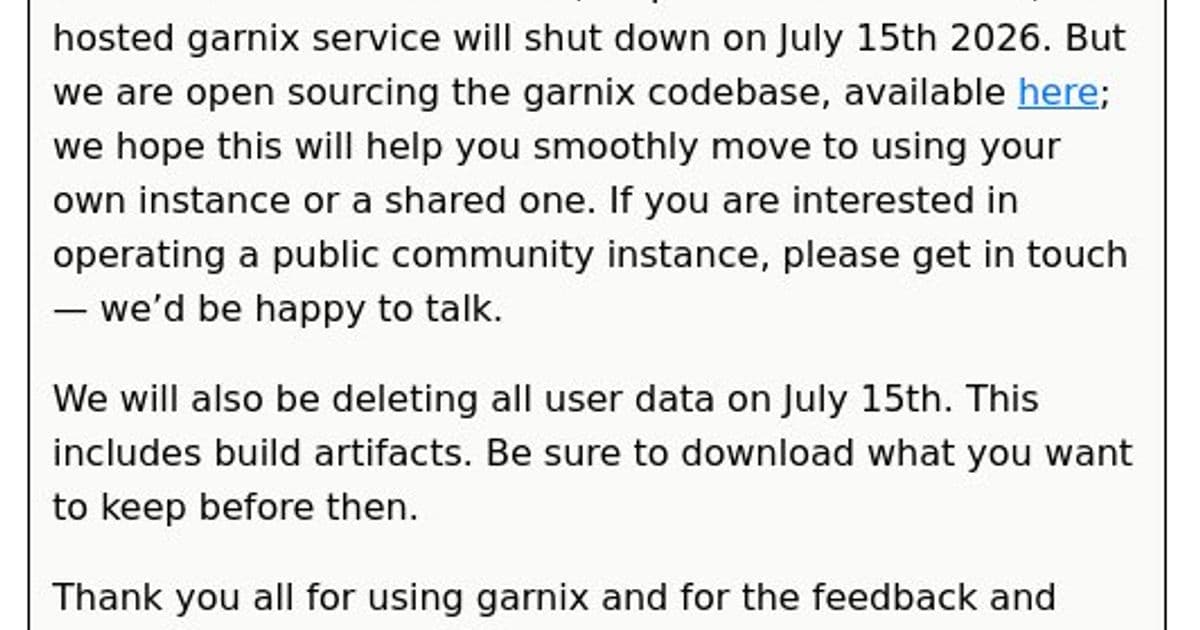
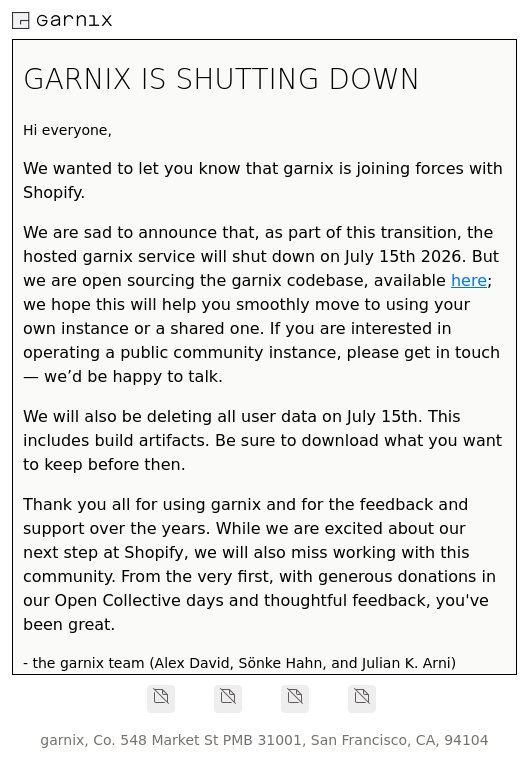
Garnix, the hosted continuous integration service built around the Nix package manager, has sent a final communique to its users: the service will be discontinued on July 15 2026. The announcement, delivered via email from [email protected], explains that the company has been acquired by Shopify and will therefore transition its focus away from operating the public build platform.
Core Argument: A Planned Sunset, Not an Abrupt Failure
The message makes clear that the shutdown is a planned event rather than a sudden collapse. By giving users more than three years’ notice, Garnix’s team signals a respect for the community that has relied on the service for reproducible builds, binary caches, and CI pipelines. The decision to open‑source the entire codebase is presented as a mitigation strategy, allowing existing projects to migrate to self‑hosted or community‑run instances without losing the tooling they have come to depend on.
Key Details and Supporting Evidence
- Acquisition by Shopify – The email states that Garnix is “joining forces with Shopify.” While no financial terms are disclosed, the partnership suggests that Shopify sees value in Nix‑based build automation, perhaps to improve its own infrastructure for deploying web services.
- Shutdown Timeline – The hosted service will cease on July 15 2026. This date provides a concrete deadline for users to export any data they wish to retain.
- Open‑Source Release – The full Garnix codebase will be released publicly. The announcement includes a link to the repository (the exact URL was omitted in the original post but can be found in the email). By open‑sourcing the platform, the team hopes to enable:
- Individual developers to run private instances.
- Organizations to host shared instances for their teams.
- The broader Nix community to maintain and extend the service.
- Data Deletion – All user data, including build artifacts, will be permanently removed on the shutdown date. Users are urged to download any necessary artifacts beforehand.
- Invitation to Operate Community Instances – The team explicitly invites anyone interested in maintaining a public, community‑run Garnix instance to get in touch, indicating a willingness to support a decentralized continuation of the service.
Implications for the Nix Ecosystem
Migration Challenges and Opportunities
The abrupt loss of a hosted binary cache can disrupt CI pipelines that have come to rely on Garnix’s fast, reproducible builds. Projects will need to adjust their CI configurations to point to alternative caches (e.g., cache.nixos.org or self‑hosted caches) and possibly re‑architect their build pipelines to accommodate the new environment.
At the same time, the open‑source release democratizes the technology. Teams that previously could not afford a hosted solution now have the option to run a lightweight instance on inexpensive cloud VMs or even on‑premise hardware. This could spur a wave of small‑scale, community‑maintained caches that collectively reduce the load on the official Nix cache.
Potential for Shopify Integration
Shopify’s involvement may eventually lead to a tighter integration of Nix into its own deployment pipelines. If Shopify decides to contribute back improvements—such as enhanced scaling, better cache eviction policies, or tighter security hardening—the broader Nix community could benefit from these upstream changes.
Counter‑Perspectives and Risks
Some developers may view the shutdown as a loss of a reliable, professionally managed service. While the open‑source code is a valuable asset, operating a production‑grade instance requires operational expertise: monitoring, security patching, and capacity planning. Smaller teams might lack the resources to maintain their own instances, potentially leaving them without a suitable alternative.
Furthermore, the three‑year notice period, while generous, may still be insufficient for projects with long‑term dependencies on Garnix. Organizations that have baked Garnix into their release engineering processes will need to allocate engineering time to migrate, test, and validate new caching solutions—effort that could have been avoided if the service had continued.
Looking Ahead
The Garnix shutdown serves as a reminder of the fragility inherent in relying on third‑party hosted services for critical build infrastructure. By open‑sourcing the platform and inviting community stewardship, the Garnix team attempts to transform a potential disruption into an opportunity for decentralization and collective ownership.
For users facing the upcoming deadline, the immediate steps are clear:
- Export all needed build artifacts before July 15 2026.
- Clone the open‑source repository and begin experimenting with a local deployment.
- Assess alternative caching solutions and update CI configurations accordingly.
- Consider contributing to a community‑run instance if one emerges, or propose a new shared service for the Nix ecosystem.
In the broader context, this episode underscores the importance of building resilient, reproducible pipelines that can survive the loss of any single service. As the Nix community continues to mature, the hope is that the open‑source Garnix codebase will become a cornerstone for self‑hosted, collaborative build infrastructures, ensuring that the values of reproducibility and composability remain intact.
Comments
Please log in or register to join the discussion