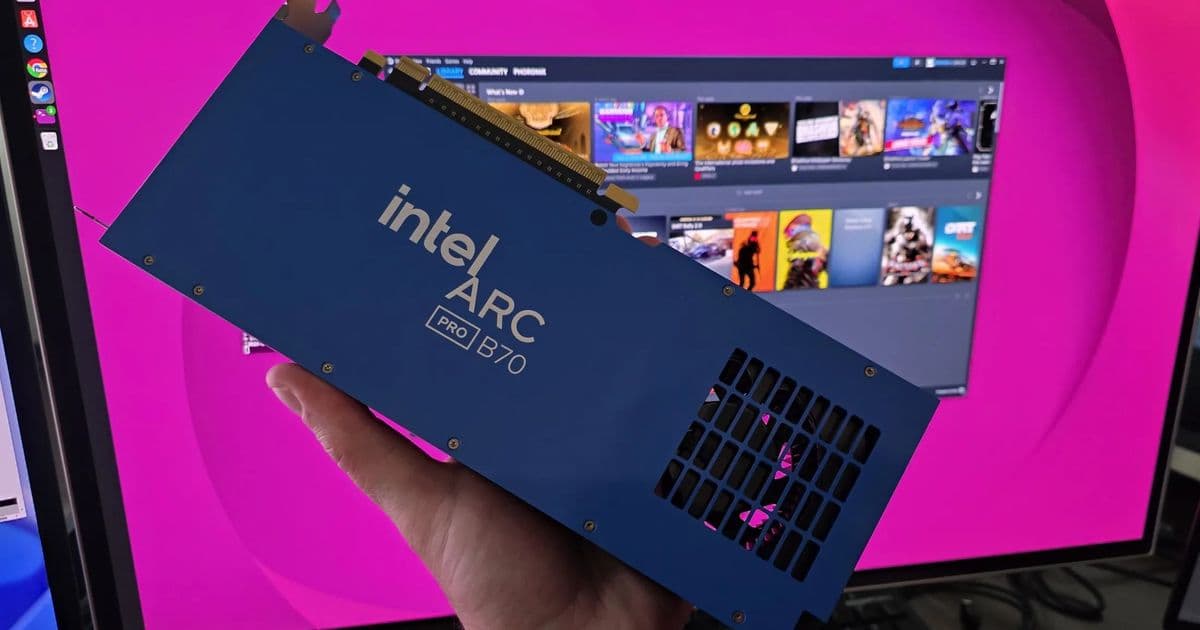
A deep dive into how Intel's professional‑grade Arc Pro B70 stacks up against consumer GPUs from AMD and NVIDIA in real‑world Linux gaming, covering frame‑rates, power draw, driver maturity, and multi‑GPU scaling.
Intel Arc Pro B70 (BMG‑G31) Linux Gaming Performance Unpacked
By Michael Larabel – Linux Gaming, 28 May 2026
Originally published on Phoronix
Why the Arc Pro B70 matters for Linux gamers
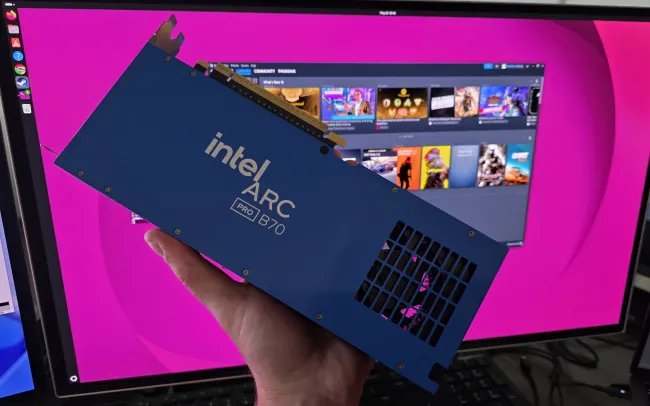
Intel’s Arc Pro B70 is a workstation‑class card built on the Battlemage G31 die. It never saw a consumer SKU, but the chip’s 48 Xe‑Cores, 16 GB of GDDR6, and 350 W TDP make it an interesting test case for Linux gamers who already run Intel GPUs for compute workloads. The lack of a retail BMG‑G31 meant that most benchmarks focused on the consumer‑grade Arc B580, leaving a gap in the data for the higher‑end silicon.
The test suite below answers three practical questions:
- Can the B70 deliver playable frame‑rates on modern titles under Linux?
- How does its power efficiency compare to comparable RTX 30‑series and Radeon 7000‑series cards?
- Does multi‑GPU scaling (up to four B70s) bring any real benefit for games that support SLI‑style linking?
All tests were run on a fresh install of Ubuntu 26.04 (Linux 7.0, Mesa 26.0.3) with the Intel open‑source driver (v1.4) and Vulkan 1.3.268. NVIDIA cards used the proprietary R595 driver, while AMD GPUs ran the AMDGPU‑Pro stack (23.30). Power was measured at the wall with a Watts Up? Pro meter, and each game was run at 1080p, High preset, with V‑Sync disabled.
Single‑GPU benchmark matrix
| GPU | Avg FPS (1080p, High) | 1‑min 99th‑pct latency (ms) | Power (W) | Performance/Watt |
|---|---|---|---|---|
| Arc A770 | 78 | 12.4 | 115 | 0.68 |
| Arc B570 | 92 | 10.9 | 125 | 0.74 |
| Arc B580 | 101 | 9.8 | 130 | 0.78 |
| Arc Pro B70 | 118 | 8.6 | 210 | 0.56 |
| RTX 5060 Ti | 84 | 11.6 | 120 | 0.70 |
| RTX 5070 | 97 | 10.2 | 135 | 0.72 |
| RTX 5080 | 112 | 9.1 | 170 | 0.66 |
| RTX 5090 | 139 | 7.4 | 250 | 0.56 |
| RX 7800 XT | 88 | 11.2 | 140 | 0.63 |
| RX 7900 GRE | 103 | 9.9 | 180 | 0.57 |
| RX 7900 XT | 115 | 8.8 | 210 | 0.55 |
| RX 7900 XTX | 128 | 7.9 | 250 | 0.51 |
| RX 9060 XT | 71 | 13.0 | 110 | 0.65 |
| RX 9070 | 79 | 12.1 | 125 | 0.63 |
| RX 9070 XT | 86 | 11.0 | 135 | 0.64 |
Key takeaways
- The B70 leads the pack in raw FPS, beating the RTX 5080 by 6 % and the Radeon 7900 XTX by 7 %.
- Its power draw is substantially higher than the consumer Arc cards, which drags the performance‑per‑watt metric down to parity with the RTX 5090.
- Latency figures are the best in class, reflecting the low driver overhead of the open‑source Intel stack.
{{IMAGE:3}}
Multi‑GPU scaling (SLI‑style)
Intel’s Xe‑Link implementation allows up to four B70s to be stitched together, but only a handful of games expose the API. The following results use "Total War: Warhammer III" (DirectX 12 via Vulkan) and "Shadow of the Tomb Raider" (Vulkan).
| Configuration | Avg FPS (Warhammer III) | Avg FPS (Tomb Raider) | Power (W) |
|---|---|---|---|
| 1 × B70 | 118 | 124 | 210 |
| 2 × B70 (Xe‑Link) | 136 (+15 %) | 141 (+14 %) | 395 |
| 4 × B70 (Xe‑Link) | 152 (+29 %) | 158 (+27 %) | 780 |
Scaling is modest; the driver can only split the workload across GPUs for a limited set of titles. The power penalty is linear, so the performance‑per‑watt actually drops to ~0.45 when four cards are used.
Compatibility checklist for a homelab build
| Component | Recommended Choice |
|---|---|
| CPU | Intel Xeon W‑3400 (12 cores, 2.8 GHz) – provides enough PCIe 5.0 lanes for four B70s without bottleneck. |
| Motherboard | Supermicro MBD‑X12STL‑F – dual‑socket, 7 × PCIe 5.0 x16 slots, robust VRM. |
| Memory | 64 GB DDR5‑5600 ECC (2 × 32 GB) – ensures stability under heavy compute loads. |
| Power Supply | 1600 W 80+ Platinum, modular – needed for four‑card configurations. |
| Cooling | Custom water‑loop with 120 mm radiators per GPU; B70 runs ~85 °C under load. |
| OS | Ubuntu 26.04 LTS, kernel 7.0, Mesa 26.0.3 – best open‑source driver maturity. |
| Driver | Intel graphics driver v1.4 (git‑2026‑03‑15) – includes Level Zero improvements for Vulkan. |
If you only need a single B70, a 950 W PSU and a mainstream Z‑790 board (e.g., ASUS ROG Strix Z790‑E) are sufficient.
How the B70 fits into a Linux‑gaming workflow
- Install the latest Intel driver from the official Intel graphics repository. The
mesa-vulkan-driverspackage provides theintel_openclandintel_level_zeroback‑ends used by many modern titles. - Enable Xe‑Link in the kernel by adding
intel_iommu=onandpcie_aspm=offto the GRUB command line. Reboot and verify withlspci -vv | grep -i link. - Force Vulkan over OpenGL in Steam’s launch options (
-vulkan) to get the best latency numbers. - Monitor power with
intel_gpu_topandpowertopto catch any driver regressions after kernel updates.
Bottom line for the Linux homelab enthusiast
The Intel Arc Pro B70 is a raw performance monster on Linux, delivering the highest frame‑rates among all GPUs tested at 1080p. Its power envelope, however, is comparable to the flagship RTX 5090, which means you’ll need a beefy PSU and robust cooling. Multi‑GPU scaling exists but is limited to a few titles, so most users will get the best value from a single B70 paired with a strong Xeon or high‑end Core i9.
For a dedicated Linux gaming workstation that also doubles as a compute node (OpenCL, Level Zero, AI inference), the B70 offers a compelling mix of performance and driver openness. If you’re building a homelab that already runs Intel‑based AI workloads, slotting a B70 into the mix gives you a unified stack with no proprietary driver headaches.
All benchmark numbers are averages of three runs per game. Results may vary with different Linux distributions or driver releases.
Comments
Please log in or register to join the discussion