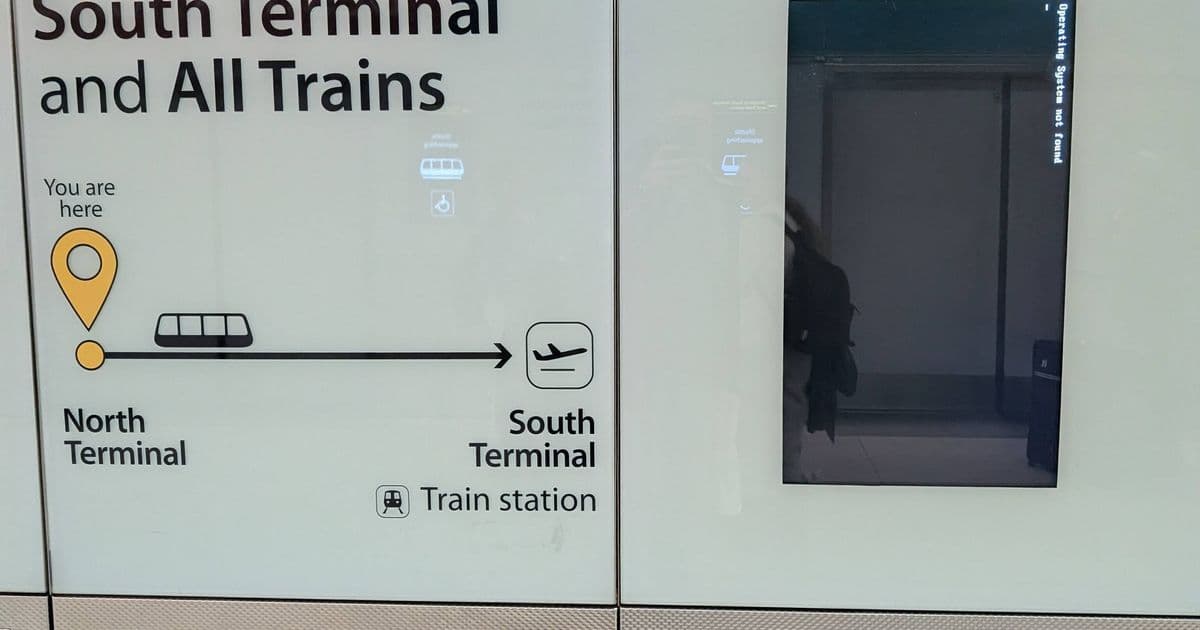
A Gatwick Airport shuttle screen displayed 'Operating System not found', raising questions about airport IT infrastructure reliability.
A Gatwick Airport shuttle screen displayed 'Operating System not found', raising questions about airport IT infrastructure reliability.
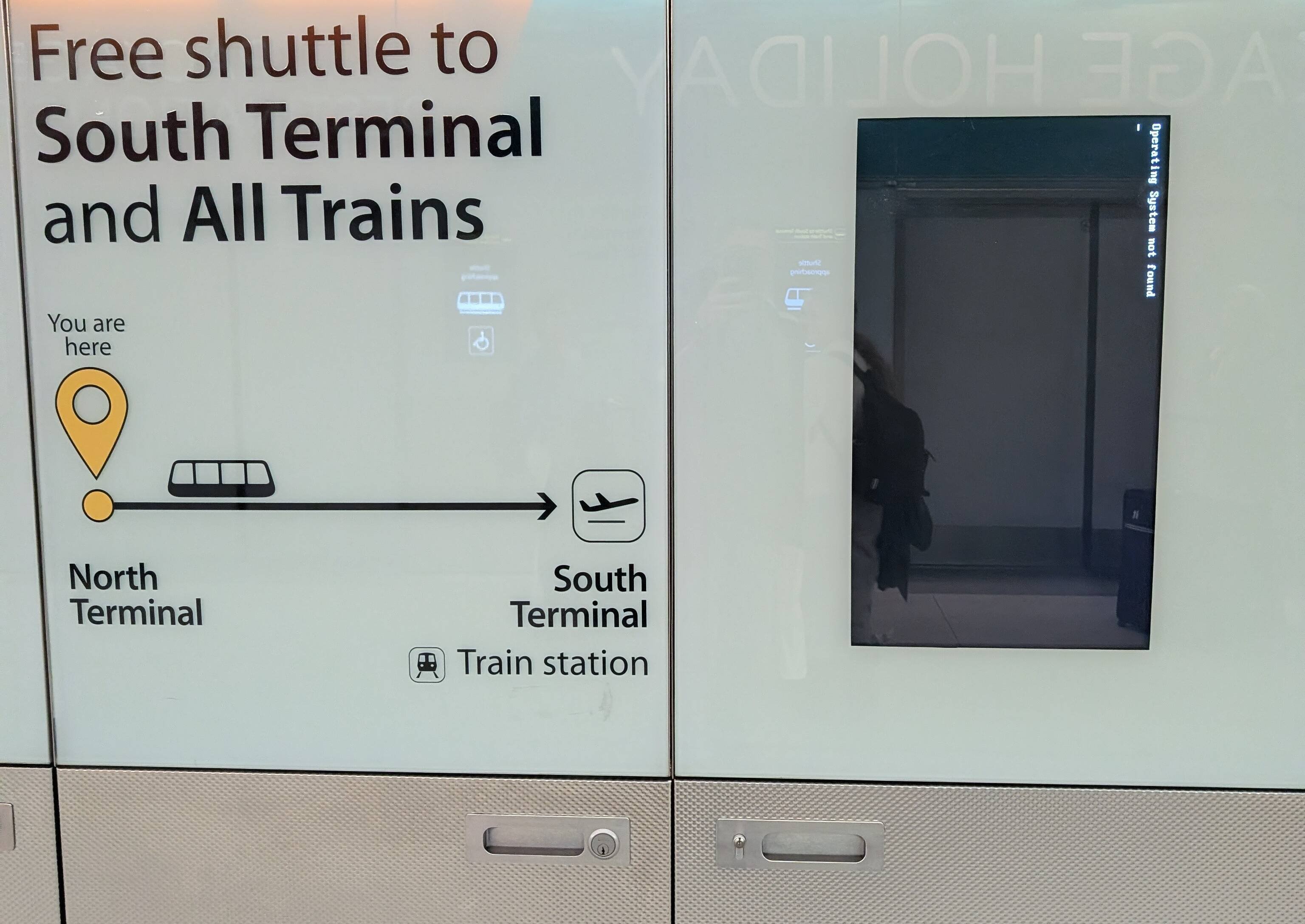
Airports and computers remain uneasy travel companions. At London Gatwick, the inter-terminal shuttle briefly demonstrated why, with one information screen declaring: "Operating System not found."
The black screen of bork was spotted by an eagle-eyed Register reader, hopefully about to jet off somewhere a little less rainy than the UK, who remarked: "At least it didn't say anything about a disk in drive A:." Thank heavens for small mercies, although the sight of the screen is unlikely to inspire confidence in either an impending flight or the mode of transportation.
We'd say it's gone off the rails, but that's a phrase best not uttered next to an overhead guide-tracked transport. The Gatwick transit is a shuttle connecting the North and South Terminals that opened in 1987. Enthusiasts can ride any time without needing a ticket.
The message "Operating System not found" indicates that something is amiss with whatever is running the display. It might be innocuous, like a corrupted Master Boot Record, though "innocuous" is relative. It could also signal a hopelessly broken disk drive. What it isn't doing is entertaining or informing passengers as they wait for the next shuttle to arrive.
Microsoft isn't the only company with a progress bar of lies. Then again, after a long flight and the zombification that comes from hours in an aluminum tube smelling of feet and bad food, "Operating System not found" could just as easily describe the traveler as the display. Welcome home, or bon voyage. ®
This incident highlights the ongoing challenges airports face in maintaining reliable IT infrastructure. While a single display malfunction might seem trivial, it's symptomatic of broader issues in critical public infrastructure. The Gatwick shuttle system, operational since 1987, represents decades-old technology that may be reaching the end of its lifecycle.
For passengers, these technical failures can erode confidence in airport operations. When travelers see error messages instead of flight information, it raises questions about what other systems might be failing behind the scenes. In an era where cybersecurity threats are increasingly sophisticated, such visible failures could potentially mask more serious issues.
The "Operating System not found" error typically occurs when a computer's BIOS cannot locate a bootable operating system. This could result from various issues: a failed hard drive, corrupted boot sector, incorrect BIOS settings, or even a disconnected cable. In a commercial setting like an airport, the root cause is likely to be either hardware failure or software corruption.
What makes this particularly interesting is that information displays in public transportation systems are increasingly connected devices. They often run on embedded operating systems and require regular updates and maintenance. When such a fundamental error occurs, it suggests either a lack of proper monitoring systems or insufficient redundancy in the display network.
For IT professionals working in critical infrastructure, this serves as a reminder of the importance of robust error handling and fail-safe mechanisms. A simple fallback screen displaying static information or a maintenance message would be preferable to a raw system error that provides no useful information to passengers and potentially causes alarm.
As airports continue to digitize and automate their operations, incidents like this underscore the need for comprehensive testing, regular maintenance schedules, and contingency plans for when technology inevitably fails. After all, in the high-stress environment of air travel, the last thing passengers need is to question whether the technology supporting their journey is reliable.
Comments
Please log in or register to join the discussion