
GitHub teamed up with Microsoft Security's Agents Offense team to add contextual reasoning to its secret scanning pipeline, cutting customer-confirmed false positives by 75.76%. For organizations standardizing security tooling across multiple clouds, the change shifts the calculus on where credential detection should live.
What changed
GitHub announced on June 11 that it has rebuilt the verification stage of its secret scanning system to lean on large language model reasoning rather than pattern matching alone. Working with Microsoft Security and AI's Agents Offense team, GitHub applied the verification approach from an internal system called Agentic Secret Finder to evaluate whether a detected value is genuinely a leaked credential or just something that looks like one.
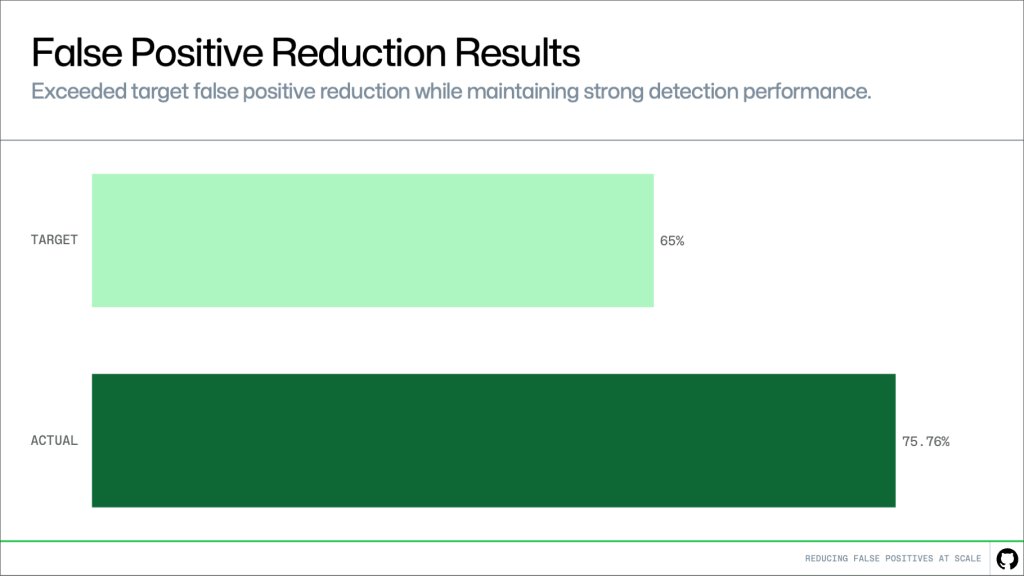
The headline number: a 75.76% reduction in false positives, measured against hundreds of customer-confirmed false positive alerts. The original target was 65%, so the team cleared its goal by a comfortable margin while, according to GitHub, preserving detection coverage. You can read the full announcement on the GitHub Blog and review the broader feature set on the secret scanning documentation.

The mechanics matter here because they explain why this is more than an incremental tuning pass. GitHub's secret scanning runs two detection modes side by side. Pattern-based detection catches known formats, the partner patterns for cloud provider tokens, API keys, and similar structured credentials. AI-powered generic detection extends coverage to unstructured secrets, things like loose passwords that match no published provider format. The pattern side already operates at what GitHub describes as industry-leading precision across billions of pushes. The generic AI side was noisier, and that noise is what this work targets.
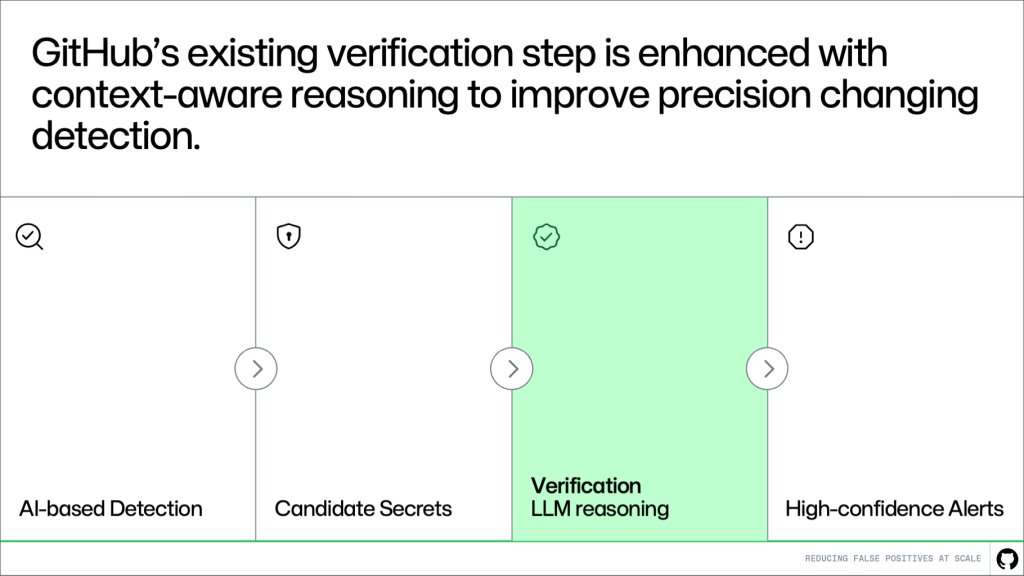
The insight driving the redesign is counterintuitive. The team did not give the verification model more code to look at. It gave the model better code. Instead of passing entire files or repositories into the LLM, which raises cost, latency, and noise, the pipeline now extracts a small set of high-signal indicators about how a candidate value is actually used. Is the value assigned to a variable and then passed into an authentication header, a database client, or a cloud SDK call? That usage trail is what separates a real exposed credential from a random UUID or an opaque test string.
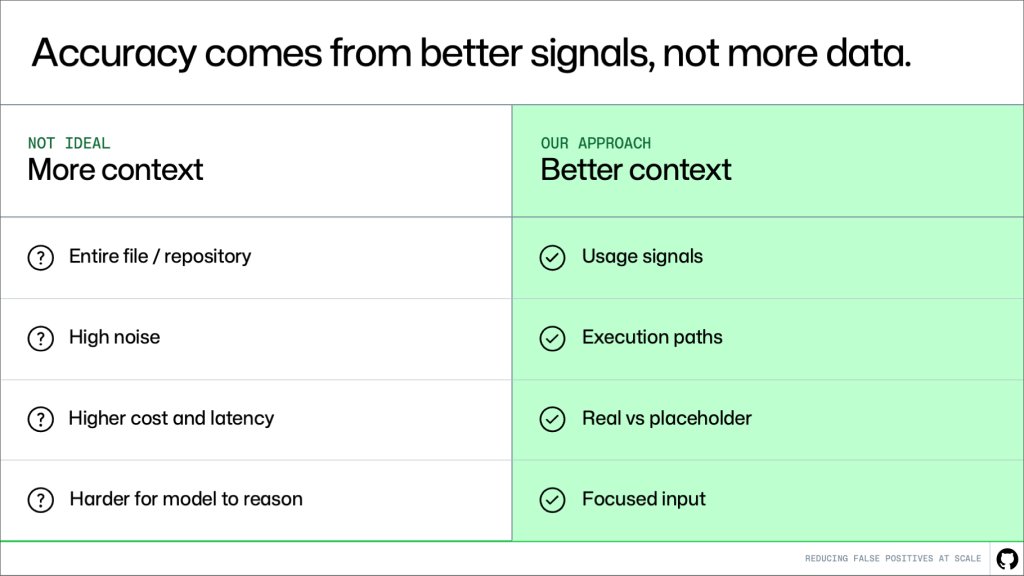
Pattern matching can confirm that a string looks like a secret. It cannot confirm that the string functions as one. Adding execution-path and usage context to the verification step closes that gap, and GitHub reports it does so without touching upstream detection logic or reducing what gets flagged in the first place.
Provider comparison
For teams running workloads across AWS, Azure, and Google Cloud, secret scanning is rarely a single-vendor decision. Each cloud ships its own native credential detection, and the source-control layer adds another. Understanding where the overlap sits is the difference between layered defense and redundant spend.
GitHub Advanced Security, which houses secret scanning, sits at the repository and push layer. Its strength is breadth across providers. Because it scans source code rather than a specific cloud's resource graph, it catches an AWS access key, an Azure connection string, and a Google service account JSON in the same pass, before any of them reach a runtime environment. That cross-provider neutrality is the practical argument for centralizing detection at the source-control layer when your estate spans more than one cloud.
The cloud-native alternatives detect later in the lifecycle and bind tighter to their own ecosystems. AWS Secrets Manager plus GuardDuty and IAM Access Analyzer focus on credentials already provisioned inside AWS, with strong automated rotation for native secret types. Azure Key Vault paired with Microsoft Defender for Cloud covers the Azure resource graph and integrates with Entra ID for identity context. Google Secret Manager with Security Command Center does the equivalent for GCP. These tools excel at managing and rotating secrets that live inside their platform. They are weaker at catching a credential a developer hardcoded into a commit, because by the time the secret reaches the cloud, the exposure in version history has already happened.
The Microsoft collaboration adds a wrinkle worth flagging for procurement teams. The Agents Offense reasoning that powers this improvement originates inside Microsoft Security, the same organization behind Defender for Cloud. Microsoft is steadily threading agentic AI verification through both its source-control product and its cloud-native security posture management. Organizations weighing a consolidation play around the Microsoft and GitHub stack should read this as a directional signal rather than a one-off feature. The reasoning layer is becoming the shared asset.
On pricing, the comparison is structural, not just numeric. GitHub bills secret scanning through GitHub Advanced Security, licensed per active committer, so cost scales with engineering headcount regardless of how many clouds you run. The native cloud secret managers bill per secret stored and per API call, so cost scales with your resource footprint inside each provider. A 200-developer shop with a sprawling multi-cloud deployment may find the per-committer model cheaper for detection coverage, while a small team with heavy automated workloads might pay less through native tooling. The false positive reduction changes this math indirectly: fewer wasted triage hours is real money when a security engineer's time is the scarce resource.
Business impact
The strategic takeaway is about where credential detection should live in a multi-cloud architecture, and this announcement strengthens the case for pushing it left, to the source-control layer, while leaving rotation and runtime enforcement to each cloud's native tooling.
The reason is trust decay. When a security tool generates too many false positives, developers stop reading its alerts. That is not a hypothetical, it is the failure mode GitHub explicitly calls out: noisy alerts mean more time triaging and less time fixing, which slows remediation and erodes confidence in the entire system. A 76% cut in false positives is therefore not a vanity metric. It is a direct intervention in the human attention budget that determines whether a security program functions at all. An alert stream that engineers actually trust gets acted on. One they have learned to ignore is worse than no alert at all, because it creates a false sense of coverage.
For a CISO standardizing tooling across clouds, the practical recommendation is layered rather than consolidated. Use source-control secret scanning as the broad, provider-neutral net that catches exposures before they propagate. Keep each cloud's native secret manager for what it does best, storing, rotating, and access-controlling the credentials your workloads legitimately need. Avoid paying for three overlapping detection systems that all flag the same hardcoded key three times in three places, because that redundancy reintroduces the exact noise problem this work was designed to solve.
Migration considerations are modest for existing GitHub Advanced Security customers, since the improvement lands inside the existing verification pipeline with no change to detection logic or required configuration. Teams not yet on the platform should weigh the per-committer licensing against their multi-cloud footprint and run the organization risk assessment GitHub points to before committing. The larger consideration is organizational, not technical. Realizing the benefit means actually retiring the manual triage workflows and suppression rules that teams built to cope with the old noise levels. A tool that is quieter only pays off if the humans around it adjust to trust the quiet.
Comments
Please log in or register to join the discussion