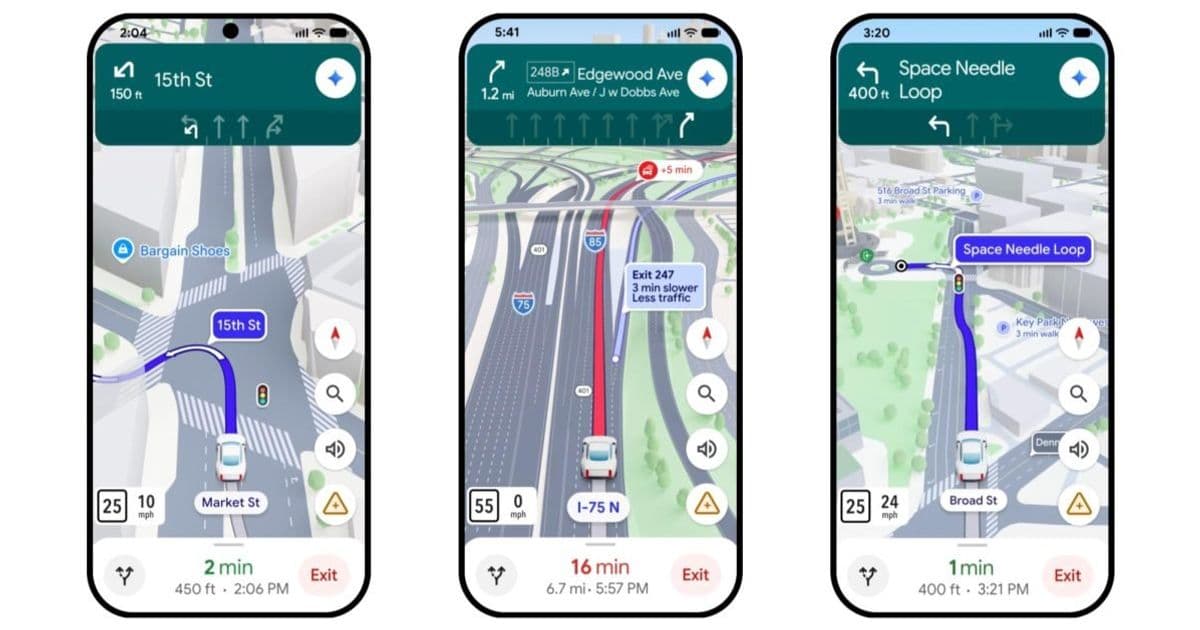
Google Maps is rolling out Immersive Navigation, a major visual and guidance overhaul that brings 3D terrain, enhanced lane details, and smarter voice prompts to help drivers navigate more confidently.
Google Maps is giving its driving experience the "biggest update in over a decade" with Immersive Navigation that redesigns visuals and offers "more intuitive guidance." It starts with a "vivid 3D view that reflects the buildings, overpasses, and terrain around you." Google Maps will highlight lanes, crosswalks, traffic lights, stop signs, and other critical road details "to help you make that turn or merge confidently."
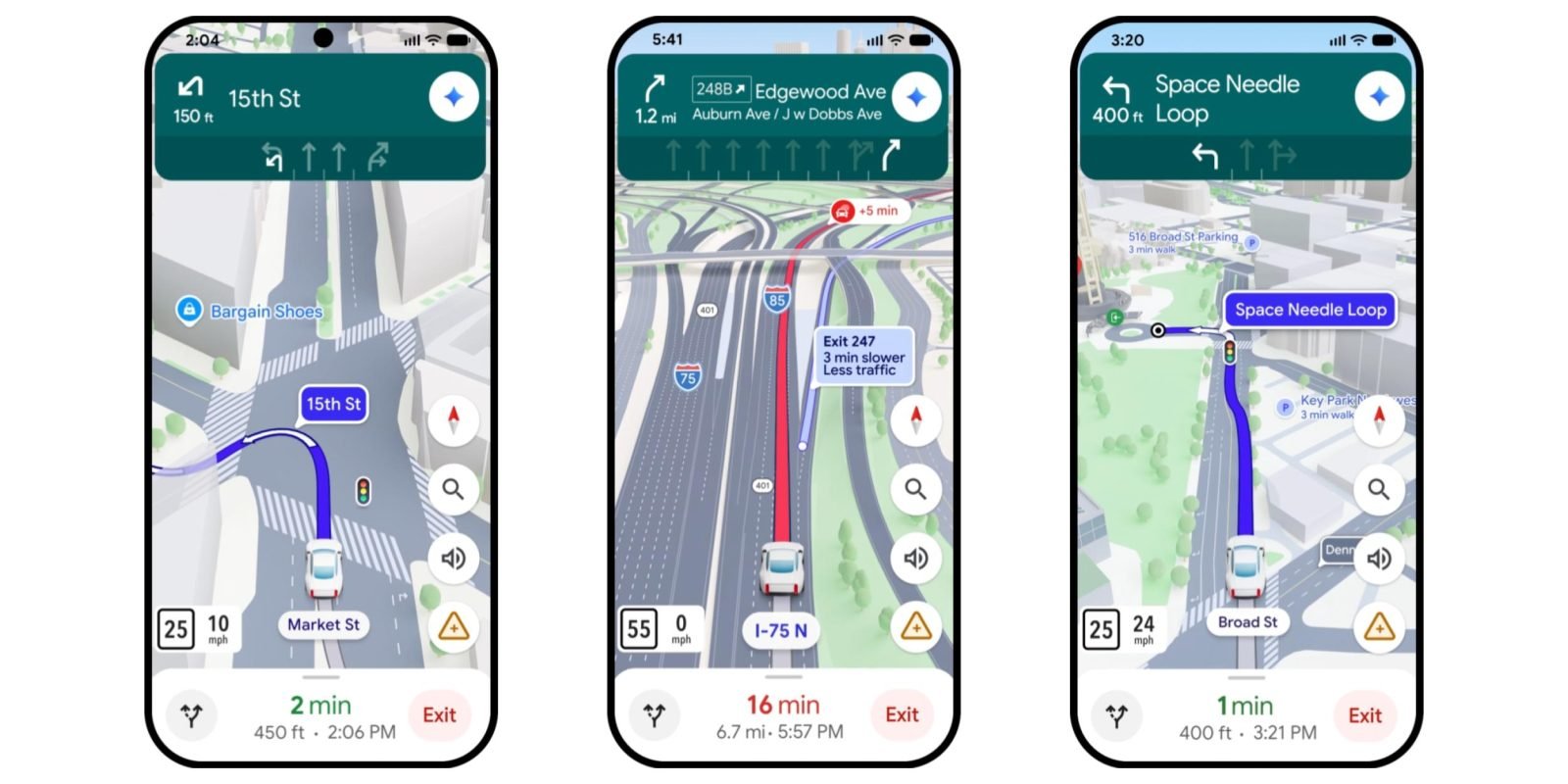
This isn't just a cosmetic refresh. The update fundamentally changes how navigation information is presented during active driving. Gone are the flat, 2D representations that have dominated navigation apps for years. Instead, drivers will see a more spatially accurate representation of their surroundings, with buildings rendered in three dimensions and terrain features clearly visible.
The lane guidance has been significantly enhanced. When approaching complex highway interchanges or multi-lane roads, Google Maps will now clearly show which lanes lead to which destinations, reducing the anxiety of last-minute lane changes. Crosswalks and traffic signals are now prominently displayed, helping drivers anticipate stops and pedestrian crossings well in advance.
Voice guidance has also been reimagined to be more conversational and contextually aware. Rather than robotic turn-by-turn commands, the system will now say things like: "Go past this exit and take the next one for Illinois 43 South." This more natural phrasing helps drivers understand the broader context of their route and reduces confusion at complex intersections.
One of the most requested features by longtime Google Maps users is finally being addressed: exit numbering. As one frustrated user commented: "At least give me the option to ALWAYS display the exit number of my next turn. Exit for 'Hwy 123 West' is a LOT less useful than 'Exit 54C' 99% of the time." The new system appears to address this by making exit numbers more prominent and consistent throughout the navigation experience.
Google is leveraging Gemini for spatial understanding to power these enhancements. The company explains that "Gemini models are used to analyze fresh, real-world imagery from Street View and aerial photos to give you an accurate view of things along your route, like landmarks and medians." This AI-driven approach allows Google Maps to create more accurate and contextually relevant visualizations of the driving environment.
Beyond the visual overhaul, Immersive Navigation introduces several practical features that address common pain points:
Route tradeoff information: Before committing to a route, drivers will now see clear information about the tradeoffs between different options. For example, you might see that one route is "longer trip with less traffic" while another is "faster one with a toll."
Real-time disruption alerts: The system will proactively warn about road construction, crashes, and other disruptions along your route. These alerts are powered by Google's community of drivers, who provide more than 10 million contributions every single day.
Destination preview: Before starting your trip, you can now preview your destination and its surroundings with Street View imagery. The app will also provide parking recommendations based on availability and cost.
Smart arrival guidance: As you approach your destination, Google Maps will highlight the building's entrance, nearby parking options, and which side of the street you should be on. This eliminates the common frustration of circling blocks trying to find the right entrance.
The rollout strategy is comprehensive. Immersive Navigation is beginning to roll out today in the US, with availability expanding over the coming months to eligible iOS and Android devices, CarPlay, Android Auto, and cars with Google built-in (Android Automotive). This broad compatibility ensures that most users will have access to the new features regardless of their preferred platform or vehicle.
For developers and tech enthusiasts, this update represents a significant investment in mobile mapping technology. The integration of Gemini's spatial understanding capabilities demonstrates how AI is transforming even the most established mobile applications. The enhanced 3D rendering also suggests improvements in mobile GPU utilization and data streaming efficiency.
Early user feedback has been mixed but generally positive. While many appreciate the enhanced visual clarity and more natural voice guidance, some users have noted that the new 3D rendering can be slightly more demanding on older devices. Google appears to be optimizing the experience for a wide range of hardware, but users with older phones may experience slightly reduced frame rates during navigation.
This update also raises interesting questions about the future of in-car navigation. As vehicles become more connected and autonomous features advance, the role of visual navigation aids may evolve. Google's investment in making navigation more intuitive and less distracting suggests a focus on driver assistance rather than replacement.
For now, Immersive Navigation represents the most significant evolution of Google Maps' driving experience in its history. By combining enhanced visuals, smarter guidance, and practical features like destination preview and arrival assistance, Google is addressing many of the longstanding frustrations that drivers have experienced with digital navigation.
The success of this update will likely be measured not just by user adoption, but by whether it actually reduces navigation-related stress and improves driving safety. If drivers can navigate complex routes with greater confidence and less distraction, Immersive Navigation will have achieved its primary goal of making the driving experience more intuitive and less stressful.
Comments
Please log in or register to join the discussion