Figure AI's robots just helped build 30,000 BMWs, and Tesla's Optimus is being tested on Gigafactory lines. The hardware finally works. The harder question is what happens to trust, work, and human connection when machines become indistinguishable from us.
For years, humanoid robots were a stage act. A company would wheel out a machine, have it climb a few stairs or wave at a crowd, and the demo would end before anyone asked it to do real work. That era is over. The shift happening right now is less about a single breakthrough and more about a convergence: mechanical engineering, battery density, and a new generation of AI models all maturing at the same time. The result is machines that are starting to earn their keep, and a set of social questions we are nowhere near ready to answer.
The trigger for a lot of recent anxiety is how convincing these systems look on video. A clip circulates, a robot moves with unsettling fluidity, and viewers can't tell whether they are watching hardware or a human actor. Sometimes it genuinely is a trick. But the fact that the illusion holds at all is the real signal. We are approaching the point where visual and behavioral cues stop being reliable, and that has consequences that reach well past robotics into how we design interfaces, verify identity, and decide who we trust.

What's actually new
The technical story splits cleanly into bodies and brains, and the brains are where the jump happened.
A decade ago, programming a robot to fold a towel meant writing brittle, explicit code for every joint angle and every edge case. Change the towel and the whole routine broke. Today, systems like Figure AI's Helix and NVIDIA's GR00T replace that rigid scripting with learned behavior. The robot watches a human perform a task, builds a model of the intent behind the motion, and generalizes. It understands that "load the dishwasher" is a goal, not a fixed sequence, so a plate in a slightly different spot doesn't crash the routine.
This is the same architectural move that reshaped the rest of AI. Instead of hand-authoring every rule, you train a general model and let it interpret context at runtime. For anyone who has watched front-end tooling evolve from imperative DOM manipulation toward declarative, intent-based frameworks, the pattern is familiar. You describe what you want, and the system figures out the steps.
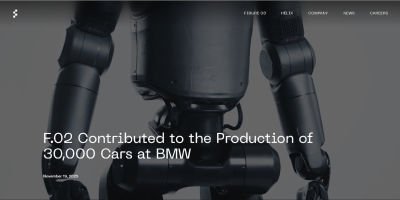
The deployments back this up. Figure's 02 model ran a multi-month stint at BMW's Spartanburg plant, handling sheet metal components and contributing to the production of more than 30,000 vehicles. Tesla is testing its Optimus units inside its own Gigafactories with an eye toward industrial scale. These are not press events. They are production lines.
The body is still the bottleneck
The digital side has sprinted ahead of the physical side, and the gap shows. Three constraints define the current ceiling.
Battery life is the first. Most humanoids run for only a few hours before needing a recharge, which is fine for a fixed factory shift and useless for an all-day household helper. Bipedal locomotion is the second. Walking on a flat, predictable factory floor is solved; navigating a cluttered living room, a staircase with a toy on it, or a crowded sidewalk is still genuinely hard and occasionally dangerous. Cost is the third, though fierce competition is finally pushing manufacturing prices down in a way that looks a lot like every other hardware category that eventually went mainstream.
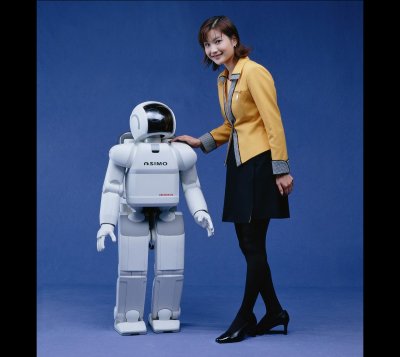
It's worth remembering where this started. Honda's ASIMO, which debuted around 2000, was celebrated mostly for not falling down. The distance between that machine and a robot autonomously sorting parts on a BMW line is the distance the field covered in roughly two decades.
Where the design problem gets uncomfortable
Here is where the user-experience lens matters, because the most consequential engineering decisions in this space are not about torque or compute. They are about perception.
Researchers are building artificial skin from silicone composites that mimic warmth and touch sensitivity, plus micro-actuators that drive realistic facial expressions. Companies like Hanson Robotics, maker of the well-known Sophia, and Realbotix with its Aria model, are pushing hard on lifelike presentation. And critically, the AI is being trained to copy human imperfection on purpose. The robots blink irregularly, shift their weight, pause and sigh mid-sentence.
That last detail is the entire game. Those flaws are a deliberate design strategy to defeat the Uncanny Valley, the dip in comfort people feel when something looks almost human but slightly wrong. The engineering goal is not accuracy. It is to make you stop noticing. As a piece of interaction design, it is effective. As a matter of consent, it is the start of a serious problem, because a system optimized to feel human is also a system optimized to make you forget it isn't.
Developer and societal experience
If you build products, the identity question lands directly on your desk. When a humanoid can present as a person over video, voice, and eventually in physical space, every system that relies on "is this a real human" as an implicit assumption needs rethinking. Authentication, customer support, content moderation, and trust-and-safety flows were all designed for a world where impersonation had a cost and a tell. That world is closing.
The upside is real and shouldn't be dismissed. Robots are well suited to the dull, dirty, and dangerous work people get hurt doing: mining, toxic waste handling, high-voltage repair. Aging societies like Japan and South Korea face labor shortages that humanoids could genuinely help fill, particularly in elder care and health monitoring. And a world where physical labor gets dramatically cheaper is a world where the cost of housing, food, and goods could fall in ways that change what work even means.
The downsides track just as closely. Mass labor displacement among drivers, warehouse staff, and retail workers could arrive faster than retraining or policy can absorb. Synthetic companionship that is always patient and never disagrees may quietly pull people away from the harder, more rewarding work of real relationships. And the impersonation risk scales from individual scams up to surveillance and autonomous weapons, where a machine that never hesitates removes one of the last brakes on harm.
Designing the guardrails
Progress here won't be stopped, so the useful question is how to constrain it. Three guardrails come up repeatedly and map neatly onto principles any responsible system architect already recognizes.
The first is a hardware kill-switch: a physical power cut that the AI cannot override. This is the robotics version of failing safe, and it has to live below the software layer so no model decision can countermand it.
The second is mandatory disclosure. A robot should never be allowed to hide that it is a machine. A digital beacon or physical marker that reliably signals "this is synthetic" is the bare minimum for informed interaction, and it is the same honesty we should expect from any interface that could be mistaken for a person.
The third is economic. If robot labor generates enormous wealth, taxing some of it to fund support for displaced workers is what keeps the technology from concentrating gains at the very top. That is a policy choice, not an engineering one, but it determines whether any of the rest matters.
The through-line in all of this is that lifelike machines work as a mirror. The more capably they replicate what we do, the more they pressure us to define what we actually value, the connection, the creativity, and the messy human effort that no model is trying to optimize away. The goal of building them should not be to replace people. Built carefully, with honest signaling and real accountability, the better outcome is that they hand back the time and attention we have been spending on work nobody wanted to do in the first place.
Comments
Please log in or register to join the discussion