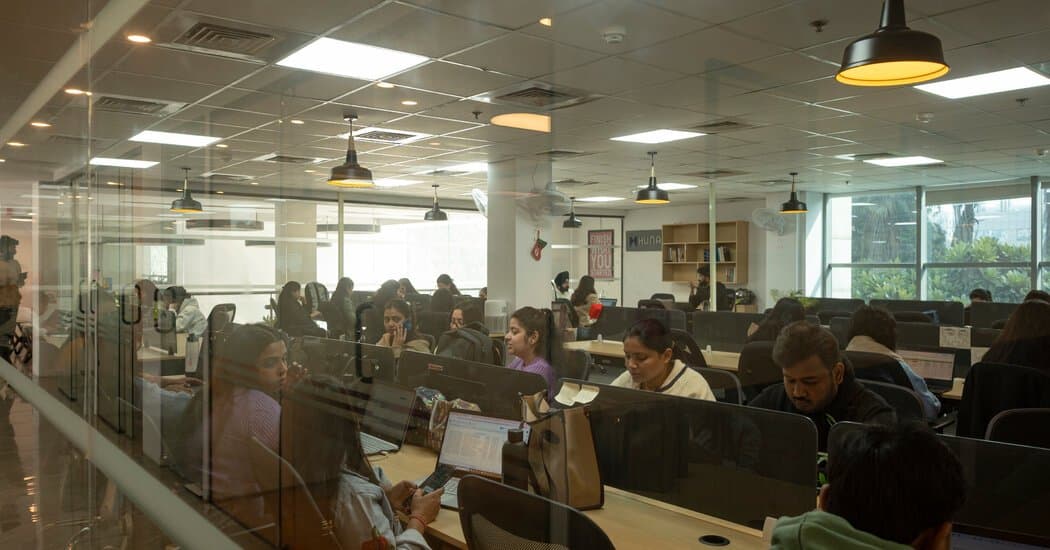
India's massive IT outsourcing sector, employing over 6 million people and worth nearly $300 billion, is racing to adapt as AI threatens to automate white-collar work that has been its core business for decades.
India's outsourcing industry, a cornerstone of the country's economic growth that employs over 6 million people and generates nearly $300 billion annually, is facing an existential threat from artificial intelligence that promises to automate the very white-collar work that has been its bread and butter for decades.
The scale of India's IT services sector cannot be overstated. For 24 years, the industry has maintained unbroken growth in software exports, becoming a global powerhouse in everything from customer service to software development to data analysis. Companies like Tata Consultancy Services, Infosys, and Wipro have built empires on the back of relatively low-cost, high-skill Indian labor that could handle everything from coding to financial analysis for Western companies.
However, the AI revolution is now forcing a reckoning. As one industry observer noted in a fictional memo dated June 2028, "The cost of electricity does not run an enterprise" - a pointed reference to how AI systems, once deployed, can operate continuously without the human costs that have made Indian outsourcing so competitive.
The AI Disruption Is Already Here
The signs of disruption are everywhere. Major technology companies are rapidly integrating AI into their operations, reducing their reliance on human contractors. Microsoft's recent agreement with the Department of Defense to deploy its AI models in classified networks signals a broader trend of AI systems taking over tasks previously handled by human analysts and programmers.
Indian IT companies are scrambling to adapt. Many are investing heavily in AI capabilities, trying to position themselves as AI service providers rather than traditional outsourcing firms. The strategy makes sense - if you can't beat the automation, join it. But the transition is proving difficult and expensive.
The Human Cost
The human impact could be devastating. Unlike previous technological disruptions that created new categories of work even as they eliminated others, AI threatens to be different. When AI can write code, analyze data, and handle customer service as well as humans - and do it 24/7 without breaks - the traditional outsourcing model breaks down.
For the 6 million Indians employed in this sector, many of whom have built careers and middle-class lifestyles around these jobs, the disruption could be catastrophic. Unlike manufacturing jobs that moved overseas, these are white-collar positions that require education and training - the very type of employment that developing economies have relied upon for upward mobility.
The Timeline Question
Industry experts disagree on how quickly this disruption will occur. Some argue that the complexity of enterprise IT systems means human oversight will be needed for years to come. Others point to the rapid improvements in AI capabilities and suggest that significant job losses could begin within the next 2-3 years.
What's clear is that the industry's historical pattern of unbroken growth is over. For the first time in 24 years, software exports from India may face actual decline as companies find ways to automate the work that previously required human contractors.
The Adaptation Challenge
Indian IT companies face a difficult transition. They must simultaneously:
- Invest in AI capabilities to remain relevant
- Retrain their massive workforce for new types of work
- Maintain profitability while transitioning business models
- Compete with both traditional rivals and new AI-native companies
Some companies are exploring partnerships with AI firms, while others are developing their own AI tools. The common thread is that all recognize the need for dramatic change.
The Broader Economic Impact
The disruption extends beyond the IT sector itself. Real estate markets in tech hubs like Bangalore and Hyderabad, which have boomed on the back of the outsourcing industry, could face significant pressure. Local economies that have grown dependent on the spending power of IT professionals may contract.
Moreover, India's economic development strategy, which has relied heavily on becoming the world's back office, may need complete rethinking. The country's ability to provide high-skill employment to its large, educated workforce is now in question.
Looking Forward
The next few years will be critical. If Indian companies can successfully pivot to AI services, they may maintain their dominant position in the global tech services market. If not, they risk being completely disrupted by both Western AI companies and new competitors from other developing nations.
One thing is certain: the era of Indian outsourcing as we know it is ending. Whether the industry can reinvent itself quickly enough to survive remains the billion-dollar question - or in this case, the $300 billion question that will determine the economic future of millions of Indian workers.
As the fictional 2028 memo concluded, the fundamental economics of the industry are changing. When machines can do the work of humans at a fraction of the cost, the traditional outsourcing model simply cannot survive. India's IT giants must now prove they can evolve fast enough to avoid becoming casualties of the very technology they helped bring to the world.
Comments
Please log in or register to join the discussion