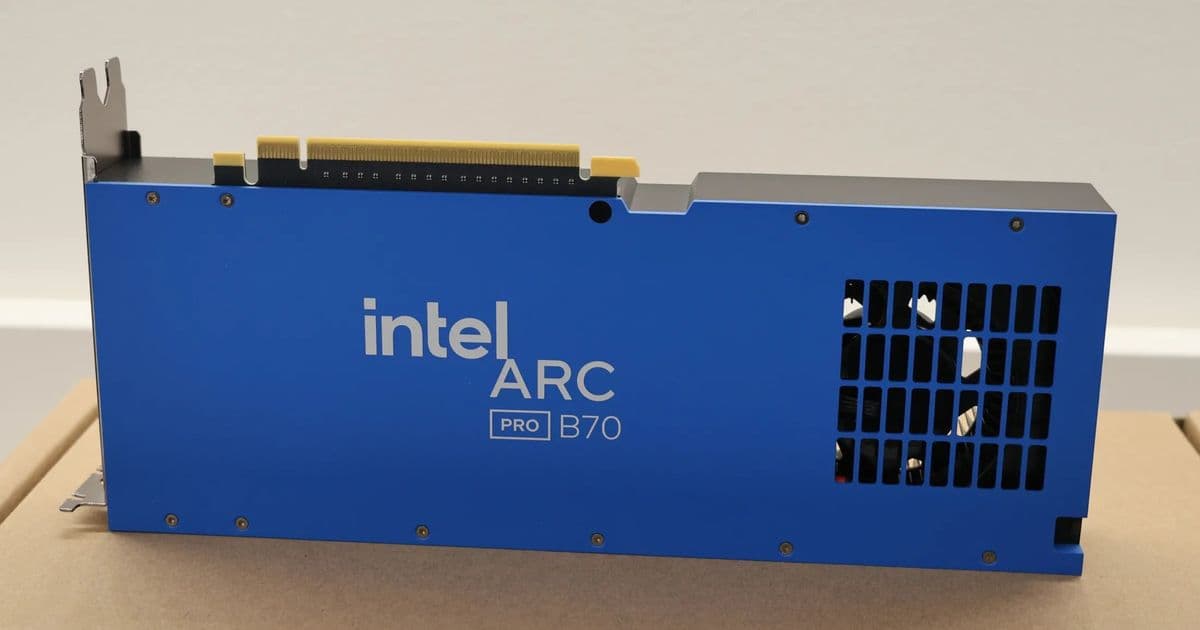
Intel's Arc Pro B70 with 32GB VRAM delivers strong Linux performance across AI workloads, compute tasks, and graphics APIs, though power consumption remains unmeasured.
Intel has finally delivered on the promise of Battlemage with the Arc Pro B70, a professional graphics card featuring 32 Xe cores, 32GB of GDDR6 memory, and a 230W TDP. Last week, Intel sent four B70 cards to Phoronix for Linux testing, providing the first comprehensive look at this hardware on the open-source driver stack.
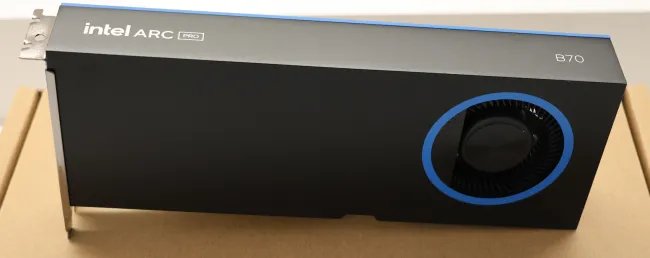
The Arc Pro B70 sits at the top of Intel's professional lineup, offering substantial compute resources with 256 XMX engines for AI acceleration, 32 ray-tracing units, and a 2.8GHz maximum dynamic clock. The 32GB VRAM configuration makes it particularly interesting for AI and machine learning workloads where memory capacity is often the limiting factor.
Testing Setup
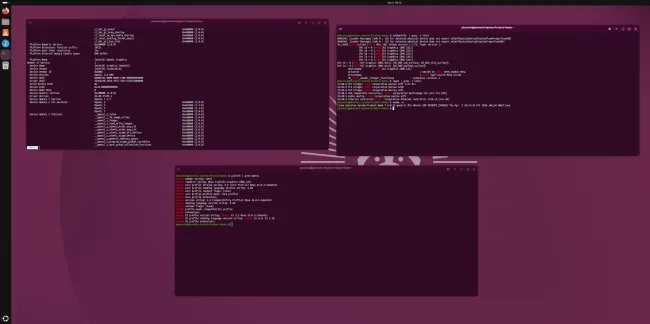
All benchmarks were conducted on Ubuntu 26.04 with Linux 7.0 kernel and Mesa 26.0 graphics drivers. The Intel Compute Runtime 26.09.37435.1 with IGC 2.30.1 compiler was used for GPU compute workloads. The test system featured a Ryzen Threadripper 9980X workstation.
For comparison, the testing included:
- Arc Pro B50
- Arc Pro B70 (test subject)
- Arc B580
- Arc A770
AMD Radeon PRO and NVIDIA RTX hardware testing is ongoing on the same Ubuntu 26.04 stack and will be compared in future articles.
AI and LLM Performance
The Arc Pro B70 showed strong performance in AI workloads, particularly in OpenVINO and Llama.cpp benchmarks. The 32GB VRAM proved beneficial for larger model inference tasks, allowing the card to handle models that would otherwise require multiple GPUs or specialized hardware.
OpenVINO GenAI benchmarks demonstrated the B70's capabilities in Intel's optimized AI framework, with the XMX engines providing efficient inference acceleration. The card's performance scaled well with model complexity, maintaining reasonable throughput even with larger parameter counts.
Llama.cpp testing revealed the B70's versatility across different AI frameworks. The open-source nature of Llama.cpp combined with Intel's open-source Linux driver stack created a seamless testing environment, with the B70 delivering competitive inference times compared to other Arc hardware.
Compute Performance
OpenCL benchmarks showed the B70's strength in general-purpose GPU computing. The 32 Xe cores and robust memory subsystem translated to solid performance across various compute workloads, from scientific computing to image processing tasks.
Specialized benchmarks like FluidX3D, clpeak, and Embree SYCL highlighted the card's capabilities in specific domains. FluidX3D, a computational fluid dynamics application, benefited from the B70's memory bandwidth and compute throughput. Embree SYCL performance demonstrated the card's suitability for ray tracing workloads beyond gaming applications.
Intel's SYCL software stack, including OIDn (Intel Open Image Denoise), OSPRay Studio, and OpenVKL, showed good performance on the B70. These applications are particularly relevant for professional visualization and rendering workflows, where the B70's 32GB VRAM provides a significant advantage.
Graphics Performance
OpenGL and Vulkan benchmarks revealed the B70's graphics capabilities, though these are secondary to its compute and AI strengths. The card performed competitively against other Arc hardware in standard graphics benchmarks, with the open-source Mesa drivers providing stable performance.
Workstation graphics performance testing focused on applications commonly used in professional environments. The B70's large memory capacity proved advantageous in scenarios involving complex 3D models and high-resolution textures.
Blender Performance
Blender testing showed the B70's capabilities in content creation workflows. The card's performance in both GPU rendering and viewport operations was competitive, with the 32GB VRAM allowing for more complex scenes and higher resolution textures without running into memory limitations.
Limitations and Missing Data
One notable gap in this testing is the absence of power consumption measurements. Intel's Xe driver on Linux 7.0 doesn't currently expose power usage through the conventional sysfs interface, preventing accurate power draw measurements during benchmarking.
Additionally, the testing was limited to single-card configurations. Given the B70's target market for professional and AI workloads, multi-GPU performance is crucial, and this testing is still in progress.
Driver and Software Status
A significant positive aspect of the B70 testing was the performance on the fully open-source Linux graphics driver stack. The combination of Linux 7.0 kernel, Mesa 26.0, and Intel Compute Runtime provided a stable and performant environment without requiring proprietary drivers.
This open-source approach is particularly valuable for enterprise and professional users who prioritize long-term support and transparency in their driver stack.
Competitive Landscape
The Arc Pro B70 enters a competitive market for professional graphics cards. While direct comparisons with AMD Radeon PRO and NVIDIA RTX hardware are still pending, the B70's specifications suggest it will compete favorably in AI and compute workloads, particularly where the 32GB VRAM capacity provides a clear advantage.
Future Testing
Additional benchmarks are planned, including:
- Multi-GPU configurations with four B70 cards
- vLLM testing for AI workloads
- Competitive comparisons with AMD and NVIDIA professional hardware
- More comprehensive AI/LLM benchmarks
The Arc Pro B70 represents Intel's most serious push into the professional graphics market to date. With strong AI performance, substantial memory capacity, and solid open-source driver support, it offers a compelling option for Linux-based professional workstations, particularly for AI and compute-intensive workloads.
The full benchmark results and detailed comparisons will be available as testing continues, but initial results suggest the Arc Pro B70 delivers on its promise as a capable professional graphics solution for the Linux ecosystem.
Comments
Please log in or register to join the discussion