
After a decade of marketing slides and documentation references, Intel's Key Protection Technology is getting actual mainline Linux driver support, queued in the cryptodev tree for Linux 7.2 alongside the next-gen Gen6 QAT accelerators.
Intel has been talking about Key Protection Technology (KPT) since at least 2016, when it first showed up in QuickAssist documentation, and it was promoted heavily at the 2017 launch of 1st Gen Xeon Scalable. For anyone running QAT offload in a homelab or a small server rack, the gap between the marketing and the actual upstream driver has been a running joke. That gap is finally closing. A patch series sitting in the kernel crypto subsystem's cryptodev development tree adds KPT support targeting Intel's Gen6 QuickAssist hardware, and it is lined up for Linux 7.2.
{{IMAGE:2}}
What KPT Actually Does
Key Protection Technology keeps encryption keys encrypted by hardware while they are in use, in flight, and at rest. The point is that your private keys never sit in plaintext in host memory. On a normal QAT setup, when you offload TLS handshakes or bulk crypto to the accelerator, the key material has to be handed to the device, and depending on how the stack is built it can be exposed in DRAM where a compromised host or a memory-scraping attack could grab it.
With KPT, the key gets wrapped and the accelerator does the unwrapping internally, so the plaintext form only ever exists inside the protected boundary of the QAT engine. For a server terminating thousands of TLS connections, this is the difference between a host-memory key compromise being catastrophic versus being mostly contained. It is the same general idea behind HSMs and confidential computing, applied to the inline crypto offload path rather than a separate dedicated module.
Why It Took This Long
This is the part that should make any QAT user raise an eyebrow. KPT has been advertised with QAT-enabled Xeon Scalable parts for years, but the mainline Linux QAT driver never actually supported it. Intel's own open-source QATlib library still lists KPT among its limitations, explicitly noting it is not supported.
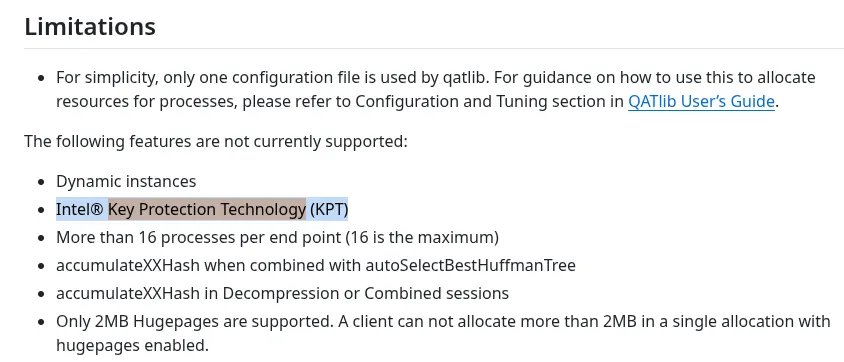
So the feature existed in silicon and in the closed documentation, but if you were running upstream kernels and the open library, you simply could not use it. Searching the current Linux source tree turns up no other Key Protection Technology references outside this new Gen6 work, which strongly suggests this is the first real implementation landing in the open driver rather than an extension of something that was already there.
The likely explanation is that Gen6 brought fundamental KPT improvements that made it practical to wire up cleanly. Intel began adding QAT Gen6 support to the kernel last year and has been steadily exposing new capabilities since, including expanded telemetry and better QAT Zstandard compression handling. KPT fits that pattern of Gen6 being the platform where the full feature set finally shows up in the open driver.
What the Patch Brings
The queued work does a few concrete things in the QAT accelerator crypto driver:
| Component | Purpose |
|---|---|
| New sysfs interfaces | Userspace control and status for KPT on the device |
| Driver infrastructure | Plumbing to handle wrapped key material through the Gen6 engine |
| Gen6 device binding | Ties the KPT path specifically to next-gen QuickAssist hardware |
The sysfs additions are the part most operators will touch directly, giving you a way to query and interact with KPT state per accelerator from userspace rather than needing out-of-tree tooling. The rest is the underlying scaffolding needed before any of the higher-level crypto offload paths can take advantage of protected keys.
Build and Deployment Notes
If you are speccing a Gen6 QAT box, the practical takeaway is to plan around Linux 7.2 as the baseline kernel for KPT-enabled deployments. Earlier kernels with Gen6 support will run the hardware, but without this driver work you do not get the in-memory key protection regardless of what the platform datasheet claims. That is a meaningful distinction for anyone building a system where the threat model includes host memory compromise, such as a multi-tenant box or an edge node in a less trusted physical location.
For existing Gen4 and Gen5 QAT users, this change does not appear to backport. The implementation is scoped to Gen6, so if KPT is a hard requirement for your build, the accelerator generation matters as much as the kernel version. It is worth validating the actual behavior on hardware once 7.2 ships, since a sysfs interface existing and the key-protection path being fully exercised end to end through QATlib are two different milestones, and the library limitations note suggests the userspace side still has catching up to do.
The broader pattern here is Intel using each QuickAssist generation to finally deliver features that were promised generations earlier. KPT joins improved telemetry and Zstd offload as Gen6 era additions that move the open-source QAT stack closer to feature parity with the closed documentation. For homelab builders who have spent years reading about Key Protection Technology in slide decks without being able to enable it on an upstream kernel, Linux 7.2 is the release where that finally changes.
Comments
Please log in or register to join the discussion