
JetBrains has unveiled Air, an agentic IDE built on the abandoned Fleet codebase, marking a significant shift in how AI agents are integrated into development workflows. The tool allows multiple AI agents to run tasks concurrently, supporting major models like OpenAI Codex, Anthropic Claude, and Google Gemini, while raising questions about the future of traditional IDEs.
JetBrains has entered the agentic AI development space with the launch of Air, a new IDE that leverages multiple AI agents to handle concurrent development tasks. The tool, currently in public preview for macOS with Windows and Linux versions coming soon, represents a significant evolution in how developers interact with AI-assisted coding tools.
What is JetBrains Air?
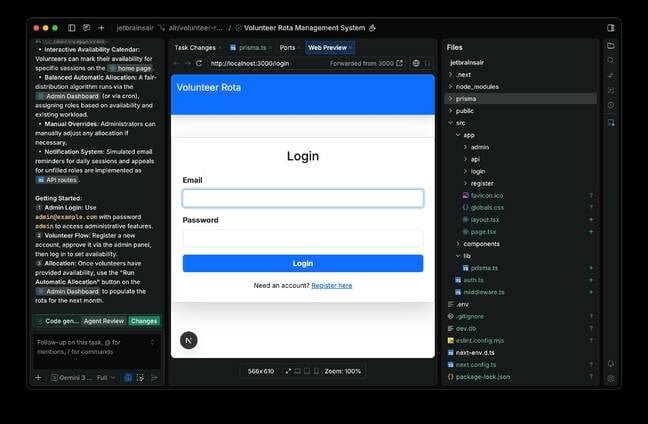
Air is designed to delegate tasks to multiple AI agents running concurrently, allowing developers to switch between tasks, review outputs, and approve changes. The IDE supports major AI models including OpenAI Codex, Anthropic Claude Agent, Google Gemini CLI, and JetBrains' own Junie. It also implements the Agent Client Protocol (ACP), a vendor-neutral protocol for agent-editor communication sponsored by JetBrains and Zed.
The key innovation in Air is its task-based workflow. Users describe tasks to the system, which then executes them using AI agents either directly in a local workspace, within a Git worktree, Docker containers, or (in future releases) cloud containers. A built-in code editor allows for traditional development alongside AI-assisted workflows.
The Fleet Connection
Interestingly, Air isn't entirely new technology. JetBrains has built it on the codebase of Fleet, an abandoned IDE project that was originally conceived as a potential successor to IntelliJ IDEA. Fleet never made it out of preview, but its foundation provides a modern base for Air's agentic capabilities.
This decision highlights the challenges JetBrains faces in balancing its traditional user base with the need to innovate in the AI space. While IntelliJ IDEA remains popular among developers, the rise of AI-assisted coding has fragmented the IDE market, with model providers like Anthropic creating their own development tools.
Junie CLI: Standalone AI Agent
Alongside Air, JetBrains has released Junie CLI, a command-line interface that makes its AI agent "fully standalone." Previously limited to IDE extensions, Junie can now be used independently across macOS, Linux, and Windows. The tool costs between $10 and $60 per month depending on license type, with support for models from OpenAI, Anthropic, Google, and Grok.
Developers have requested support for local models like Ollama and Qwen, though JetBrains has stated this is "an active topic in our planning" without providing an ETA.
The Agentic Development Landscape
The launch of Air comes amid significant changes in the development tools market. A recent Rust survey showed VS Code's dominance declining, while AWS has backed Open VSX as an alternative marketplace. Meanwhile, concerns about AI-generated code persist, with most developers expressing distrust in AI outputs while failing to adequately verify them.
The term "vibe coding" was recently named Word of the Year, reflecting the growing trend of AI-assisted development where developers rely heavily on AI suggestions rather than writing code manually.
What This Means for Developers
For JetBrains' loyal IntelliJ IDEA users, Air represents both opportunity and uncertainty. The company must balance maintaining its traditional IDE while establishing a new AI-centric development environment. This dual approach could lead to fragmentation within JetBrains' own product line.
However, Air's support for multiple AI models and the ACP protocol suggests JetBrains is positioning itself as a neutral platform rather than competing directly with model providers. This strategy could help the company maintain relevance as the development landscape continues to evolve.
Looking Ahead
The agentic IDE space is rapidly evolving, with new concepts emerging faster than they can be validated. JetBrains' move into this space with Air, built on the foundation of Fleet, demonstrates the company's commitment to staying relevant in an AI-driven development future.
As more developers adopt AI-assisted coding tools, the question remains whether traditional IDEs will continue to dominate or if agentic tools like Air will become the new standard. JetBrains' challenge will be to serve both its existing user base and attract new developers looking for AI-native development experiences.
The success of Air will likely depend on how well it balances the needs of traditional developers with the capabilities that AI agents bring to the development process. As the tool moves beyond preview and expands to additional platforms, it will be interesting to see how the development community responds to this new approach to software creation.
Comments
Please log in or register to join the discussion