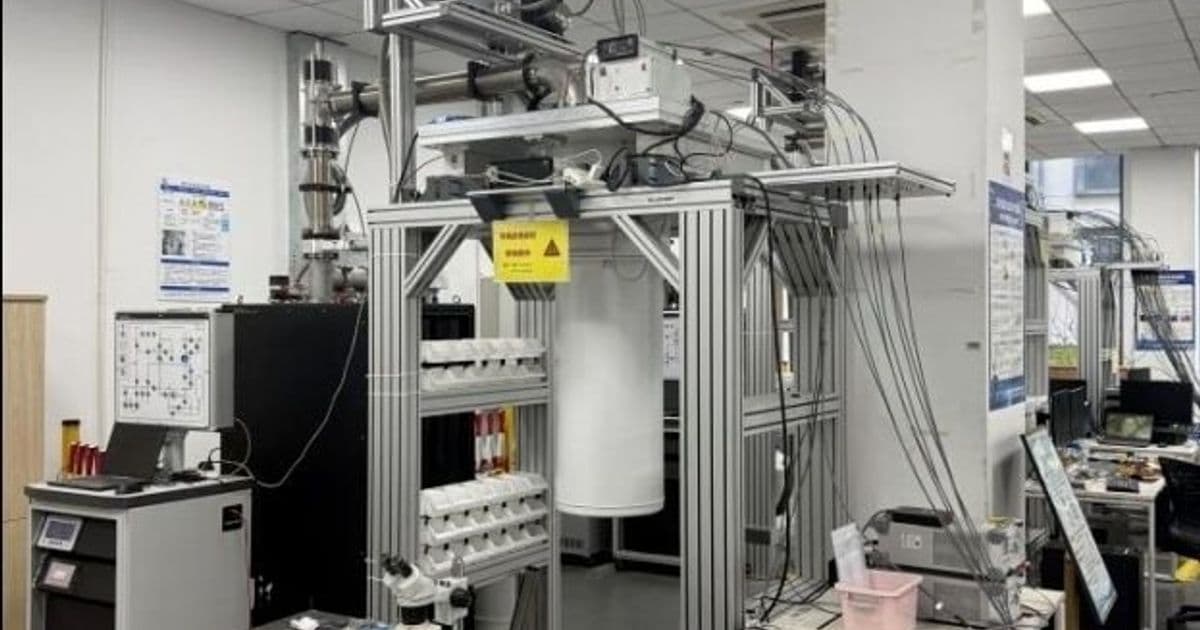
A Chinese quantum computing startup claims to have completed fabrication on an 8-inch semiconductor production line, raising questions about the practicality of quantum chip manufacturing using conventional semiconductor processes.
The recent announcement that Shanghai-based quantum computing startup Juliang Guangqi has raised 200M RMB in an angel round has generated significant attention. The company, co-led by Heli Capital and Junshan Capital with participation from SMIC PE, claims to be China's first superconducting quantum computing company leveraging industrial semiconductor production lines.
What's Claimed
Juliang Guangqi positions itself as "Fairchild Semiconductor in the quantum era," drawing an analogy to the historical moment when eight engineers left Shockley Semiconductor Laboratory to found Fairchild Semiconductor, which later became instrumental in the development of the integrated circuit industry. The company claims to have completed taping out on an 8-inch industrial-grade semiconductor production line in China—a first for the country, according to their announcement.
The startup's founder, Dr. Yu Wenlong, has a background in applied physics from the University of Science and Technology of China and a Ph.D. in physics from Georgia Tech. The company's core team consists of overseas-educated talents, and they've adopted an IDM (Integrated Device Manufacturer) model covering chips, complete machines, and applications.
What's Actually New
The most significant claim is leveraging mature semiconductor industry infrastructure for quantum computing fabrication. Traditional quantum computing research typically occurs in specialized laboratory environments with custom fabrication processes. Juliang Guangqi's approach of using established semiconductor production lines could theoretically offer advantages in scalability and manufacturing consistency.
The technical details remain sparse, but the mention of "silicon-based superconducting quantum computing" suggests they're exploring quantum bits (qubits) fabricated on silicon substrates, possibly using Josephson junction technology. This approach has been explored by research groups and companies like IBM and Google, though with limited success in creating commercially viable systems.
The company's emphasis on industrial production rather than pure research represents a shift in quantum computing commercialization strategy. Most quantum computing companies focus on developing their own proprietary fabrication methods or rely on specialized foundries.
Limitations
Several critical questions remain unanswered:
Technical Feasibility: Superconducting quantum computing requires extremely low temperatures (typically below 20 millikelvin) and precise control systems. Using standard semiconductor fabrication processes doesn't automatically solve these fundamental challenges.
Qubit Quality: The announcement doesn't address qubit coherence times, error rates, or other critical performance metrics that determine the usefulness of a quantum computer. These factors are far more important than fabrication method alone.
Scalability: While 8-inch wafer fabrication is standard for classical semiconductors, quantum computers require thousands of high-quality qubits with precise interconnections. The company hasn't demonstrated the ability to manufacture such systems.
Quantum Advantage: No quantum computing company has yet demonstrated clear quantum advantage—solving practical problems faster than classical computers. Juliang Guangqi would need to overcome this fundamental industry challenge.
Competition: Established players like IBM, Google, Rigetti, and IonQ have invested billions in quantum computing with limited commercial returns. Juliang Guangqi's approach faces significant competition from these well-funded entities.
The analogy to Fairchild Semiconductor is particularly problematic. Fairchild succeeded because they solved a real manufacturing problem for a commercially viable technology (transistors). Quantum computing remains a nascent technology without clear commercial applications.
For investors and industry observers, the key question is whether Juliang Guangqi can translate semiconductor manufacturing expertise into actual quantum computing capability. The company's website and technical publications would provide more insight into their actual progress.
Comments
Please log in or register to join the discussion