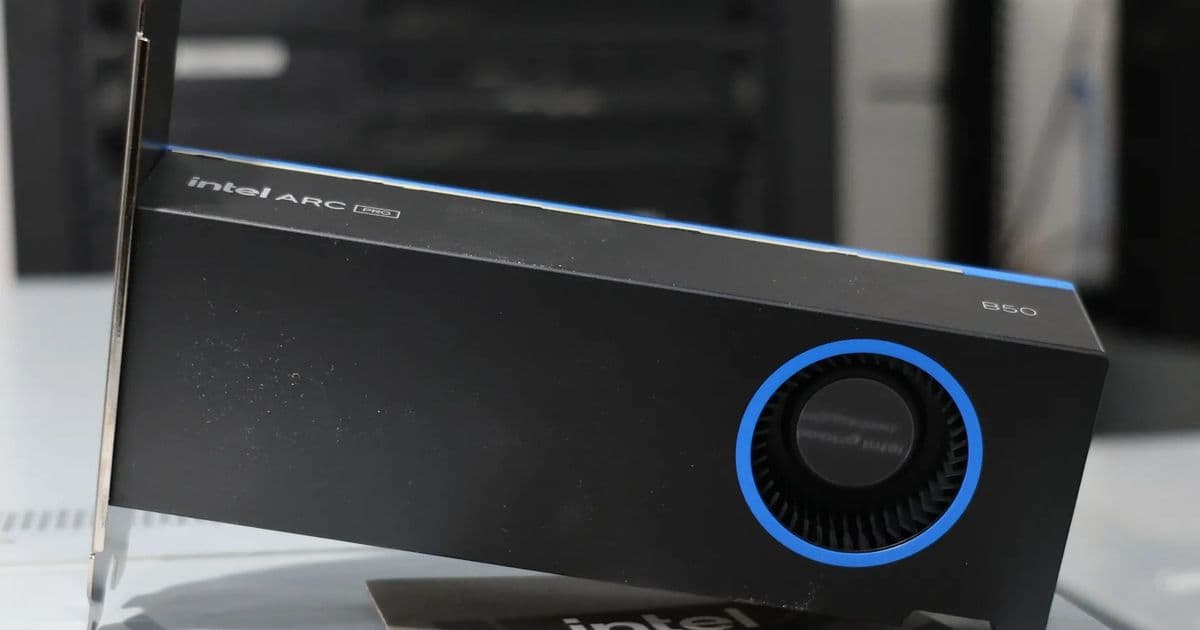
New Linux kernel patches by developer Simon Richter enable firmware updates for Intel Arc discrete GPUs on ARM and RISC-V systems, overcoming a key limitation in heterogeneous computing setups.

The modern Intel Xe kernel graphics driver architecture was designed with cross-platform compatibility as a foundational principle, enabling support for Intel Arc discrete GPUs on non-x86 architectures like ARM and RISC-V. However, until now, one significant limitation persisted: the inability to update GPU firmware on these alternative architectures. Independent developer Simon Richter has addressed this gap with a new patch series currently under review for the Linux kernel.
These patches modify the Intel Management Engine Interface (MEI) driver to function on non-x86 kernels while decoupling ME interfaces from GPU drivers. The changes enable firmware updates for Intel discrete graphics cards like the Arc Pro B50  when installed in ARM-based servers or RISC-V development boards. This firmware update capability is critical for maintaining hardware compatibility, addressing security vulnerabilities, and unlocking performance optimizations delivered through microcode updates.
For homelab builders and performance-focused users, this development removes a major roadblock in heterogeneous system configurations. Enthusiasts running ARM-based Kubernetes nodes or RISC-V development platforms can now incorporate Intel Arc GPUs with confidence that firmware can be updated alongside kernel upgrades. The architectural changes also simplify driver maintenance by reducing x86-specific dependencies in the GPU firmware update pathway.
While current Intel Arc performance on non-x86 platforms already shows promise in compute workloads, firmware update capability ensures these systems can adapt to future optimizations. System builders should monitor kernel release cycles for these patches' inclusion, as firmware updates often deliver tangible performance improvements and hardware bug fixes. The patchset represents another step toward truly architecture-agnostic GPU support in Linux environments.
Technical implementation details show careful restructuring of the MEI driver's hardware access layer, with abstraction layers added to handle architecture-specific communication protocols. This maintains security while enabling the firmware update mechanism to function across different CPU instruction sets. The solution demonstrates how discrete GPU ecosystems can evolve beyond traditional x86 constraints.
For homelab configurations combining ARM SoCs with Intel Arc accelerators, this development enables more flexible GPU passthrough in virtualization setups and ensures long-term hardware support. Performance-focused users should verify firmware versions using tools like intel-gpu-tools when building mixed-architecture systems once these patches reach stable kernels.
Comments
Please log in or register to join the discussion