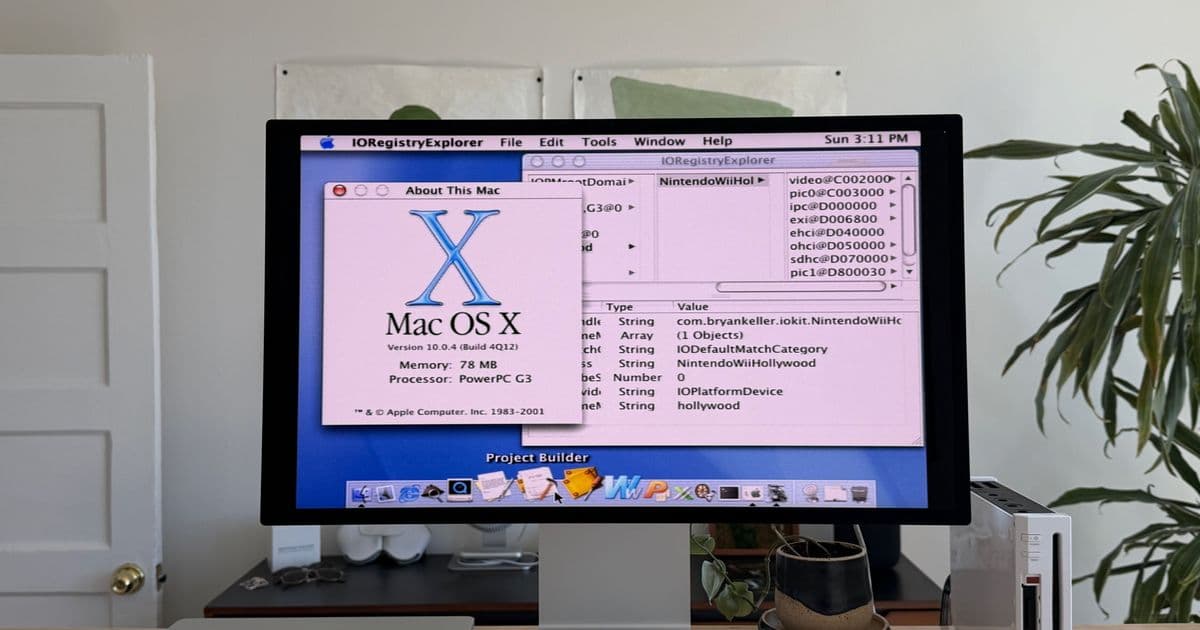
An analysis of Bryan Keller's remarkable achievement in porting Mac OS X 10.0 Cheetah to the Nintendo Wii, exploring the technical challenges, solutions, and broader implications of this unconventional operating system transplantation.
In the realm of retro computing experiments, few projects capture the imagination quite like running an operating system on hardware it was never designed for. Bryan Keller's successful port of Mac OS X 10.0 Cheetah to the Nintendo Wii represents not just a technical curiosity, but a masterclass in understanding the fundamental relationship between software and hardware. This achievement demonstrates how deep knowledge of both operating system architecture and hardware implementation can enable seemingly impossible feats of software transplantation.
The core argument behind this project lies in its exploration of compatibility boundaries—what happens when we take an operating system designed for PowerPC Macs and adapt it to run on a gaming console with a different hardware architecture? The answer reveals much about the flexibility of operating system components and the specific points where hardware abstraction breaks down.
At the heart of this technical endeavor was the fundamental challenge of bridging two different hardware ecosystems. The Wii, with its PowerPC 750CL processor and unique memory configuration (88MB split across 24MB of 1T-SRAM and 64MB of GDDR3), presented both opportunities and obstacles. The processor compatibility was straightforward—an evolution of the PowerPC 750CXe used in G3 Macs—while the unconventional memory layout required careful navigation. The author's approach of testing Mac OS X Cheetah with 64MB of RAM in QEMU before attempting the real hardware port demonstrates a methodical approach to problem-solving, establishing feasibility before committing to the complex task.
The bootloader development represents one of the most fascinating aspects of this project. Rather than attempting to port Open Firmware or modify BootX, Keller wisely chose to develop a custom bootloader from scratch. This decision eliminated unnecessary complexity while providing complete control over the boot process. The bootloader's responsibilities—hardware initialization, kernel loading via Mach-O format parsing, device tree construction, and kernel invocation—formed the critical foundation upon which the entire port rested. The clever hack of using LED blinking to trace kernel execution progress highlights the ingenuity required when traditional debugging methods are unavailable.
Kernel patching emerged as another significant technical challenge. The XNU kernel's assumptions about memory layout, particularly Block Address Translations (BATs), conflicted with the Wii's memory architecture. The solution required not just patching but creating a specialized development environment: a Mac OS X Cheetah guest running on QEMU, with source code shared via NFS between host and guest. This setup enabled the iterative process of identifying and fixing compatibility issues while maintaining visibility into the boot process.
The driver development portion of the project reveals the true complexity of operating system transplantation. Unlike straightforward hardware compatibility layers, Mac OS X uses IOKit—a sophisticated object-oriented driver framework. Creating drivers for the Wii's Hollywood SoC required implementing entirely new driver families rather than leveraging existing ones. The Hollywood driver, which serves as the foundation for all other Wii hardware drivers, exemplifies this approach by publishing nubs for child devices that other drivers could attach to.
The SD card driver implementation presents an interesting case study in hardware abstraction. By utilizing the IPC functionality provided by MINI on the Starlet coprocessor, the driver could communicate with the SD card through memory-mapped I/O. The challenge of cached memory—where the PowerPC CPU might read stale data from its cache instead of newly loaded contents from RAM—required careful management of uncached memory regions. This problem exemplifies the subtle but critical details that must be addressed when adapting software to new hardware.
The framebuffer driver development showcases another fascinating technical solution: the dual-framebuffer strategy. The Wii's video hardware expects YUV pixel data, while Mac OS X provides RGB data. The elegant solution involved maintaining two framebuffers—one in RGB format for Mac OS X and one in YUV format for the Wii—with periodic conversion between them. This approach, inspired by the Wii Linux project, demonstrates how hardware incompatibilities can be overcome with clever software solutions.
The USB support implementation reveals the limitations of working with incomplete source code. The absence of IOUSBFamily source code for Mac OS X Cheetah forced creative workarounds, including creating a fake PCI device nub and patching binaries without access to original source. The endianness issue—where the Wii's "reversed-little-endian" hardware clashed with IOUSBFamily's assumptions—further complicated the implementation, highlighting how subtle hardware characteristics can derail software compatibility.
The implications of this project extend far beyond its technical achievements. First, it demonstrates the remarkable flexibility of operating system components when properly understood. By carefully separating drivers from the kernel and implementing hardware-specific abstractions, Keller showed how even complex systems can be adapted to unexpected hardware. Second, the project provides valuable insights into the boot process of classic Mac OS, shedding light on components like Open Firmware, BootX, and XNU that many developers have never examined closely.
From a broader perspective, this work contributes to the field of operating system archaeology—preserving and understanding historical systems by running them on modern or alternative hardware. The techniques developed here could potentially enable other PowerPC-based operating systems to run on the Wii, expanding the possibilities for retro computing experiments.
Counter-perspectives to this project, however, highlight its limitations as a practical endeavor. The performance constraints of Wii hardware make it more of a technical demonstration than a viable computing platform. The limited functionality—particularly the incomplete USB support—means the system remains more of a curiosity than a practical tool. Additionally, the specialized knowledge required to replicate or build upon this project places it beyond the reach of most developers, limiting its broader impact.
The project's evolution from a kernel-centric approach to a bootloader-driver separation also reveals important design considerations for operating system transplantation. By moving drivers out of the kernel, Keller not only simplified the kernel modifications but also created a more modular system that could potentially support other Mac OS X versions with different driver architectures.
In conclusion, Keller's port of Mac OS X to the Wii represents a significant technical achievement that demonstrates both the possibilities and limitations of operating system transplantation. The project's true value lies not in creating a practical alternative to traditional Mac hardware, but in the deep understanding it provides about the relationship between software and hardware. As computing continues to evolve with new architectures and platforms, the techniques and insights gained from such projects will remain valuable for understanding the fundamental principles that underpin all operating systems.
For those interested in exploring this project further, the wiiMac bootloader repository provides instructions for attempting the port yourself. The XNU source code remains available for those interested in studying the kernel that was modified, while IOKit documentation offers insights into the driver framework that enabled this remarkable achievement.
Comments
Please log in or register to join the discussion