
Meta CEO Mark Zuckerberg has unveiled Muse Spark, the company's first proprietary AI model, marking a significant shift from its previously open-source Llama approach. The model, which cannot be downloaded or self-hosted, represents Meta's new dual-track strategy of maintaining both open and closed AI development.
Meta's latest AI model, Muse Spark, represents a significant departure from the company's previously championed open-source approach, marking a strategic pivot that has left many in the tech community questioning the company's commitment to transparency in artificial intelligence development.
The Open Source Promise That Wasn't
Nearly two years ago, Mark Zuckerberg positioned Meta as a champion of open-source AI, publishing a manifesto titled "Open Source AI is the Path Forward" that extolled the virtues of transparent development. In that document, Zuckerberg argued that open-source AI represented "the world's best shot at harnessing this technology to create the greatest economic opportunity and security for everyone."
The social media magnate drew parallels between open-source AI and the rise of Linux, suggesting that Meta's approach would foster innovation and prevent the concentration of AI power in the hands of a few large corporations. "If we were the only company using Llama, this ecosystem wouldn't develop and we'd fare no better than the closed variants of Unix," he wrote at the time.
However, the reality of Meta's AI strategy has proven more complex than Zuckerberg's initial vision. The company's decision to keep Muse Spark's weights proprietary and limit access to its AI portal or API represents a stark contrast to the open approach that characterized the Llama family of models.
From Llama to Muse: A Strategic Shift
Muse Spark, developed by Meta's newly formed Superintelligence team, is described as the "first step on our scaling ladder and the first product of a ground-up overhaul of our AI efforts." The model's proprietary nature marks a significant departure from Meta's previous approach, where Llama models were available for download and self-hosting.
This shift appears to be driven by several factors. First, Meta's Llama 4 family, despite being heavily hyped for its multimodal and agentic capabilities, failed to meet expectations. The company ultimately abandoned development of its largest variant, codenamed Behemoth, which was planned to have 2 trillion parameters.
The disappointing performance of Llama 4 was apparently significant enough to prompt Meta to start over from scratch, recruiting top AI talent including Alexandr Wang to lead the new Superintelligence Labs division.
The Dual-Track Strategy
Meta's approach to AI development now appears to be following a dual-track strategy, maintaining both open and closed models. This isn't unprecedented in the industry – Google regularly releases small open weights models derived from its larger proprietary Gemini models, with its Gemma 4 family being the latest example. OpenAI has made similar moves with gpt-oss, though the long-term commitment to that approach remains unclear.
Zuckerberg has attempted to reassure the open-source community that this shift doesn't represent a complete abandonment of transparent development. "Looking ahead, we plan to release increasingly advanced models that push the frontier of intelligence and capabilities, including new open source models," he wrote in a Threads post.
However, the question remains: if Zuckerberg truly believed in the merits of open-source AI as he articulated in 2024, why pursue a closed model strategy at all? The answer likely lies in the competitive pressures of the AI race and the desire to maintain proprietary advantages in a rapidly evolving field.
Technical Capabilities and Performance Claims
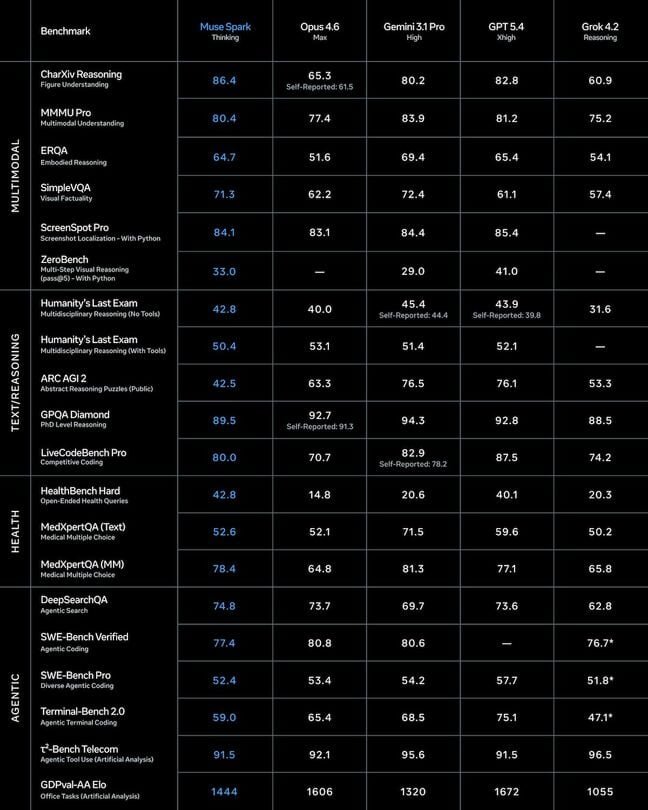
Despite the philosophical questions surrounding its development approach, Meta claims that Muse Spark represents a significant technical achievement. The company asserts that the model's performance matches and in many cases exceeds that of top models from OpenAI, Anthropic, and Google.
Meta has introduced several innovative features in Muse Spark, including:
- A "contemplating mode" that orchestrates multiple reasoning agents working in parallel
- Tool-use capabilities
- Visual chain of thought processing
- Multi-agent orchestration
The company claims that Muse Spark was also more efficient to train than its predecessors, demonstrating that "we can reach the same capabilities with an order of magnitude less compute than our previous model."
However, these claims should be viewed with some skepticism given Meta's history of benchmark controversies. The company was previously accused of manipulating results to make Llama 4 appear more competitive than it actually was.
Access and Availability
Unlike Llama models, Muse Spark is not available for download or self-hosting. Access is limited to Meta's AI portal or API access for those who receive an invitation. This restricted availability has drawn comparisons to the exclusivity of Zuckerberg's private school, highlighting the contrast with Meta's previous open approach.
The contemplating mode, one of Muse Spark's most touted features, won't be available immediately but will "roll out gradually in meta.ai."
The Business Case for Proprietary AI
Meta's shift toward proprietary models reflects broader trends in the AI industry. While open-source development can foster innovation and community engagement, proprietary models offer several advantages:
- Control over distribution and usage
- Protection of intellectual property
- Ability to monetize through API access
- Reduced risk of misuse or malicious applications
For a company like Meta, which has faced numerous controversies regarding data privacy and content moderation, maintaining control over its most advanced AI models may be seen as a necessary precaution.
Looking Forward
Muse Spark is just the first in what Meta promises will be a new line of Muse models, with larger variants already in development. Unlike the abandoned Behemoth project, these future models may actually see the light of day.
The success of this new approach will likely determine whether Meta continues down the path of proprietary AI development or returns to its open-source roots. If Muse Spark delivers on its performance promises and proves commercially viable, it could signal a permanent shift in Meta's AI strategy.
However, if the model fails to gain traction or if the open-source community continues to drive innovation more effectively, Zuckerberg may find himself returning to the principles he once championed. The AI landscape is still evolving rapidly, and the balance between open and closed development remains a subject of intense debate.
For now, Meta's AI future appears to be a hybrid one, with both open and closed models playing important roles. Whether this approach will prove sustainable or whether the company will ultimately have to choose a side remains to be seen.
What's clear is that the idealistic vision of open-source AI as the sole path forward has given way to the pragmatic realities of competitive technology development. In the high-stakes world of artificial intelligence, even the most ardent supporters of openness may find themselves building walls when the pressure to compete becomes intense enough.
As Meta continues to invest billions in AI development, the success or failure of Muse Spark will be closely watched as a test case for the viability of proprietary AI models in an industry that was once dominated by open-source approaches.
Comments
Please log in or register to join the discussion