Microsoft wants partners to prove they can move Copilot and agent projects from pilots into governed production work.
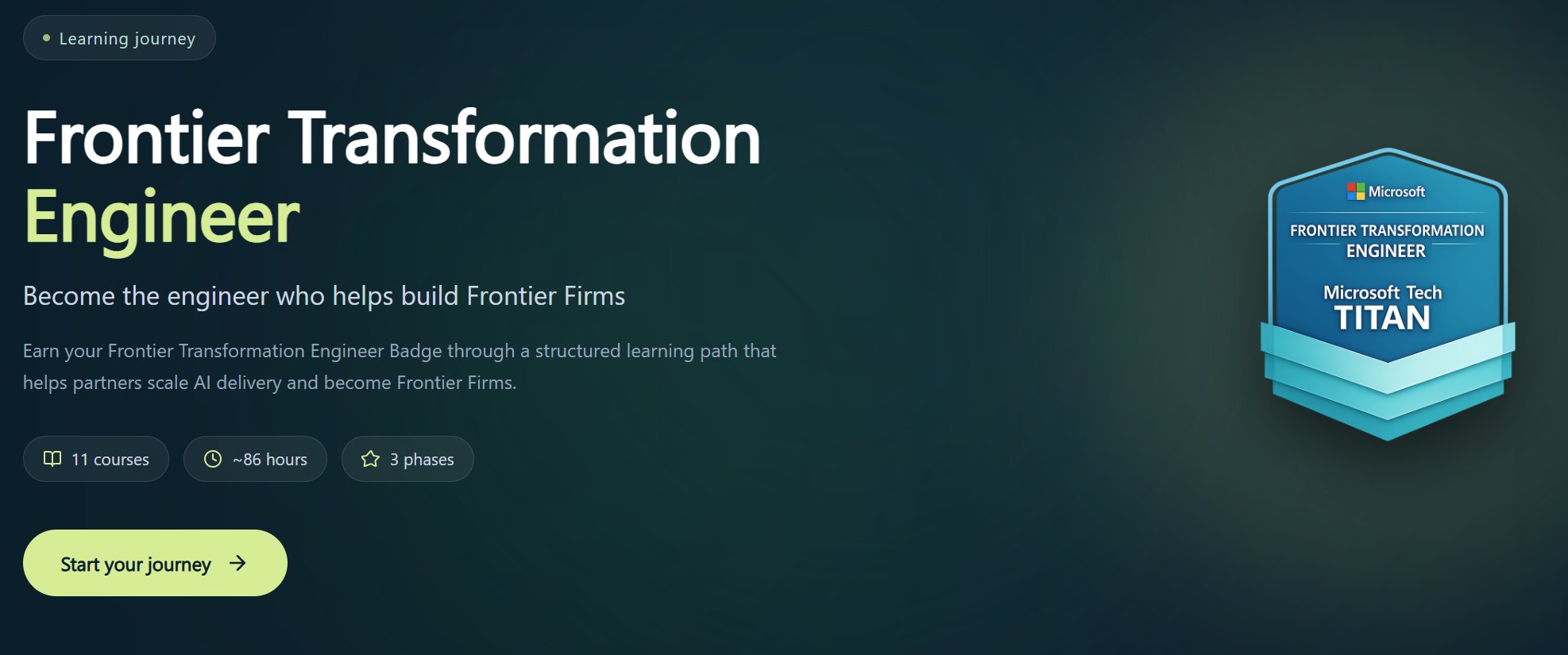
Microsoft has introduced the Frontier Transformation Engineer badge for partner specialists who build agent-based AI systems, Microsoft Copilot deployments and customer transformation programs.
The badge gives Microsoft partners a new way to show AI delivery skill as customers ask for production systems, security controls and measurable business outcomes. Microsoft points partners to the Frontier Partner Skilling path, the Frontier learning path and its 2026 skilling update.
Microsoft's update
Microsoft frames Frontier Transformation as the shift from AI pilots to broad operating change. That framing fits the market. Customers have run chat demos, document assistants and proof-of-concept agents. Many now need identity design, data controls, audit trails, cost management and adoption plans.
The Frontier Transformation Engineer badge targets solution architects, cloud architects, data and AI specialists, security specialists, Copilot builders, agent developers and senior consultants. Microsoft wants those workers to combine certifications, implementation patterns and customer delivery experience.
Partners should treat the badge as a sales and delivery asset. A badge will not replace references or architecture reviews, but it can help a partner prove that its team has studied Microsoft's preferred patterns for Copilot, Azure AI and agent governance.
Provider comparison
Microsoft has an advantage with customers that already run Microsoft 365, Entra ID, Purview, Defender, Fabric, GitHub and Azure. Those customers can connect Copilot and agent projects to identity, compliance and productivity workflows that their IT teams know. A partner can use that installed base to shorten procurement and migration planning.
Amazon Web Services gives partners a broad AI platform through Amazon Bedrock, SageMaker, Q and its data services. AWS fits customers that built their core workloads around S3, IAM, Lambda, EKS and Redshift. AWS partners often lead with model choice, infrastructure control and application modernization.
Google Cloud brings Gemini, Vertex AI, BigQuery and strong data engineering tools. Google fits customers that want analytics-led AI programs, large search and knowledge systems, or AI work tied to data warehouses and machine learning pipelines.
Microsoft's partner badge gives Microsoft a channel advantage rather than a model advantage. OpenAI, Anthropic, Google and other model providers keep changing the model layer. Partners win customer trust when they connect models to business processes, security rules and support models. Microsoft wants its partners to prove that skill inside the Microsoft ecosystem.
Pricing and commercial planning
Partners should connect the badge to pricing conversations. AI pilots often hide the full cost of production because teams test with narrow data sets and small user groups. Production work adds model usage, orchestration, monitoring, security review, data preparation, change management and support.
Microsoft customers may face costs across Copilot licenses, Azure AI services, Azure compute, search, storage, Fabric, Purview and integration work. Partners should map those costs before they propose a rollout. A Copilot extension that serves 50 users can look cheap during a pilot, then expose new costs when a business unit adds thousands of users and connects more data sources.
AWS and Google Cloud customers face the same pattern. Model calls, vector storage, retrieval pipelines, fine-tuning, evaluation and governance tooling all add cost. Cloud architects should give buyers a usage model, not a single monthly estimate. That model should show user count, request volume, data size, latency needs and compliance controls.
Migration considerations
Frontier Transformation work rarely starts with a clean slate. Customers bring legacy document stores, SharePoint sites, file shares, CRM records, ticket systems and custom applications. Partners need to decide which sources belong in the first release and which sources require cleanup.
Identity and access control should lead the plan. If a user cannot open a document in SharePoint, an agent should not summarize it. If a team restricts customer records in Dynamics 365, a Copilot workflow should honor the same boundary. Partners should test permission trimming before they invite business users into a pilot.
Data quality comes next. Agents fail when source systems contain stale policies, duplicate customer records or vague process notes. A partner should include data owners in the project plan and give them concrete cleanup tasks. That work can slow the first release, but it protects customer trust.
Partners also need an exit and portability plan. A customer may start with Microsoft Copilot Studio, then add Azure AI Foundry, GitHub or a third-party framework. Another customer may keep Microsoft 365 Copilot for productivity work and use AWS or Google Cloud for data science. A sound architecture keeps prompts, evaluations, connectors and observability practices clear enough for future changes.
Business impact
Microsoft's badge gives partner leaders a way to sort talent and shape training budgets. A partner can identify architects and consultants who already handle Copilot, agents, security and data integration, then move them through the Frontier path.
Sales teams can use the badge in account planning. Instead of pitching AI as a demo, they can ask buyers which workflow needs a governed agent, which business metric needs improvement and which risk team must approve the design.
Customers will still judge partners by delivery. The badge can open a conversation, but project results will decide renewals. Partners that pair the badge with strong architecture reviews, cost models and adoption plans will stand out in Microsoft's channel.
Comments
Please log in or register to join the discussion