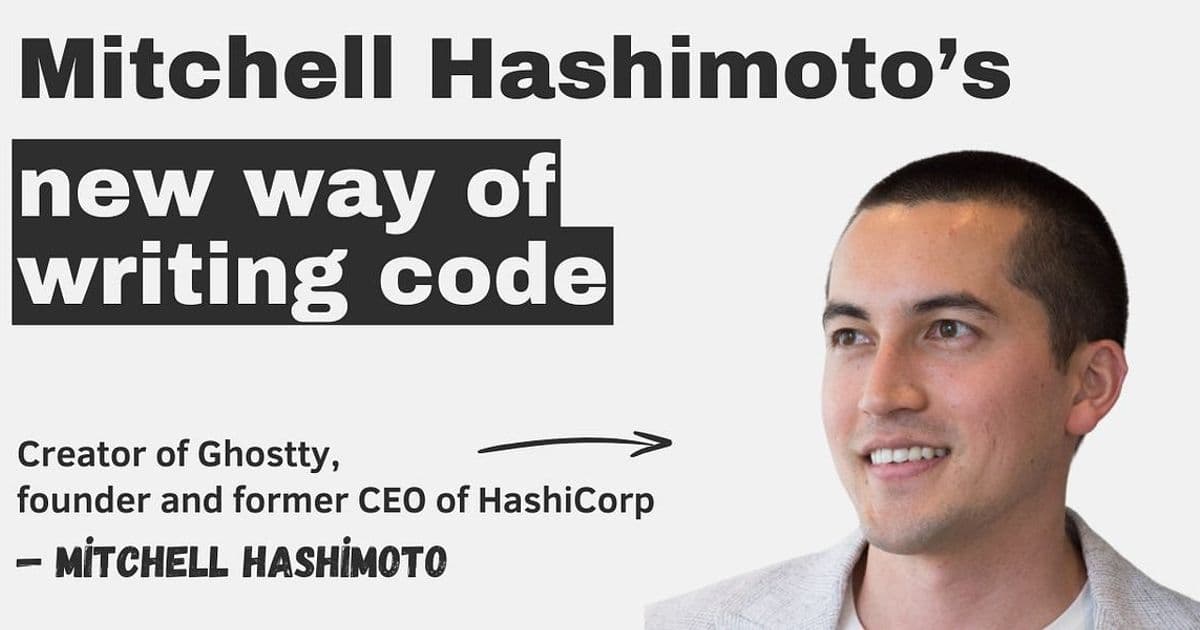
HashiCorp's co-founder reveals how AI agents have fundamentally transformed his coding workflow, from background research to continuous code review, while sharing insights on open source's future and the challenges of building infrastructure tools.
Mitchell Hashimoto, co-founder of HashiCorp and creator of Ghostty, has completely reimagined how he approaches software engineering in the age of AI. In a recent conversation with Gergely Orosz, Hashimoto revealed that AI agents have transformed his day-to-day workflow in ways that go far beyond simple code generation.
The New Engineering Workflow
Hashimoto's approach is methodical and continuous. "If I'm coding, I want an agent planning. If they're coding, I want to be reviewing," he explains. This creates a constant feedback loop where AI handles background tasks while he focuses on high-level decisions.
His workflow includes kicking off research tasks before leaving the house. While driving or away from his desk, agents analyze edge cases, compare libraries, and prepare groundwork for when he returns. This asynchronous collaboration means work progresses even when he's not actively coding.
Open Source in the AI Era
The rise of AI has fundamentally changed how Hashimoto views open source contributions. "Open source has always been a system of trust. Before, we've had default trust. Now it's just default deny." The reason is simple: AI makes it trivial to create plausible-looking but incorrect contributions.
This shift from "default trust" to "default deny" represents a philosophical change in how open source projects will need to operate. Projects must now assume that contributions could be AI-generated and potentially flawed, requiring more rigorous verification processes.
Git's Impending Transformation
Hashimoto predicts that Git and GitHub may not survive the agentic era in their current form. The problem is scale: agents cause so much churn that merge queues become untenable, branches proliferate, and repositories balloon in size.
He compares the needed shift to Gmail's revolution for email: "We're at the Gmail moment for version control... never delete, archive everything." The current model of branch-based development simply won't scale when AI agents are making thousands of micro-changes.
The Best Engineers Are Invisible
One of Hashimoto's most surprising insights concerns hiring. The best engineers he's ever hired had "boring, invisible backgrounds." They don't have social media profiles, no GitHub contributions, and work at companies you've never heard of.
"Every moment you spend on social media is taking away from something else... the best engineers are the ones that context-switch the least." These engineers focus entirely on their work rather than building personal brands or contributing to open source projects.
Advice for AI-Skeptical Engineers
For engineers hesitant about AI adoption, Hashimoto recommends starting with research tasks rather than code generation. "There's a lot of people like, 'I don't want it to write code for me.' But just delegate some of the research part."
He uses agents for library comparisons, edge-case analysis, and deep research—tasks that traditionally required hours of manual investigation. This approach allows engineers to benefit from AI without feeling like they're being replaced.
The HashiCorp Journey
Hashimoto's experience building HashiCorp provides valuable context for understanding today's AI transformation. The company had no real business for four years, and their first commercial product was a complete failure. Atlas, which required customers to adopt the entire HashiCorp stack, created an unsolvable internal budget problem.
The pivot to selling individual services like Vault proved successful, but the journey was filled with near-misses. VMware almost acquired HashiCorp for $100 million when it was only three people—a deal that would have prevented Terraform from ever existing.
What This Means for Engineering
Hashimoto's transformation represents a broader shift in how software engineering will be practiced. The role is evolving from writing code to orchestrating AI agents, from manual research to automated investigation, and from individual contribution to continuous collaboration with intelligent systems.
The engineers who thrive in this new environment will be those who can effectively delegate to AI while maintaining oversight and quality control. They'll need to understand not just how to write code, but how to direct and review AI-generated work.
As Hashimoto puts it, the future of engineering isn't about replacing humans with AI—it's about creating a symbiotic relationship where each handles what they do best. Humans provide direction, judgment, and creativity, while AI handles execution, research, and repetitive tasks.
The transformation is already underway, and engineers who adapt to this new paradigm will find themselves more productive and effective than ever before.
Comments
Please log in or register to join the discussion