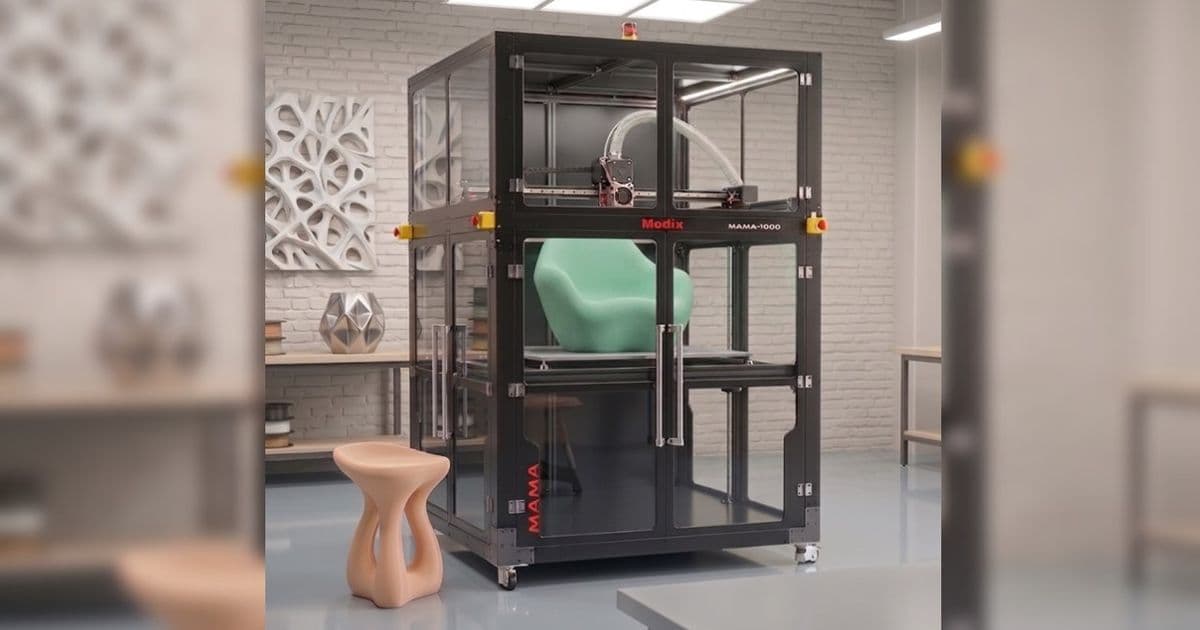
Modix’s new MAMA‑1000 combines a 1 m³ build envelope with a high‑throughput DYZE Design Pulsar pellet extruder capable of 3 kg/h material feed, while retaining the option to switch to standard filament. Priced from $35,000, the machine targets industrial designers, furniture makers, and large‑scale artists who need fast, low‑cost polymer processing.
Announcement
Modix has unveiled the MAMA‑1000, a compact member of its MAMA family that promises one‑cubic‑meter prints using pellet extrusion. The system ships fully assembled for a base price of $35,000, which includes professional installation and a warranty. By marrying a large build volume with a high‑throughput pellet head, Modix aims to give manufacturers and creators a faster, cheaper alternative to traditional filament printers for parts such as tables, chairs, and life‑size statues.
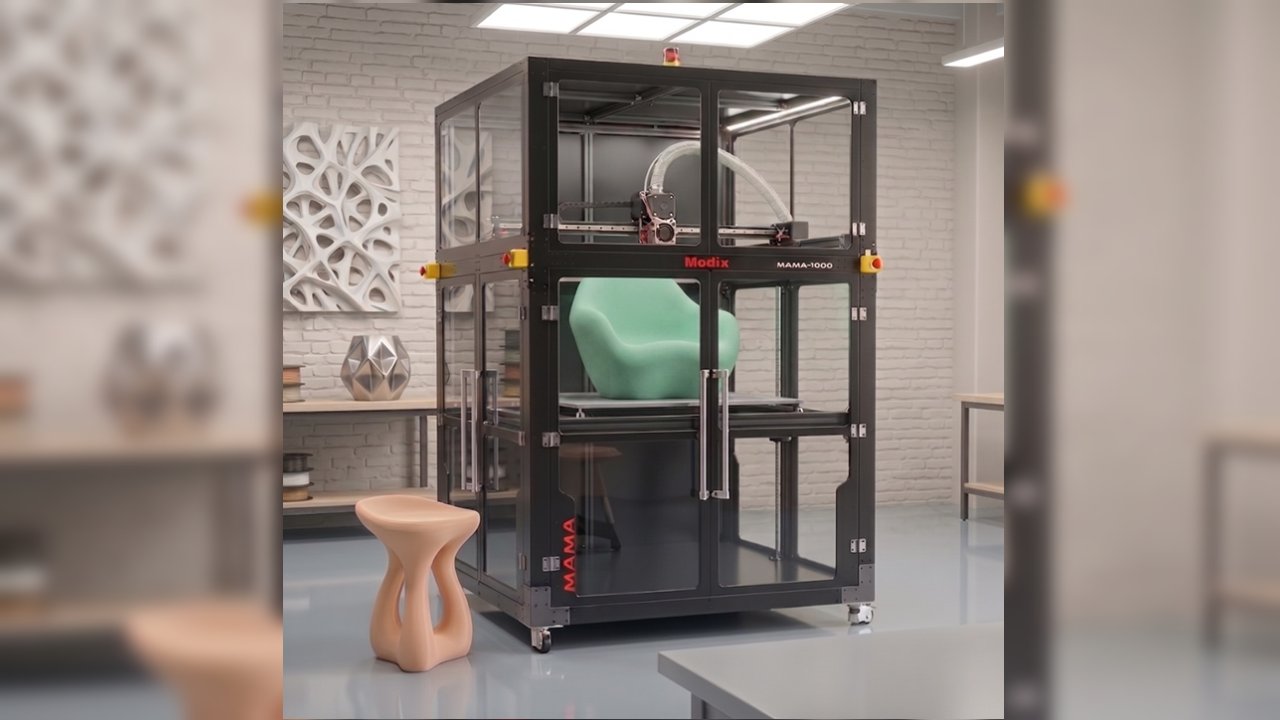
Technical specifications
Pellet extrusion core
- Print head: DYZE Design Pulsar pellet extruder (Canadian‑made)
- Nozzle size: 3 mm–5 mm (standard) – up to 10× the diameter of typical 0.4 mm desktop nozzles
- Heating zones: Three independent zones for precise melt temperature control
- Feed mechanism: Screw‑driven feeder powered by compressed air, delivering up to 3 kg of polymer per hour
- Materials: PLA, PETG, ABS, Nylon, and specialty engineering pellets; bulk PLA can be sourced for ≈ $2 /kg
Dual‑mode capability
- Filament swap: Optional Griffin Ultra head accepts 1.75 mm filament with a 1.6 mm nozzle for fine‑detail work.
- Motor control: Closed‑loop NEMA‑23 stepper motors provide sub‑0.1 mm positioning repeatability, mitigating the larger inertia of a 1 m³ gantry.
Build envelope and mechanics
- Volume: 1 m × 1 m × 1 m (exactly 1 cubic meter)
- Frame: Rigid aluminum extrusion with reinforced cross‑bracing to limit deflection under the weight of large prints.
- Enclosure: Fully sealed, temperature‑controlled chamber; optional 25 kg dryer and pigment mixer can be integrated for on‑the‑fly color blending.
- Dual‑extruder option: IDEX‑style heads enable simultaneous support generation or multi‑material prints.
Throughput comparison
| Machine | Nozzle (mm) | Max material feed | Typical print speed* |
|---|---|---|---|
| Modix MAMA‑1000 (pellet) | 3–5 | 3 kg/h | 150 mm³/s (large fills) |
| Orange Storm Giga (filament) | 0.4 | 0.2 kg/h | 30 mm³/s |
| Typical desktop (0.4 mm) | 0.4 | 0.05 kg/h | 10 mm³/s |
| *Speeds are illustrative; actual rates depend on part geometry and material. |
Market implications
Cost per kilogram
Because pellets bypass filament winding, the material cost drops from $20–$30 /kg for premium filament to $2–$5 /kg for bulk pellets. At a 3 kg/h feed rate, a 10‑hour print consumes roughly 30 kg of polymer, translating to $60–$150 in raw material versus $600–$900 for filament equivalents. For manufacturers producing large furniture components or architectural models, the MAMA‑1000 can reduce material spend by 80 %.
Production speed vs. precision
The 3 mm–5 mm nozzle sacrifices fine detail; surface roughness typically lands in the 200–300 µm range. However, the optional Griffin Ultra head restores desktop‑level resolution (≈ 50 µm) for critical features, allowing a hybrid workflow: bulk fill with pellets, then switch to filament for mating surfaces or aesthetic details.
Competitive positioning
Modix’s pricing places the MAMA‑1000 above entry‑level large‑format printers (often <$15K) but well below industrial pellet systems from companies like 3D Systems or Stratasys, which can exceed $150K. The $35K price point therefore targets midsize firms, design studios, and high‑end makerspaces that need volume without the capital outlay of a full production line.
Supply chain considerations
Pellet availability aligns with the broader plastics supply chain, meaning users can source material from the same distributors that service injection‑molding plants. This reduces lead times compared with filament, which often requires specialty spooling and can be subject to import bottlenecks. Additionally, the optional dryer and pigment mixer give manufacturers in‑house control over moisture content and color, further insulating them from external variability.
Outlook
If the MAMA‑1000 can deliver on its promised throughput and reliability, it could accelerate the adoption of pellet‑based additive manufacturing in sectors that currently rely on CNC machining or injection molding for large parts. The hybrid filament/pellet capability also offers a migration path for companies already invested in filament workflows. As bulk polymer prices remain stable and the ecosystem around pellet extrusion matures, the economic advantage of printing at $2‑$5 /kg versus filament’s $20‑$30 /kg is likely to become a decisive factor for large‑scale makers.
For further details, see Modix’s official product page and the DYZE Design technical brief.
Comments
Please log in or register to join the discussion