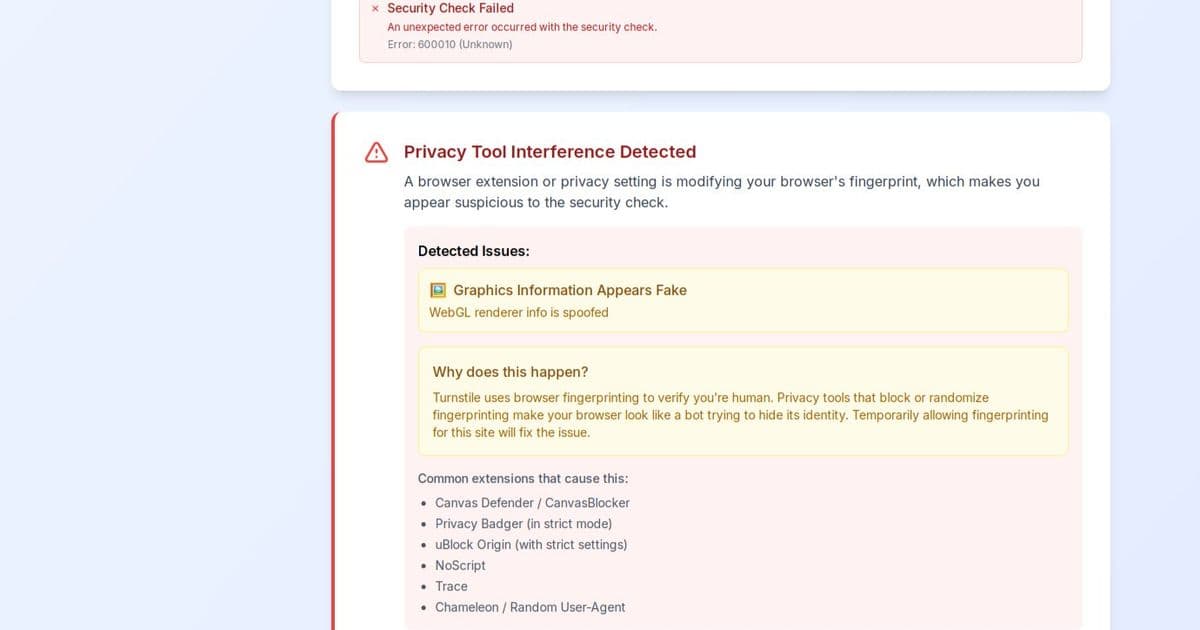
Cloudflare’s Turnstile verification has begun to reject browsers that hide or randomize WebGL information, effectively forcing a device fingerprint. The change impacts WebKitGTK users, raises privacy concerns, and highlights divergent approaches to fingerprint mitigation in Firefox and Safari.
The New Requirement Hidden Behind Turnstile
Since early May 2026, users of WebKitGTK‑based browsers have reported that Cloudflare’s Turnstile widget—its “prove you’re human” challenge—gets stuck in an endless loading loop. The symptom is not a network error or a missing JavaScript file; the widget simply refuses to render, leaving the page inaccessible. The root cause, as the community has uncovered, is a newly enforced check for a fingerprintable WebGL renderer string. When the browser reports a spoofed or randomized value, Turnstile treats the client as a bot attempting to conceal its identity and aborts the verification flow.
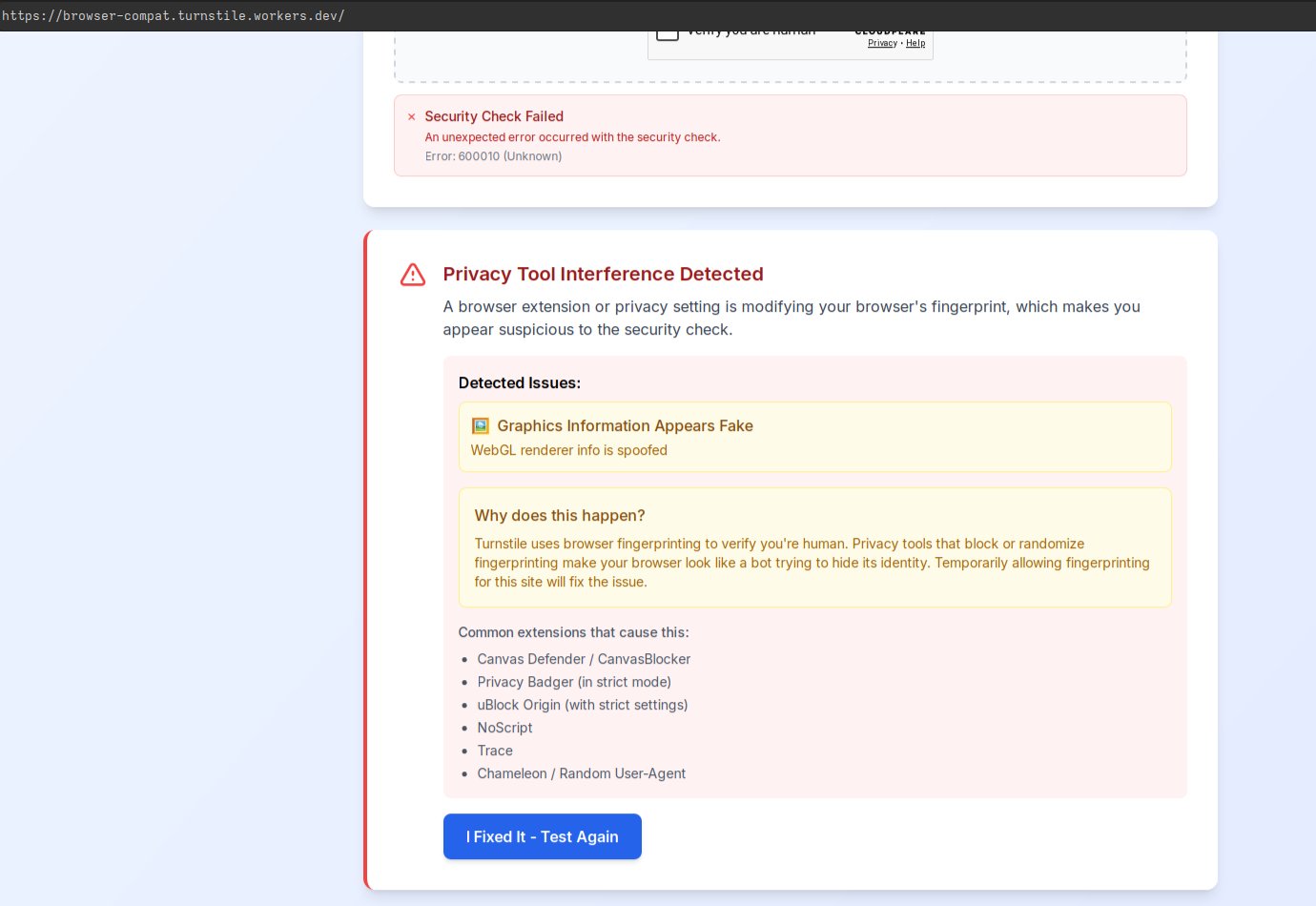
Screenshot of Turnstile test page, “WebGL renderer info is spoofed”.
The widget displays a clear error message when the WebGL renderer cannot be read.
How the Check Works
Turnstile collects a small set of hardware‑derived signals to augment its risk‑based model. Among these signals is the WebGL UNMASKED_RENDERER_WEBGL string, which on most desktop browsers reveals the graphics driver and GPU model. By comparing the reported value against a whitelist of known legitimate browsers, Cloudflare can flag browsers that deliberately falsify this attribute.
The logic, as inferred from the client‑side script, follows roughly these steps:
- Create a hidden canvas and obtain a WebGL rendering context.
- Query
gl.getParameter(gl.UNMASKED_RENDERER_WEBGL). - If the returned string matches a pattern of known spoofed values (e.g., "Google SwiftShader", "Mozilla Software"), the script sets a flag
fingerprintBlocked = true. - When
fingerprintBlockedis true, Turnstile aborts the challenge and displays an error.
Because WebKitGTK does not expose a real GPU identifier—Apple’s policy for WebKit on iOS and macOS has been to return a generic string for privacy—Turnstile now treats every WebKitGTK instance as suspicious. Safari, by contrast, receives a hard‑coded but consistent identifier, which Cloudflare appears to have whitelisted.
The Privacy Argument
Cloudflare’s public justification reads:
“Turnstile uses browser fingerprinting to verify you’re human. Privacy tools that block or randomize fingerprinting make your browser look like a bot trying to hide its identity. Temporarily allowing fingerprinting for this site will fix the issue.”
From a privacy‑first perspective, this stance is troubling. Fingerprinting is precisely the technique that privacy‑oriented browsers aim to mitigate; requiring it to access a site effectively forces users to abandon their protection. The policy therefore creates a binary choice: either surrender a piece of hardware identity or be denied access.
Why Apple Blocks It
Apple has long prevented WebGL from leaking detailed GPU information on iOS and macOS, returning a generic string such as "Apple GPU". This decision is grounded in the belief that the marginal utility of the data does not outweigh the privacy risk. Cloudflare’s new requirement runs counter to that philosophy, suggesting that the company values the additional signal more than the user’s expectation of anonymity.
Divergent Behaviors in Firefox and Safari
Firefox’s approach to WebGL fingerprinting has recently shifted. Historically, the privacy.resistFingerprinting (RFP) setting forced the browser to return sanitized GPU strings, similar to Apple’s approach. However, a regression documented in Bugzilla #1916271 caused Firefox 145.0 to expose the real GPU characteristics again, effectively breaking the RFP guarantee.
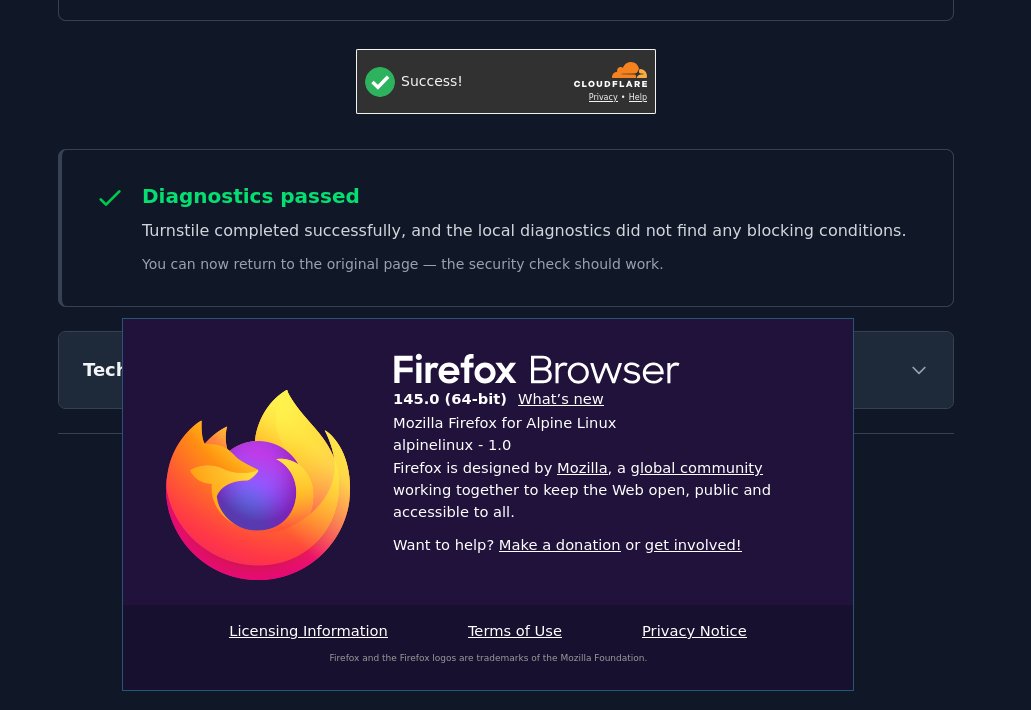
Screenshot of Turnstile test page on Firefox 145.0 passing with no issues.
With the default settings, Firefox now supplies a real renderer string, allowing Turnstile to succeed.
When a user manually enables RFP via about:config (privacy.resistFingerprinting = true), the widget detects the altered canvas and reports only a generic "Canvas Randomization Detected" message.
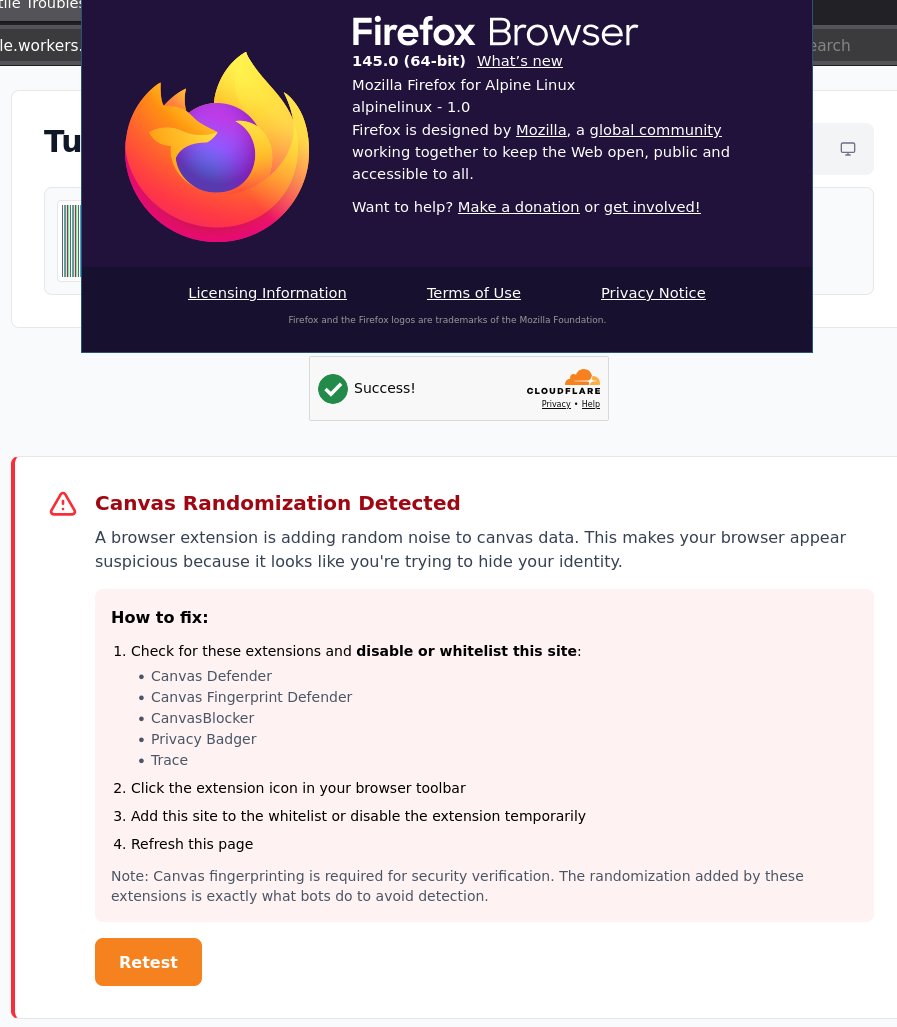
Screenshot of Turnstile test page on Firefox 145.0 after enabling RFP.
The challenge still fails, indicating that Turnstile treats any deviation from the expected renderer as suspicious.
This divergence illustrates two competing philosophies:
- Safari – maintains a static, privacy‑preserving identifier that Cloudflare has chosen to accept.
- Firefox – offers an opt‑in privacy shield that, when enabled, now collides with Turnstile’s expectations.
Implications for the Web Ecosystem
- Increased Fragmentation – Websites that rely on Turnstile will effectively force users onto a narrow set of browsers or configurations, undermining the open nature of the web.
- Pressure on Browser Vendors – Both Apple and Mozilla may face pressure to adjust their fingerprinting mitigations, either by providing a whitelist‑compatible identifier or by lobbying Cloudflare to relax its requirement.
- Potential for Abuse – If a service can deny access based on fingerprinting status, it creates a lever for tracking: a site could infer whether a user runs a privacy‑enhancing tool simply by observing the failure mode.
- Legal and Regulatory Scrutiny – In jurisdictions where privacy‑by‑design is mandated, mandating a fingerprint for access could be interpreted as a violation of data minimisation principles.
Counter‑Perspectives
Proponents of the change argue that fingerprinting, when used responsibly, adds a valuable signal to distinguish automated abuse from genuine human interaction, especially in the face of sophisticated botnets that can solve traditional CAPTCHAs. They claim that the cost to privacy is minimal because the WebGL string alone does not uniquely identify a user.
Critics, however, point out that the string is just one element of a broader fingerprinting surface; when combined with other attributes (canvas hash, audio fingerprint, etc.), it can contribute to a highly stable identifier. Moreover, the decision to block browsers that deliberately obscure this data creates a coercive privacy model—the user must choose between anonymity and access.
What Users Can Do Now
- WebKitGTK users – Until Cloudflare revises its policy, the only practical workaround is to use a different browser (e.g., Firefox with RFP disabled or Safari on macOS).
- Firefox privacy enthusiasts – If you rely on RFP, be prepared for occasional access failures on Turnstile‑protected sites; consider whitelisting those domains in the browser’s privacy settings.
- Web developers – If your site uses Turnstile, you may want to provide an alternative verification path for users whose browsers cannot supply a fingerprintable WebGL context, such as a fallback email link or a traditional CAPTCHA.
Looking Ahead
The episode underscores a broader tension between anti‑bot measures and privacy‑preserving technologies. As more services adopt risk‑based challenges that incorporate hardware signals, the web community will need to negotiate a balance that respects both security and the right to conceal one’s device characteristics. Whether Cloudflare will soften its stance, or whether browsers will converge on a privacy‑friendly yet verifiable identifier, remains to be seen.
Comments
Please log in or register to join the discussion