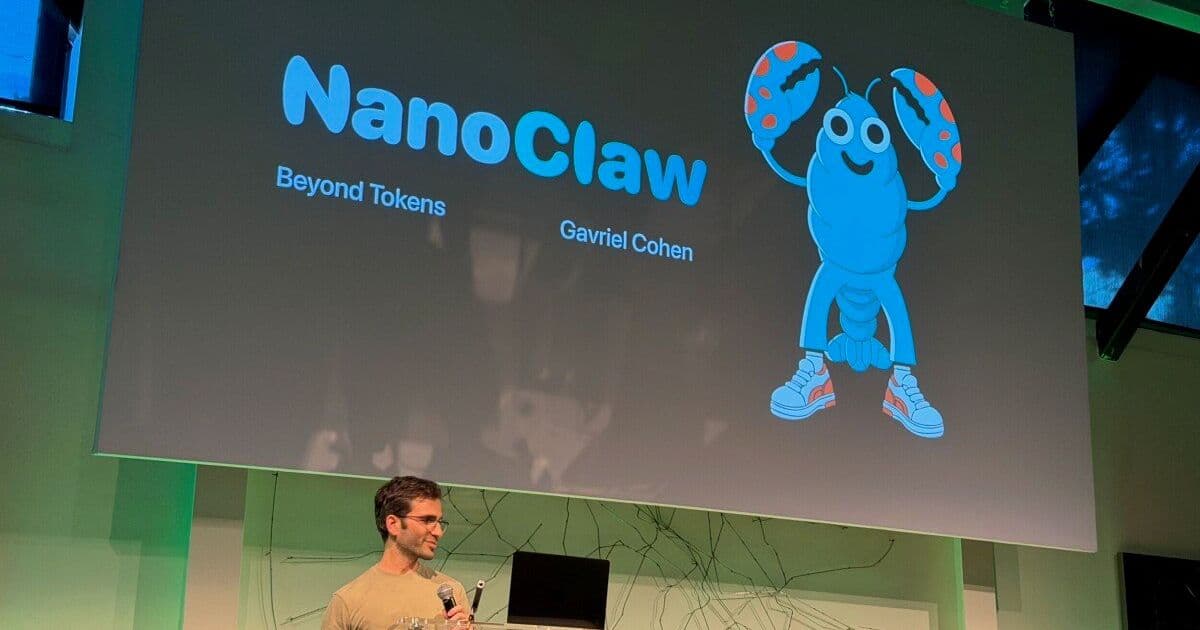
NanoClaw is routing agent-downloaded tools through JFrog-reviewed registries, a practical supply-chain control for teams letting AI agents fetch code, inspect pull requests, and operate inside real build environments.
Product
NanoClaw, a secure AI agent framework from NanoCo AI, is integrating with JFrog registries so agents can fetch packages and tools from reviewed sources instead of pulling arbitrary code straight from the public internet. The move targets a very specific failure mode: an AI agent that can improve itself by installing new libraries is also an AI agent that can import malware, typo-squatted packages, compromised dependencies, or prompt-injection payloads packed into project files.
That matters because agent permissions are becoming a hardware and infrastructure problem, not only an AI policy problem. Once an agent can run package managers, spawn containers, inspect pull requests, or trigger CI, it starts behaving like a junior admin with inconsistent judgment. Sandboxing helps, but a sandbox still consumes CPU, memory, network, disk, credentials, and human trust. On a homelab bench, that means more than a bad answer in chat. It means a worker VM can download hostile code, chew through runner minutes, exfiltrate test secrets if exposed, or poison build output.
NanoClaw’s answer is to narrow the supply path. Instead of letting agents fetch from whatever npm, PyPI, container, model, or tool endpoint a generated plan suggests, NanoClaw can point those fetches through JFrog’s governed artifact layer. The relevant pieces are JFrog Artifactory, which acts as a universal artifact repository, and JFrog’s security and curation products, including package review, policy controls, and software composition analysis exposed through the broader JFrog platform.
The practical result is simple: the agent may still decide it needs a tool, but the organization controls which packages are eligible to be downloaded. That is a stronger control than writing another sentence in an instruction file telling the agent not to do something dangerous.
NanoClaw creator Gavriel Cohen also described an internal agent factory, referred to in documentation as a PR Factory, that uses NanoClaw agents to triage pull requests. When a PR opens, the factory spins up a dedicated worker agent, posts a Slack thread, reviews the diff, and proposes a test plan. Merges, credentialed GitHub actions, and test execution still require human approval. That approval boundary is the interesting part. It treats the AI agent as a fast, disposable analyzer, not as a maintainer with commit rights.
Performance Data
No public throughput, latency, package-cache hit-rate, or power-consumption benchmark was disclosed with the announcement. That limits how far anyone should go on hard performance claims. Still, the architecture has measurable trade-offs, and they are the same trade-offs I would track before putting this in front of a busy repo or a self-hosted CI rack.
| Area | What changes with JFrog-backed downloads | Metric to measure | Expected direction |
|---|---|---|---|
| Package fetch latency | Agent downloads route through a governed registry instead of arbitrary upstreams | Cold install time, warm install time, cache hit rate | Cold path may be slower, warm cache should improve repeatability |
| Security filtering | Packages can be blocked before execution | Blocked package count, policy violation count, CVE severity mix | More early failures, fewer risky installs reaching runtime |
| CI reproducibility | Agents consume the same curated package set as developers and build workers | Lockfile drift, rebuild success rate, dependency mismatch count | Better repeatability if policies are kept stable |
| Runner utilization | PR Factory creates one worker per pull request | vCPU-minutes per PR, RAM peak, queue time | Higher baseline compute use, cleaner isolation per PR |
| Human review load | Agent proposes triage and test plans | Time to first review, maintainer approvals per PR | Faster first pass, but approval quality must be audited |
| Power draw | More isolated workers can mean more active cores and storage IO | Wall watts at idle and under PR load | Depends on worker density and cache behavior |
For a small open-source project, the latency hit may be almost invisible. For a monorepo with heavy JavaScript dependency trees, containerized test environments, and a dozen concurrent PRs, registry behavior becomes a real benchmark axis. npm installs are already network-sensitive. Add security inspection, policy checks, and per-PR worker isolation, and the difference between a warm artifact cache and repeated public pulls can be the difference between a quiet 80 W build node and a 250 W space heater.
A sensible homelab test would use three lanes:
| Test lane | Setup | What I would record |
|---|---|---|
| Baseline | Agent or CI worker pulls directly from public registries | Install time, package count, network bytes, wall watts |
| Cached JFrog path | Same workload through Artifactory with warmed cache | Cache hit rate, install time, disk IO, wall watts |
| Curated JFrog path | Same workload with policy gates enabled | Block rate, failure reasons, review time, successful rebuild rate |
The power-consumption angle is easy to ignore until the agent factory scales out. A single PR worker on a modern mini PC might barely move the needle. Ten isolated workers doing dependency installs, static analysis, test discovery, and container builds can saturate E-cores, spike NVMe writes, and hold the CPU package in boost long enough to matter. On a Ryzen 7 or Core Ultra box running Proxmox, I would watch package power, SSD temperature, and fan curves during agent bursts. On a 1U server, I would track IPMI power draw and runner queue depth together, because the best security model in the world still needs a capacity plan.
The compatibility picture is broader than NanoClaw alone. JFrog already sits in many enterprise build paths, so routing agent downloads through it fits existing DevSecOps habits. It should be most useful where teams already mirror npm, Maven, Docker, PyPI, or internal artifacts through Artifactory. The awkward cases are developer machines and experimental repos where agents expect direct internet access and package policies lag behind real usage.
| Compatibility target | Fit | Watch item |
|---|---|---|
| npm-heavy repos | Strong fit | Typosquat and install-script policy matter most |
| Container builds | Strong fit | Base-image provenance and layer caching decide performance |
| Python tooling | Good fit | Native wheels and platform tags need policy coverage |
| Self-hosted GitHub runners | Good fit | Network egress and secret scoping must be locked down |
| Ephemeral cloud VMs | Good fit | Cache locality may be weaker unless colocated with registry |
| Hobby homelabs | Mixed | Setup complexity may outweigh benefit unless agents have real permissions |
The security claim is also measurable. Do not only count vulnerabilities found. Count the packages that never ran. A malicious postinstall script blocked at registry policy time is much cheaper than the same script detonating inside a worker and relying on container isolation to save the day.
Why It Matters
The most useful part of Cohen’s argument is the rejection of instruction-based safety as a primary control. Agent instruction files often contain lines like “never run destructive commands” because an agent previously did something destructive or plausibly could. That is not enforcement. It is steering.
For infrastructure people, the analogy is obvious. You do not give a backup script root access to the database host and then write “please do not delete production” in a README. You give it the minimum token scope, the minimum filesystem access, and a network path that cannot reach the wrong target. AI agents need the same treatment.
Package downloads are a high-value control point because they sit before execution. Once untrusted code is inside a container, the defender is already paying runtime cost. The malicious package can probe the filesystem, burn CPU, attack metadata services, attempt outbound connections, or manipulate build output. Containers reduce the blast radius, but they do not make arbitrary code safe. VM isolation helps more, especially for hostile PR review, but VM isolation still leaves supply-chain integrity, auditability, and cost.
JFrog’s role is to make the artifact source boring in the best possible way. A reviewed registry gives security teams a place to enforce allowlists, deny known-bad packages, inspect metadata, and produce audit trails. That does not prove every package is safe. It does turn agent package acquisition into a governed workflow instead of a live-fire internet crawl.
The PR Factory detail adds a second theme: AI-generated contribution volume is becoming a maintainer workload problem. If anyone can point a coding agent at a repository and produce a plausible pull request, maintainers need triage tools that are fast but constrained. NanoClaw’s approach of spinning up a dedicated worker per PR is attractive because it limits cross-contamination between reviews. The human approval cards for merges and credentialed actions are the right shape of control. The agent can read, summarize, and propose. The maintainer still decides when state changes.
Build Recommendations
For a production team, I would not wire an agent directly to public registries and call the job done because it runs in a container. The safer build has three layers: curated package intake, isolated execution, and human approval for privileged actions.
Recommended baseline:
| Layer | Recommendation | Reason |
|---|---|---|
| Registry | Route agent package installs through JFrog Artifactory or another governed artifact manager | Gives one policy point for downloads |
| Policy | Block known malicious packages, high-severity CVEs where practical, suspicious install scripts, and unapproved registries | Stops common supply-chain failures before runtime |
| Execution | Use disposable workers per PR or task | Limits persistence and cross-task contamination |
| Secrets | Do not expose production credentials to review agents | Prevents prompt injection from becoming credential theft |
| Approval | Require human approval for merges, test runs with credentials, deployment, and write actions | Keeps state-changing operations accountable |
| Telemetry | Log package requests, policy denials, tool calls, network egress, and worker lifetime | Gives maintainers evidence when something behaves oddly |
For a homelab or small team, the cheaper version is still useful. Put agents on a separate VLAN or locked-down VM pool. Force package managers through a local artifact cache. Start with read-only repository access. Add write permissions only after you have logs showing what the agent actually does during normal work. Measure wall power during a PR burst before deciding how many concurrent workers to allow.
My minimum benchmark sheet before adopting this in a serious repo would include:
| Benchmark | Pass condition |
|---|---|
| Cold dependency install through curated registry | Slower than direct public pulls is acceptable if policy logs are clear |
| Warm dependency install through cache | Should beat or closely match direct public pulls |
| Malicious package simulation | Package is blocked before execution |
| Prompt-injected PR | Agent reports suspicious instructions and does not trigger privileged actions |
| Secret exposure test | Worker cannot read deployment credentials during review |
| Concurrent PR load | Queue time and wall watts stay within budget |
| Rebuild reproducibility | Same commit resolves the same approved package set |
NanoClaw’s JFrog integration is not a magic shield. It is a useful piece of plumbing for a world where agents are becoming build participants. The core idea is old-school systems hygiene: make dangerous actions impossible by removing the path, then log the paths that remain. For AI agents that can download code and operate on pull requests, that beats another warning line in an instruction file every time.
Comments
Please log in or register to join the discussion