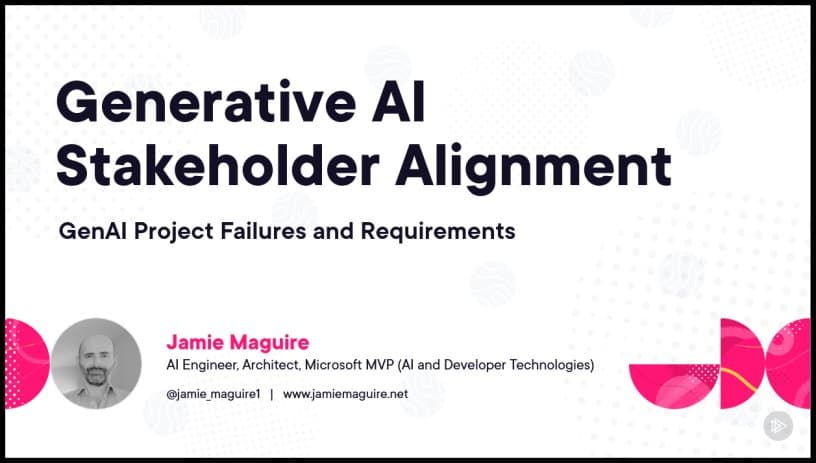
Jamie Maguire launches 30-minute Pluralsight course addressing why 95% of AI projects fail and how to align stakeholders for success
A new Pluralsight course addressing the critical challenge of AI project failure has launched, offering practical frameworks for stakeholder alignment and requirement management. The course, titled Generative AI Stakeholder Alignment, comes from developer and consultant Jamie Maguire and tackles why most AI initiatives deliver minimal return on investment.
The AI Project Failure Problem
The course opens with a stark statistic: 95% of organizations see little return on their AI investments. According to MIT NANDA's 2025 State of AI in Business research, this isn't due to technology limitations but rather to fundamental project management failures. Common issues include vague requirements, stakeholder misalignment, and measuring the wrong success metrics.
Maguire identifies several AI-specific failure patterns that traditional software projects don't typically encounter. These include hallucination creep (where AI systems gradually produce more confident but incorrect outputs), model drift (performance degradation over time), bias amplification, and the "solution seeking a problem" trap where teams build impressive AI systems that don't address actual business needs.
Building AI-Ready Requirements
The first module focuses on transforming how teams write requirements for AI projects. Traditional SMART (Specific, Measurable, Achievable, Relevant, Time-bound) criteria need significant adaptation for AI systems. The course introduces the "Guardrails as Requirements" principle, teaching practitioners how to embed safety constraints, ethical boundaries, and performance thresholds directly into requirement documents.
A key technique covered is the before-and-after requirement comparison. For example, a vague requirement like "create a chatbot for customer service" transforms into "develop a chatbot that handles 80% of tier-1 inquiries with 95% accuracy, maintains brand voice consistency, and escalates to humans within 30 seconds for complex issues." This specificity prevents the scope creep and misaligned expectations that plague many AI initiatives.
Stakeholder Alignment Framework
Module two introduces practical tools for keeping diverse stakeholders aligned throughout AI project lifecycles. The course covers RACI (Responsible, Accountable, Consulted, Informed) mapping specifically adapted for AI projects, where technical complexity often creates confusion about roles and decision rights.
Five clarifying questions form the backbone of stakeholder alignment: What problem are we solving? What does success look like? What are the non-negotiable constraints? Who owns the outcomes? How will we measure progress? These questions help surface hidden assumptions and conflicting priorities early.
Checkpoint rituals provide ongoing alignment mechanisms. Rather than treating alignment as a one-time kickoff activity, the course teaches teams to establish regular review points where stakeholders reassess goals, validate assumptions, and course-correct based on emerging insights from AI system behavior.
Preventing Scope Drift and Measuring Success
The final module addresses scope management in AI projects, where the technology's flexibility often leads to feature creep. The "Scope Drift Pattern" helps teams recognize when new requirements genuinely add value versus when they're chasing AI's potential without business justification.
A "Danger Zone Matrix" provides a visual tool for evaluating how proposed additions affect project timelines, budgets, and success metrics. This helps teams make data-driven decisions about scope changes rather than falling into the trap of "just one more feature" that extends timelines indefinitely.
Measurement frameworks extend beyond traditional performance metrics to include risk assessment, safety considerations, and value delivery. The course teaches practitioners to establish KPIs across four dimensions: technical performance (accuracy, latency, reliability), operational risk (security, compliance, governance), user safety (bias, fairness, harm prevention), and business value (ROI, efficiency gains, customer satisfaction).
Course Structure and Access
The 30-minute course is structured into three modules, each building on the previous concepts. It's designed for practitioners who need practical tools they can apply immediately, drawing from Maguire's experience building real-world AI systems.
This course joins Maguire's other AI-focused offerings on Pluralsight, including Developing an Artificial Intelligence Strategy for Your Organization, Aligning Generative AI with Business Cases, and Vector Databases & Embeddings for Developers. Together, these courses provide a comprehensive toolkit for organizations navigating AI adoption from strategy through implementation.
For teams struggling with AI project failures or organizations planning their first AI initiatives, the course offers battle-tested frameworks that address the human and organizational factors that determine AI project success as much as the technology itself.
Comments
Please log in or register to join the discussion