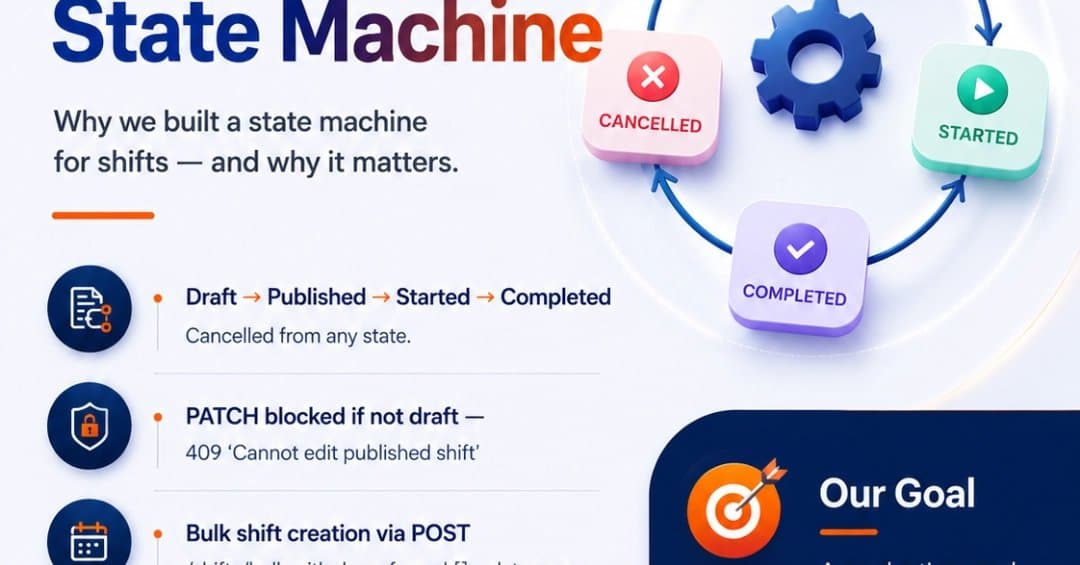
Exploring how Taskdudes implemented a shift state machine to bring structure and reliability to their workforce management SaaS, with insights into the challenges and benefits of this architectural approach.
The Taskdudes team recently implemented a shift state machine as part of their workforce management SaaS, a decision that highlights a common challenge in systems managing complex, multi-stage business processes. This implementation transforms how shifts flow through their system from Draft → Published → Started → Completed, with additional safeguards for state-aware cancellations and restricted modifications.
The Problem with Scattered State Logic
In workforce management systems, tracking the lifecycle of employee shifts presents unique challenges. Without a structured approach, teams often end up with scattered conditional logic throughout their codebase, where different parts of the application handle state transitions inconsistently. This approach creates several problems:
- Inconsistent behavior: Different parts of the application might handle the same transition differently
- Hidden dependencies: Business rules become embedded in application logic rather than being explicitly defined
- Debugging nightmares: When something goes wrong, tracing the flow of state changes becomes difficult
- Scaling challenges: Adding new states or transitions requires changes throughout the codebase
The Taskdudes team recognized these issues and opted for a more structured approach by implementing a formal state machine pattern.
Implementation Details
The shift state machine implementation includes several key components:
State Transitions
The core workflow follows a clear progression:
- Draft: Initial state when a shift is created
- Published: Shift is visible to employees and available for claiming
- Started: An employee has begun the shift
- Completed: The shift has been finished
State-Aware Cancellation Handling
A critical aspect of workforce management is the ability to cancel shifts, but this operation must be handled differently based on the current state. The implementation likely includes rules such as:
- Draft shifts can be cancelled without restrictions
- Published shifts might require manager approval
- Started shifts cannot be cancelled but might be marked as "abandoned"
- Completed shifts are final and cannot be cancelled
PATCH Restrictions
The system implements restrictions on modifying shifts based on their state:
- Draft shifts can be modified freely
- Published shifts might have limited modifications (only certain fields can be changed)
- Started and Completed shifts are typically read-only
Bulk Shift Creation APIs
For operational efficiency, the team implemented bulk creation capabilities, likely with the following characteristics:
- All created shifts start in the Draft state
- Bulk operations respect the same state transition rules
- Proper error handling for partial failures in bulk operations
Architectural Benefits
The state machine approach provides several advantages for the Taskdudes platform:
Predictable Workflows
With explicit state definitions and transitions, the behavior of the system becomes more predictable. This predictability extends to both the development team and end users, who can understand exactly how shifts progress through the system.
Better Maintainability
By centralizing state logic, the team reduces code duplication and makes the system easier to maintain. When business rules change, modifications are confined to the state machine implementation rather than scattered throughout the application.
Easier Debugging
When issues arise, the explicit state transitions make it easier to trace the flow of operations. The system can log state changes, providing a clear audit trail of how shifts move through their lifecycle.
Clear Business Rules
The state machine forces explicit definition of business rules. Instead of hidden assumptions in application code, the rules become first-class citizens in the system architecture.
Safer Scaling
As features are added, the state machine provides a structured foundation for extending functionality. New states or transitions can be added without fundamentally changing the existing architecture.
Technical Implementation Considerations
While the article doesn't detail the exact implementation, building a state machine in a NestJS application would likely follow these patterns:
State Machine Library
The team might use a library like xstate or ts-state-machine to implement the core state logic, or build a custom solution leveraging NestJS's dependency injection system.
Database Design
In PostgreSQL with Prisma, the state machine would require:
- A
Shifttable with astatusfield - Possibly a
ShiftTransitiontable for auditing state changes - Proper constraints to prevent invalid state transitions
Redis for State Caching
Redis could be used to:
- Cache current state of active shifts
- Implement distributed locking during state transitions
- Store temporary state during complex multi-step operations
API Layer
The REST API would implement:
- Different endpoints for different operations based on current state
- Input validation that respects state-dependent rules
- Proper HTTP status codes for state-related operations
Trade-offs and Challenges
Implementing a state machine isn't without challenges:
Initial Complexity
The upfront investment in designing and implementing the state machine is greater than simple conditional logic. This requires careful planning to ensure all possible states and transitions are defined.
Performance Considerations
Each state transition requires validation, which can add overhead. The team must balance this against the benefits of consistency and reliability.
Learning Curve
Team members need to understand the state machine paradigm, which might require onboarding time.
Rigidity
While structure is beneficial, overly rigid state machines can make it difficult to handle edge cases or exceptions. The implementation must include mechanisms for handling exceptional scenarios without breaking the overall flow.
Broader Context: State Machines in SaaS
The Taskdudes implementation reflects a broader pattern in SaaS architecture where state machines are increasingly used to manage complex business processes. Other domains where this pattern excels include:
- Order management systems
- Content publishing workflows
- Approval processes
- Subscription lifecycle management
- Ticketing systems
In each case, the benefits of explicit state management—consistency, auditability, and maintainability—outweigh the initial implementation complexity.
Conclusion
The Taskdudes team's implementation of a shift state machine demonstrates a thoughtful approach to managing complex business logic in their workforce management SaaS. By choosing this pattern, they've created a foundation that will support predictable behavior as the platform scales and evolves.
For teams facing similar challenges with scattered state logic, a state machine implementation offers a path toward more maintainable and reliable systems. While the upfront investment is significant, the long-term benefits in code quality and operational efficiency typically justify the approach.
The Taskdudes team is documenting their entire 45-day product build journey, which provides a valuable case study for engineering teams exploring similar architectural decisions. Their implementation serves as a practical example of how state machines can bring structure to complex business processes in real-world applications.
Current Stack: Next.js • NestJS • PostgreSQL • Prisma • Redis
Comments
Please log in or register to join the discussion