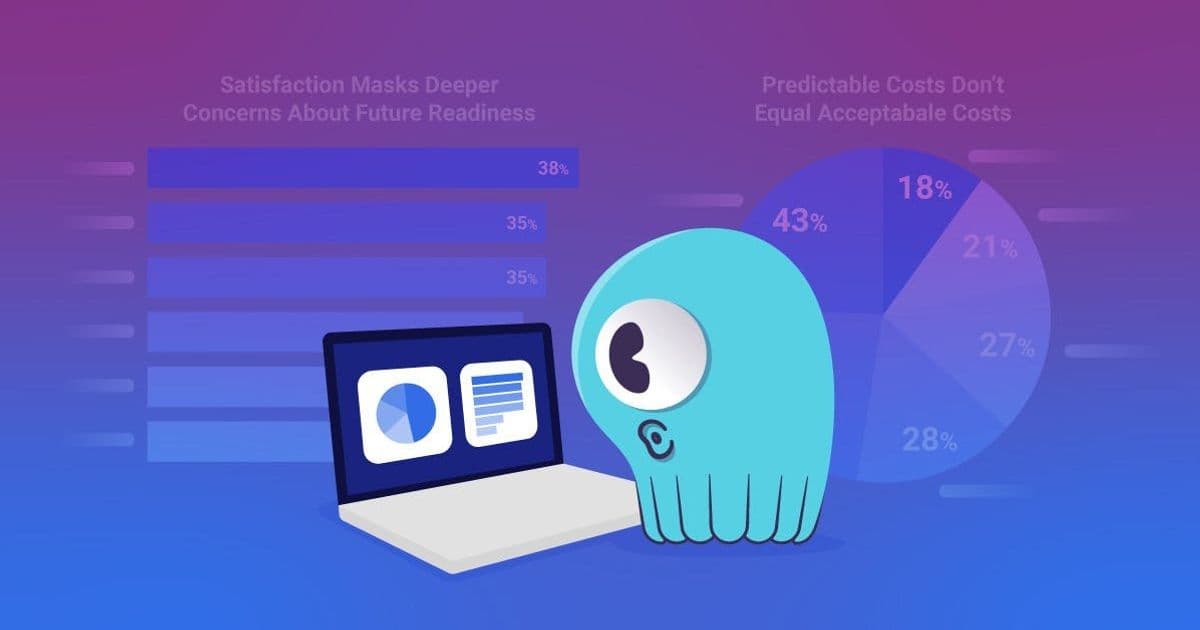
A Futurum Group study commissioned by ScyllaDB finds that 38 % of tech leaders fear their cloud databases won’t handle future AI/ML workloads, yet most wait for a crisis before acting. A modest 10 % cost reduction could trigger migrations, highlighting the tension between “good enough” performance and rising expense.
 )
)
ScyllaDB commissions Futurum Group study on cloud database cost and migration
When a water heater sputters, you notice it immediately; when a cloud database drifts, the signs are subtler. The Futurum Group’s latest research, Is Cloud Database Complacency Affecting Your Business Objectives?, surveyed technical decision‑makers about performance, cost and migration triggers. The study, funded by ScyllaDB, paints a picture of satisfaction mixed with unease.
The problem: “good enough” masks looming constraints
- Performance confidence is fragile – One‑third of respondents say their current cloud database meets today’s needs, but 38 % worry it can’t support the data explosion from AI/ML workloads. The workloads are unpredictable, so past metrics are poor predictors of future behavior.
- Cost pressure is real – 35 % of leaders want better performance but feel budget‑bound, while another 35 % are nervous about rising spend despite being happy with performance. The top cost drivers are:
- Unexpected load spikes (40 %)
- New or stricter technical requirements (38 %)
- Networking bandwidth growth (38 %)
- Storage growth (38 %)
- A tiny incentive can tip the balance – A 10 % reduction in database spend is enough for many organizations to start evaluating alternatives. At multi‑million‑dollar annual bills, that translates into tens of millions saved.
Why migration is still reactive
Even with these concerns, most teams wait for a trigger before moving. The study identified the most common catalysts:
| Trigger | Share of respondents |
|---|---|
| Leadership change | 36 % |
| Major production incident | 32 % |
| Load spike | 32 % |
| Cost reduction ≥10 % | 31 % |
| Maintenance burden | 31 % |
| Performance issue | 29 % |
| Volatile costs | 28 % |
The data suggest that cost volatility is almost as compelling as outright performance problems. In practice, teams juggle feature delivery, roadmap commitments and limited operational bandwidth, so even a clear cost signal can be buried under day‑to‑day priorities.
Early warning signs to watch
The study lists several metrics that often precede a crisis:
- Cost outpacing throughput – Spending climbs faster than the amount of data processed, hinting at diminishing scalability.
- Rising tail latency – Increases in P95/P99 latency during peak periods signal that the system is approaching its limits, even if SLA thresholds are still met.
- Growing operational friction – More manual tuning, frequent capacity adjustments, and longer time spent on database upkeep indicate a loss of efficiency.
- Disproportionate engineering effort – When adding a new workload or scaling a modest increase requires a large engineering sprint, the underlying platform is likely a bottleneck.
Moving from reaction to strategy
Recognizing a problem is only half the battle. The report recommends a proactive playbook:
- Map options to use cases – Build a vendor‑neutral shortlist that covers your current and near‑future workloads.
- Define evaluation criteria – Include cost predictability, latency targets, scaling ergonomics and operational overhead.
- Stress‑test today’s database – Simulate peak loads in a staging environment to locate the breaking point before production does.
- Set explicit decision triggers – For example, “migrate if cost per query exceeds $0.0002” or “switch if 99th‑percentile latency > 150 ms for three consecutive days.”
- Align with a 12–24‑month roadmap – Ensure the chosen platform can grow with your product vision, not just support the status quo.
“Your database might be ‘good enough for now,’ but if that isn’t aligned with where your business needs to go, complacency is already costing you.” – Guy Currier, Futurum Group Chief Analyst
Access the full findings
The complete report is available for download on the ScyllaDB site. It includes the raw poll data, detailed charts and an expert panel discussion that dives deeper into migration patterns.
Tags: #cloud-database #database-migration #cost-management #AI‑ML workloads #ScyllaDB
Comments
Please log in or register to join the discussion