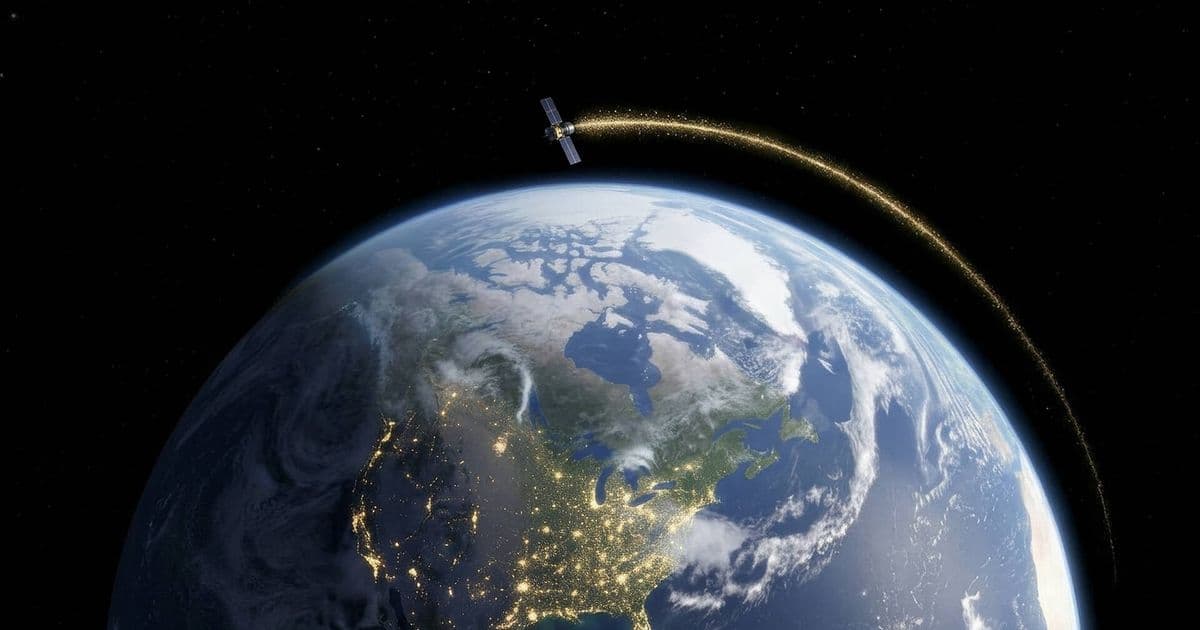
Nvidia unveils the Space-1 Vera Rubin Module, a GPU designed for orbital datacenters and space-based AI processing, promising up to 25x the compute of an H100.
Nvidia has unveiled its Space-1 Vera Rubin Module, a GPU specifically engineered for space-based computing that promises to deliver up to 25 times the AI compute performance of an H100 GPU in the harsh environment above Earth's atmosphere.
Space computing enters a new orbit
The announcement came during Nvidia CEO Jensen Huang's keynote at GTC 2026, where he positioned the Vera Rubin Module as the solution for AI processing in size-, weight-, and power-constrained environments like satellites and orbital datacenters. The module is designed to handle space-based inferencing, geospatial intelligence processing, and autonomous space operations without relying on ground-based systems.
This development comes as multiple companies are betting on Earth orbit as the next frontier for datacenters after filling up rural America. Companies like Aetherflux, Axiom Space, Kepler Communications, Planet, Sophia Space, and Starcloud are already using Nvidia's accelerated computing platforms for next-generation space missions.
The economics of orbital datacenters remain questionable
Despite the technological advancement, the economics of launching datacenters into orbit remain problematic. Gartner distinguished VP analyst Bill Ray described orbital data centers as a "bubble" in a February report, citing prohibitive launch costs and the immense technical challenges of cooling datacenters in the vacuum of space.
"Companies are wasting money by pouring funds into the orbital data center 'bubble' because the economics do not work," Ray stated. "This is due to the prohibitive costs of launching hardware and the immense technical challenges of cooling these orbital datacenters in the vacuum that is space."
Nvidia itself acknowledges these challenges. During the company's most recent earnings call, Huang admitted that launching datacenters into orbit is currently a poor economic decision, yet he's proceeding anyway. "Whether your chips are tiny and lightweight or not, they still have to deal with all the really hard challenges that space can throw at them, and all without humans on board to triage and problem-solve," Ray noted.
Beyond the Vera Rubin Module
Nvidia's space computing push extends beyond the new module. The company also highlighted its IGX Thor unit as a durable edge computing system that "enables spacecraft to process sensor data locally," and its Jetson Orin AI development module as another space-constrained system suitable for orbit. According to Nvidia, Jetson Orin "enables real-time processing of vision, navigation and sensor data directly onboard spacecraft, reducing latency and optimizing bandwidth."
The RTX Pro 6000 Blackwell Server Edition GPU is positioned as an ideal ground-based partner to orbital geospatial imaging processing systems that have traditionally used CPUs for computational work.
The race to space is on
While Nvidia didn't specify which partners are testing the new Rubin module, Aetherflux has announced plans to launch its first datacenter satellite into orbit during the first quarter of 2027. The company joins other space-focused firms already working with Nvidia's technology to power next-generation space missions across orbital and ground environments.
Huang's vision extends beyond immediate practicality. "Space computing, the final frontier, has arrived," he declared during his GTC keynote. "As we deploy satellite constellations and explore deeper into space, intelligence must live wherever data is generated."
Whether orbital datacenters become a practical reality or remain a technological curiosity, Nvidia is positioning itself at the forefront of space-based computing. The company appears willing to weather the current economic headwinds in anticipation of a potential boom in space-based AI processing, embodying Huang's philosophy that it's better to be ready for a boom that never comes than to miss it in case it does.
Comments
Please log in or register to join the discussion