
Om AI Technology, founded in 2021, is betting on small, fast multimodal models that run on devices instead of cloud GPUs. Its OttoBox AI Studio showcases edge‑native video analysis, while the upcoming VLX model promises millisecond inference for security, industrial inspection and AI‑powered robots.
Om AI – From Cloud‑Heavy Models to Edge‑First Vision
The race for larger language and vision models has begun to settle into a new phase: real‑world deployment. A handful of Chinese startups are turning the spotlight on edge AI, and Om AI Technology is one of the most vocal. Founded in 2021, the company deliberately avoided the path of building massive cloud‑only models. Instead, it set its sights on general‑purpose multimodal vision models that run on the device itself – PCs, cameras, robots and other AIoT hardware.
The problem: video understanding on constrained hardware
Traditional video‑analysis pipelines depend on models with hundreds of millions of parameters, hosted on expensive GPU clusters. That architecture forces two costly steps:
- High inference fees – every frame must be sent to the cloud, billed per compute second.
- Data‑privacy risk – video streams often contain sensitive information that organizations are reluctant to upload.
For use‑cases like security monitoring, factory inspection or autonomous drones, latency and privacy are non‑negotiable. Even a few hundred milliseconds of round‑trip time can render a detection useless.
Om AI’s edge‑centric answer
Om AI’s engineering mantra is small, precise, fast. Its core research team, steeped in media and audiovisual production, builds models that fit within a few hundred megabytes and still deliver millisecond‑level inference on a typical edge GPU or NPU. The result is a suite of capabilities that include:
- Video scene parsing – recognizing actions, objects and context across frames.
- Audio‑text alignment – linking spoken words to visual cues for automatic captioning.
- Asset matching – locating reusable media assets in large libraries without leaving the device.
By keeping the model on‑device, Om AI eliminates bandwidth costs, reduces latency to near‑real‑time, and satisfies strict data‑security policies.
OttoBox AI Studio – an edge‑native content‑creation companion
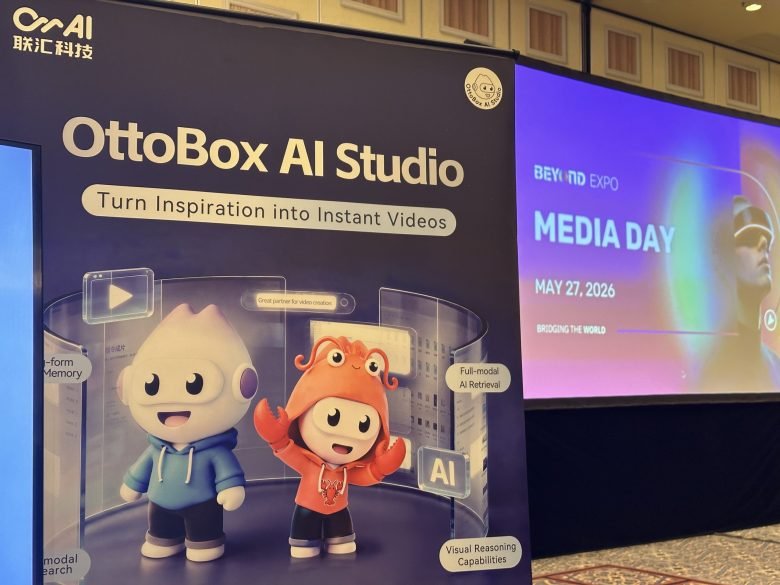
At the BEYOND Expo 2026 media day, Om AI unveiled OttoBox AI Studio, a desktop‑grade application aimed at media professionals. Unlike cloud‑centric SaaS tools, OttoBox runs the heavy lifting locally:
- Video analysis extracts shot boundaries, key frames and spoken keywords instantly.
- Script generation leverages a lightweight language model tuned on broadcast scripts to suggest narration.
- Rapid video production stitches clips, adds subtitles and applies effects without uploading raw footage.
The product is positioned as a “content‑creation companion for the AI‑native era,” promising to speed up editorial workflows while keeping raw media in‑house.
From PCs to robots – a three‑pronged AI business
Om AI splits its market focus into:
- AI PCs – partnerships with Apple, Lenovo and HP embed the models directly into high‑performance laptops and workstations, delivering on‑device video editing and analysis.
- AIoT – edge cameras, smart sensors and industrial inspection rigs benefit from real‑time anomaly detection.
- Embodied intelligence – robots, robotic dogs and drones receive on‑board perception that enables autonomous navigation and decision‑making.
A notable inclusive‑AI effort is the Homer App, which assists visually impaired users by performing object search and navigation guidance through a smartphone or AI glasses.
The next step: VLX multimodal model
Om AI’s roadmap culminates in VLX, a next‑generation multimodal model that tightens the integration of video, audio and text. Early benchmarks suggest VLX can halve the parameter count of the current flagship while improving decision latency by 30 %. If the claims hold, VLX will make it feasible to run sophisticated video understanding on even smaller form factors such as edge‑AI modules in drones.
Why this matters now
The broader AI industry is witnessing a shift from cloud‑centric competition to on‑device differentiation. Companies that can deliver useful multimodal perception without a constant internet connection gain a strategic edge in sectors where latency, cost and privacy are decisive. Om AI’s approach illustrates how deep domain expertise – in this case, years of work in media production – can translate into models that solve concrete problems rather than chasing parameter counts.
Funding and traction
While Om AI has not disclosed a recent financing round, its strategic collaborations with major OEMs and the deployment of OttoBox across multiple AI PC lines signal strong commercial validation. The company’s ability to ship functional edge models at scale suggests it has secured enough capital to sustain R&D on VLX and expand its AIoT footprint.
For more details on OttoBox AI Studio, see the official announcement on the Om AI website. The VLX technical paper is available on the company’s GitHub repository.
Comments
Please log in or register to join the discussion