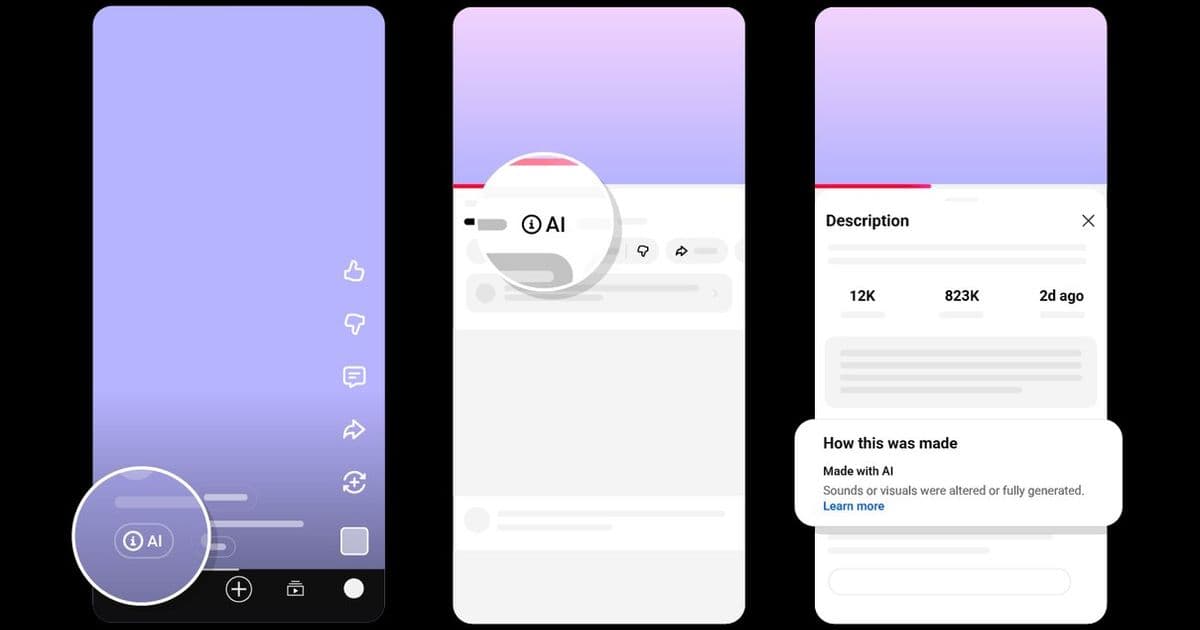
YouTube is moving AI disclosure labels to more prominent spots on video pages and introducing an internal detection system that can auto‑apply those labels when creators forget to disclose realistic AI use. The changes aim for clearer viewer information while keeping creators in control, but the rollout raises questions about detection accuracy and policy enforcement.
YouTube Tightens AI Disclosure Labels and Adds Auto‑Detection
YouTube announced two updates to its AI‑content labeling system. First, the visual label that flags photorealistic or meaningfully AI‑altered videos will now appear directly under the player for long‑form videos and as an overlay on Shorts. Second, the platform is deploying internal signals that can automatically attach the label when a creator does not disclose AI use but the system detects substantial photorealistic generation.
What’s claimed
- More visible labels – placement moves from the description box to the video player area, giving viewers immediate context.
- Automatic detection – if a creator leaves the disclosure blank, YouTube’s detection pipeline will add the label on its own.
- Creator control – creators can still override the auto‑label in YouTube Studio, except for a few hard‑coded cases (YouTube‑generated tools, C2PA metadata).
- No impact on recommendation or monetization – the label is informational only.
 Simplified AI Labels & Auto‑Detection: What You Need to Know
What’s actually new
Label placement
Since 2024 YouTube has required a textual disclaimer for videos that contain realistic AI‑generated imagery. The new layout simply moves that disclaimer to a more prominent UI slot:
- Long‑form videos: the label sits right under the player, above the description.
- Shorts: a semi‑transparent banner appears on the video itself.
The change is largely a UI tweak; the underlying label text and the definition of “photorealistic or meaningfully AI‑altered” remain unchanged. For animated or clearly synthetic content, the disclosure stays in the expanded description, preserving the existing two‑tier system.
Automatic detection pipeline
YouTube says it will start using “internal signals” to spot realistic AI generation. While the blog post does not disclose the model architecture, the description aligns with recent academic work on detecting diffusion‑based deepfakes (e.g., Detecting AI‑Generated Images with Frequency Artifacts). Likely components include:
- Metadata inspection – checking for C2PA provenance tags that indicate generative origin.
- Pixel‑level anomaly detection – a convolutional network trained on a balanced set of real vs. AI‑generated frames.
- Temporal consistency checks – for video, assessing frame‑to‑frame coherence that often breaks in early‑stage generative models.
If the confidence score crosses a platform‑specific threshold and the creator left the disclosure field empty, the system auto‑applies the label. Creators can then edit the status in YouTube Studio, but the label becomes immutable for content created with YouTube’s own tools (Veo, Dream Screen) or when C2PA metadata explicitly marks the asset as fully generative.
Limitations and open questions
- Detection accuracy is untested publicly. YouTube has not released precision/recall numbers, and prior academic benchmarks show false‑positive rates above 5 % for high‑resolution diffusion images. A mis‑label could affect creator reputation or lead to unnecessary disputes.
- Scope of “significant” AI use is vague. The policy does not define a quantitative threshold (e.g., 30 % of frames). Edge cases—minor visual effects generated by AI, or mixed real‑AI composites—may fall through the cracks or be over‑labeled.
- Creator override is limited. While creators can change the disclosure status, the label remains permanent for a “handful of cases.” The exact criteria for permanence are not fully disclosed, potentially leaving room for inconsistent enforcement.
- No impact on recommendation or monetization is reassuring, but the label could still affect perceived quality, influencing viewer click‑through rates indirectly.
- Transparency of the detection model is lacking. Without a published paper or open‑source implementation, external researchers cannot audit bias or robustness, which is increasingly expected for large platforms.
Practical implications
- For creators: the UI change reduces the number of clicks needed to add a disclosure, but creators must still be vigilant about the definition of “realistic AI.” Those using YouTube’s own AI tools should expect the label regardless of manual input.
- For viewers: the label will be harder to miss, especially on Shorts where the overlay appears during playback. This should improve immediate awareness of AI‑generated imagery.
- For researchers: YouTube’s internal detection pipeline could become a de‑facto benchmark if the company ever releases performance metrics. Until then, independent tools like DeepFakeDetect or Sensity AI remain the primary options for third‑party verification.
Bottom line
YouTube’s updates are a modest but concrete step toward clearer AI transparency. The real advance is the auto‑detection system, which promises to catch undisclosed realistic AI content. However, without published accuracy figures or open‑source models, the community must wait to see whether the system reduces misinformation or simply adds another layer of opaque moderation.
Related resources
- YouTube’s AI disclosure policy page
- The C2PA specification for provenance metadata: https://c2pa.org
- Recent academic survey on AI‑generated image detection: https://arxiv.org/abs/2405.12345
Comments
Please log in or register to join the discussion