
Sophos researchers have uncovered how the Payouts King ransomware group is leveraging QEMU virtual machines to evade detection and maintain persistent access to compromised systems.
The Payouts King ransomware is using the QEMU emulator as a reverse SSH backdoor to run hidden virtual machines on compromised systems and bypass endpoint security. QEMU is an open-source CPU emulator and system virtualization tool that allows users to run operating systems on a host computer as virtual machines (VMs). Since security solutions on the host cannot scan inside the VMs, attackers can use them to execute payloads, store malicious files, and create covert remote access tunnels over SSH.
For these reasons, QEMU has been abused in past operations from multiple threat actors, including the 3AM ransomware group, LoudMiner cryptomining, and 'CRON#TRAP' phishing. Researchers at cybersecurity company Sophos documented two campaigns where attackers deployed QEMU as part of their arsenal and to collect domain credentials.
One campaign that Sophos tracks as STAC4713 was first observed in November 2025 and has been linked to the Payouts King ransomware operation. The other, tracked as STAC3725, has been spotted in February this year and exploits the CitrixBleed 2 (CVE–2025–5777) vulnerability in NetScaler ADC and Gateway instances.
Running Alpine Linux VMs
Researchers note that the threat actors behind the STAC4713 campaign are associated with the GOLD ENCOUNTER threat group, which is known to target hypervisors and encryptors for VMware and ESXi environments. According to Sophos, the malicious actor creates a scheduled task named 'TPMProfiler' to launch a hidden QEMU VM as SYSTEM. They use virtual disk files disguised as databases and DLL files, and set up port forwarding to provide covert access to the infected host via a reverse SSH tunnel.
The VM runs Alpine Linux version 3.22.0 that includes attacker tools such as AdaptixC2, Chisel, BusyBox, and Rclone. Sophos notes that initial access was achieved via exposed SonicWall VPNs, while exploitation of the SolarWinds Web Help Desk vulnerability CVE–2025–2399 was observed in more recent attacks.
In the post-infection phase, the threat actors used VSS (vssuirun.exe) to create a shadow copy, then used the print command over SMB to copy NTDS.dit, SAM, and SYSTEM hives to temp directories. More recently observed incidents attributed to the threat actor relied on other initial access vectors. The researchers say that in an attack in February, GOLD ENCOUNTER used an exposed Cisco SSL VPN, and in March they posed as IT staff and tricked employees over Microsoft Teams into downloading and installing QuickAssist.
"In both instances, the threat actors used the legitimate ADNotificationManager.exe binary to sideload a Havoc C2 payload (vcruntime140_1.dll) and then leveraged Rclone to exfiltrate data to a remote SFTP location" - Sophos
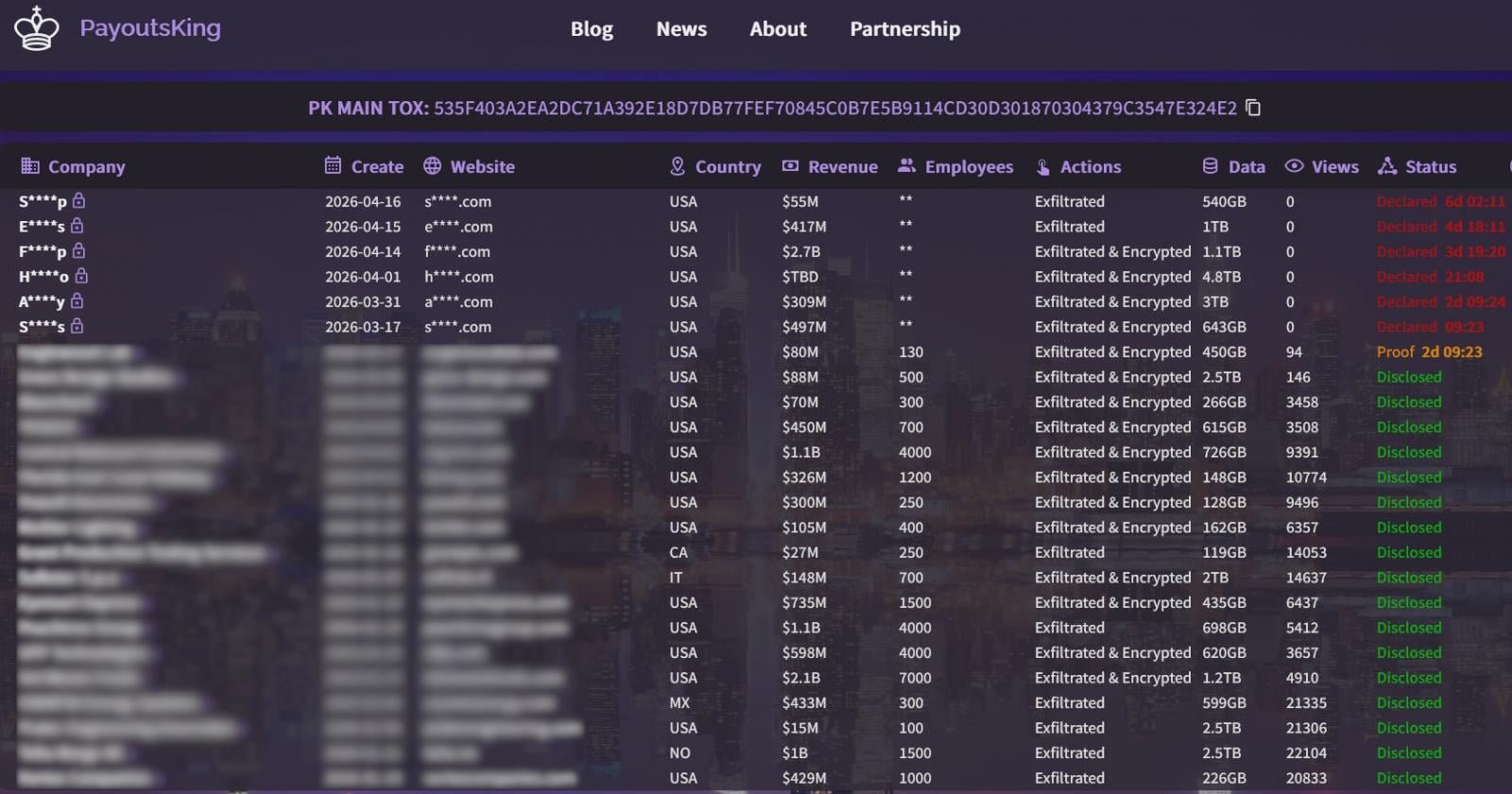
According to a Zscaler report this week, Payouts King is likely tied to former BlackBasta affiliates, based on its use of similar initial access methods like spam bombing, Microsoft Teams phishing, and Quick Assist abuse. The strain employs heavy obfuscation and anti-analysis mechanisms, establishes persistence via scheduled tasks, and terminates security tools using low-level system calls. Payouts King encryption scheme uses AES-256 (CTR) with RSA-4096 with intermittent encryption for larger files. The dropped ransom notes point victims to leak sites on the dark web.
Exploiting CitrixBleed 2
The second campaign that Sophos observed (STAC3725), has been active since February and exploits the CitrixBleed 2 vulnerability to gain initial access to target environments. After compromising NetScaler devices, the attackers deploy a ZIP archive containing a malicious executable that installs a service named 'AppMgmt,' creates a new local admin user (CtxAppVCOMService), and installs a ScreenConnect client for persistence.
The ScreenConnect client connects to a remote relay server and establishes a session with system privileges, then drops and extracts a QEMU package that runs a hidden Alpine Linux VM using a custom.qcow2 disk image. Instead of using a pre-built toolkit, the attackers manually install and compile their tools, including Impacket, KrbRelayx, Coercer, BloodHound.py, NetExec, Kerbrute, and Metasploit, inside the VM.
Observed activity includes credential harvesting, Kerberos username enumeration, Active Directory reconnaissance, and staging data for exfiltration via FTP servers. Sophos recommends that organizations look for unauthorized QEMU installations, suspicious scheduled tasks running with SYSTEM privileges, unusual SSH port forwarding, and outbound SSH tunnels on non-standard ports.
Technical Analysis and Defense Recommendations
The use of QEMU as a covert channel represents a significant evolution in ransomware tactics. By running entire operating systems within virtual machines, attackers create isolated environments that traditional endpoint detection and response (EDR) solutions struggle to monitor effectively. This technique allows threat actors to:
- Execute malicious payloads in an isolated environment
- Store stolen data and tools outside the host's file system
- Maintain persistent access through reverse SSH tunnels
- Evade behavioral analysis by security monitoring tools
The sophistication of these attacks extends beyond the QEMU deployment. The threat actors demonstrate advanced knowledge of Windows internals, using techniques like:
- Scheduled task creation with SYSTEM privileges
- Virtual disk file obfuscation using legitimate-looking extensions
- Shadow copy manipulation for credential harvesting
- Legitimate binary sideloading for payload delivery
- Manual tool compilation to avoid signature-based detection
Organizations should implement the following defensive measures:
- Monitor for unauthorized virtualization tools - Establish baseline configurations and alert on QEMU installations
- Inspect scheduled tasks - Review tasks running with SYSTEM privileges for suspicious activity
- Analyze network traffic - Look for outbound SSH connections on non-standard ports
- Implement application whitelisting - Restrict execution of unauthorized binaries
- Deploy network segmentation - Isolate critical systems from potential lateral movement
- Conduct regular security awareness training - Educate employees about social engineering tactics
The Broader Threat Landscape
The Payouts King operations highlight the increasing sophistication of ransomware groups and their willingness to adopt complex evasion techniques. The connection to former BlackBasta affiliates suggests a pattern of knowledge transfer and capability enhancement within the ransomware ecosystem.
These attacks demonstrate how threat actors are moving beyond traditional file-based malware to leverage legitimate system tools and virtualization technologies. The use of QEMU, combined with social engineering, vulnerability exploitation, and credential theft, creates a multi-faceted attack chain that is difficult to detect and mitigate.
The targeting of specific vulnerabilities like CitrixBleed 2 and SolarWinds Web Help Desk indicates that these groups are conducting thorough reconnaissance and maintaining up-to-date knowledge of the threat landscape. Organizations must prioritize patch management and vulnerability remediation to reduce their attack surface.
As ransomware groups continue to evolve their tactics, security teams must adopt a defense-in-depth approach that combines technical controls, user education, and continuous monitoring to detect and respond to these sophisticated threats.
Comments
Please log in or register to join the discussion