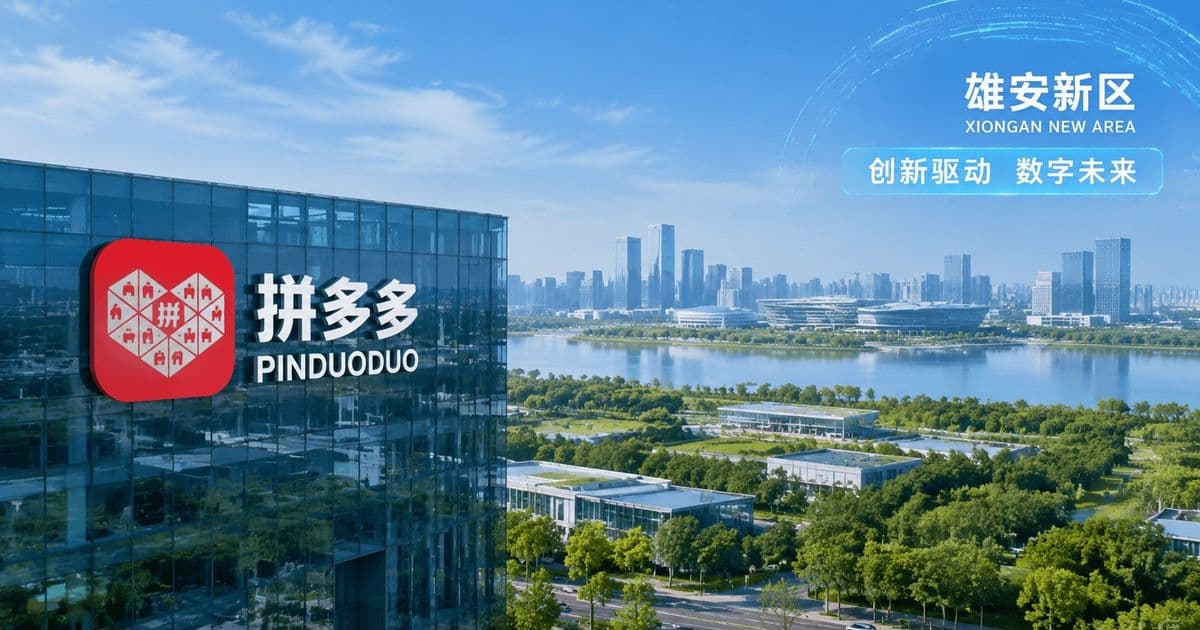
Pinduoduo's parent registered a 500 million RMB technology subsidiary in Xiong'an focused on big data, ops, and cloud services. The corporate filing is real. The "industrial internet pivot" framing around it is mostly inference, and worth reading with caution.
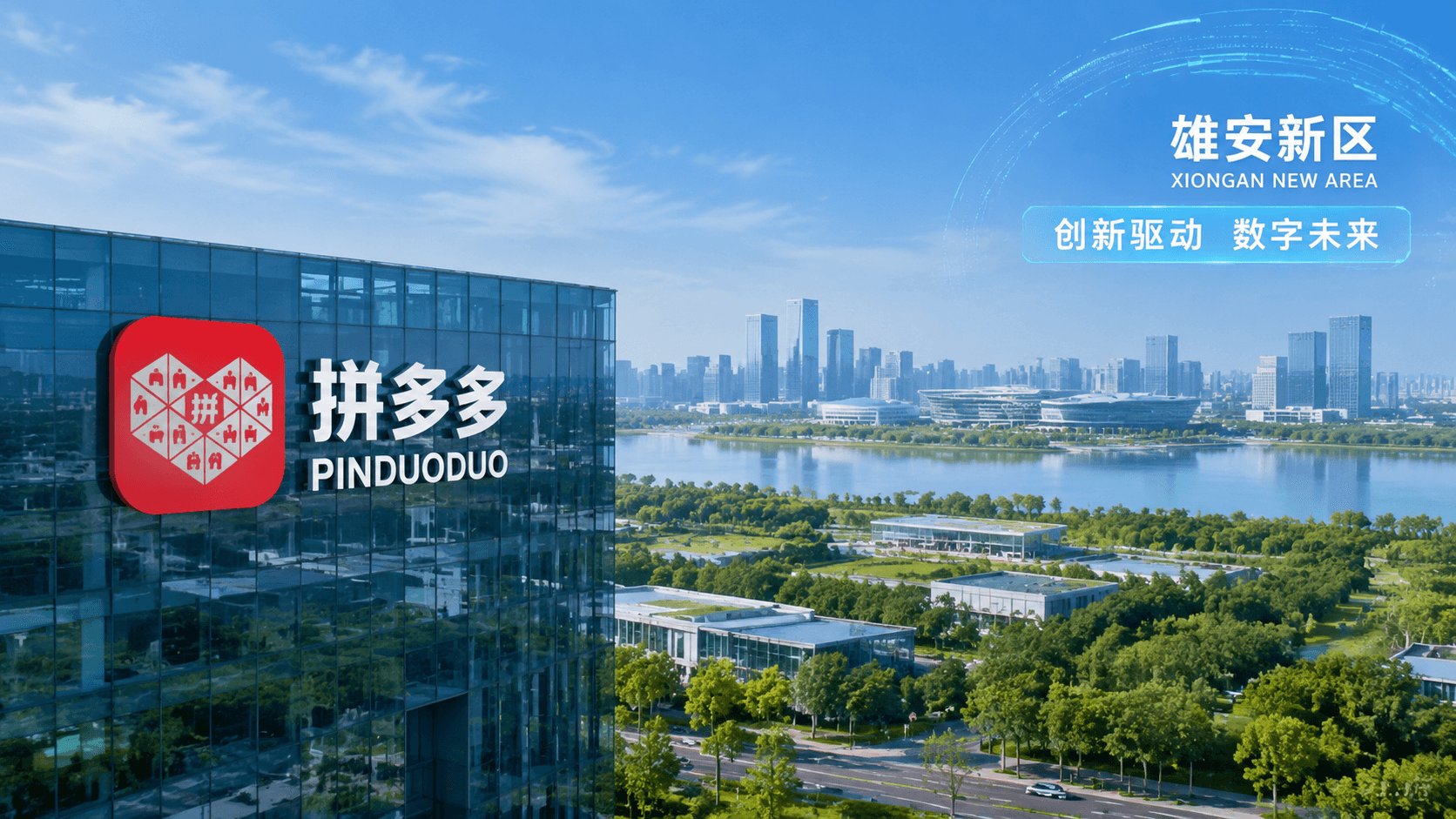
PDD Holdings, the parent company behind Pinduoduo and the cross-border platform Temu, has registered a wholly-owned subsidiary in China's Xiong'an New Area. The entity, Pinduoduo Information Technology Services (Xiong'an) Co., Ltd., carries 500 million RMB in registered capital, roughly $69 million, and its stated business scope covers big data processing, digital operations and maintenance, and cloud platform services. The company has reportedly opened recruitment for about 1,000 roles with a stated longer-term target of 5,000 jobs.
What's actually on the filing
Strip away the framing and the verifiable facts are narrow: a new legal entity, a capital figure, a registered location, and a business scope description. Business scope language in Chinese corporate registrations is notoriously broad. Companies routinely list every activity they might conceivably pursue, which means "cloud platform services" and "big data processing" on a registration document tell you what the entity is permitted to do, not what it will actually build or sell. Treating the scope text as a product roadmap is a common mistake when reading these filings.
The capital figure is also worth keeping in proportion. 500 million RMB is a meaningful commitment for a startup, but for a company of PDD's size it is a rounding error against its cash position and quarterly free cash flow. It signals intent to operate something in Xiong'an. It does not by itself signal a company-wide strategic reorientation.
What's claimed versus what's new
The story being told around this filing is that Pinduoduo is spinning its internal technical infrastructure, the supply-demand matching, distributed data processing, and supply chain systems built for its marketplace, into an external-facing technology services business. That is a plausible reading. It is also the kind of narrative that gets attached to almost every large platform company that opens a cloud-flavored subsidiary, because the playbook already exists.
Alibaba did exactly this with Alibaba Cloud, turning internal e-commerce infrastructure into a commercial cloud business that is now a major revenue line. Amazon's AWS is the canonical version of the same arc. So when PDD registers a technology subsidiary with a cloud and data scope, the analyst reflex is to assume it is following the Alibaba and Amazon path. The reflex might be right. But the precedent is doing a lot of the persuasive work here, and a registration document is not evidence that PDD has the same ambitions, the same technical leadership, or the same willingness to spend years subsidizing an infrastructure business before it pays off.
There is a real difference between operating internal infrastructure and selling it. Internal systems are tuned to one workload, one organization's data model, and one set of assumptions. Productizing them for external manufacturers and brands means building multi-tenancy, documentation, support, billing, security isolation, and SLAs. Companies discover this gap repeatedly. The matching algorithms and supply chain tooling that work for Pinduoduo's marketplace are not automatically a sellable cloud product, and the registration tells us nothing about whether PDD intends to cross that gap.
The compliance angle is the more concrete read
One part of the analysis holds up better than the cloud-business story: the compliance motivation. Temu has faced sustained regulatory pressure in North America and Europe, including scrutiny over the de minimis import exemption, product safety, and data handling. Standing up a formal, auditable technology and governance operation inside a designated domestic pilot zone is a recognizable response to that pressure. It gives the group a documented place where content review, data governance, and operational controls live.
This reading is more grounded because it ties to a specific, observable problem PDD actually has, rather than to an analogy with Alibaba. A governance and operations center does not require the company to win in the brutally competitive Chinese cloud market. It just requires the company to want defensible paperwork and processes for its overseas regulators, which it plainly does.
Why Xiong'an
Xiong'an New Area is a state-backed development zone southwest of Beijing, created in 2017 as a destination for relocated government functions and state-owned enterprises. The standard incentives apply: preferential policies for digital economy firms, tax treatment, talent subsidies, and access to local computing infrastructure. Alibaba, Tencent, and JD.com already operate there, so PDD is not breaking new ground by showing up.
For the zone itself, a commitment framed as 5,000 private-sector technology jobs is attractive precisely because Xiong'an's growth has leaned heavily on relocated state entities rather than organic private employment. Whether 5,000 jobs materializes is a separate question from whether the number gets announced. Hiring targets attached to new subsidiaries are aspirational figures, and the gap between a stated target and an eventual headcount can be large.
The financial signal underneath
The more substantive data point in the surrounding coverage is PDD's reported Q1 2026 result, where transaction services revenue is said to have passed online marketing revenue for the first time. If accurate, that shift matters more than the Xiong'an registration, because it describes the actual business changing rather than a legal entity being created. A move away from selling advertising and traffic toward taking a cut of transactions and offering deeper services would be a genuine evolution in how the company makes money, and it would make an external technology services arm a more logical extension. Read in that light, the subsidiary is a small, early, and entirely reversible step that is consistent with a larger trend, not proof of one.
The honest summary is this. PDD created a technology subsidiary in Xiong'an with a cloud and data scope and a recruitment push. Everything beyond that, the industrial internet pivot, the C2M analytics products, the compliance infrastructure for Temu, is interpretation built on a single corporate filing plus a plausible precedent. The interpretation may well prove correct over the next few years. For now, the filing is the fact and the pivot is the forecast, and those deserve to be held at different levels of confidence.
Comments
Please log in or register to join the discussion