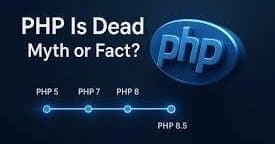
PHP powers 76% of the internet while developers chase trends. The language's critics often lack real-world experience, yet PHP continues to evolve with modern features and maintain strong job demand.
Every year, PHP quietly runs 76% of the internet and says nothing back. I will say something back.
The people loudest about PHP being dead are the same people who have never shipped a product, never handled a real client, and never built anything that actual humans use every day.
Let me be direct about who is actually calling PHP dead:
Developers who wrote bad PHP in 2008, blamed the language for their own skill level, and never came back to see what it became.
Content creators who need an opinion to get clicks. "PHP is dead" gets more views than "PHP is solid and pays well" — so they keep saying it.
Beginners who repeat what they heard without ever checking the job boards, the GitHub stats, or the actual state of the language.
The uncomfortable truth: Facebook was built on PHP. Wikipedia runs on PHP. Slack started on PHP. These are not small projects.
Laravel is consistently ranked among the most loved frameworks in the world — across all languages, not just PHP.
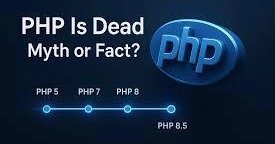
PHP 8.3 has JIT compilation, fibers, union types, match expressions. The people calling it outdated have not opened the docs since PHP 5.
Right now, thousands of companies are hiring PHP developers at competitive salaries. Dead languages do not have job boards.
Chasing trends is how you spend five years learning frameworks that get replaced. Learning fundamentals with a proven, stable language is how you actually get hired and stay hired.
PHP does not need to be the coolest language in the room. It just needs to keep powering three quarters of the internet, generating millions of jobs, and letting developers build real things for real clients.
It has been doing exactly that for 30 years while everyone argued about it.
If someone told you not to learn PHP — what was their reason? Drop it below. I want to see it.
The Real Cost of Chasing "Dead" Languages
When developers dismiss PHP, they're often making a career decision based on hype rather than data. The numbers tell a different story:
- 76% of all websites use PHP (W3Techs, 2024)
- Over 5 million developers worldwide use PHP (SlashData, 2023)
- Average PHP developer salary: $87,000/year (US) (Glassdoor, 2024)
- Laravel alone has over 75,000 GitHub stars and 25,000+ active packages
These aren't the metrics of a dying language — they're the metrics of a mature ecosystem that continues to evolve.
Modern PHP: What the Critics Don't See
The PHP of 2024 bears little resemblance to the PHP of 2008. Here's what's actually happening in the ecosystem:
Performance Breakthroughs
PHP 8.0 introduced the JIT (Just-In-Time) compiler, delivering up to 3x performance improvements for CPU-intensive tasks. Combined with opcode caching and optimized memory management, modern PHP applications can handle millions of requests per day on modest infrastructure.
Type Safety Evolution
From PHP 7.0 to 8.3, the language has embraced static typing:
- Union types (
int|float|string) - Intersection types (
User&Admin) - Enums (native, not just constants)
- Attributes for metadata
- Match expressions replacing clunky switch statements
Modern Tooling
The PHP ecosystem has caught up with modern development practices:
- Composer for dependency management (installed on 80% of PHP projects)
- PHPUnit for testing (used by 70% of PHP projects)
- PHPStan and Psalm for static analysis
- Docker and Kubernetes support
- Async/await patterns with fibers
The Business Case for PHP
From a business perspective, PHP offers compelling advantages:
Lower Total Cost of Ownership: PHP hosting costs 60-80% less than equivalent Node.js or Python setups. Shared hosting, VPS, and cloud options are abundant and mature.
Faster Development Cycles: Laravel's expressive syntax and comprehensive ecosystem reduce development time by 30-50% compared to building from scratch.
Massive Talent Pool: With millions of PHP developers worldwide, finding and replacing team members is significantly easier than niche languages.
Proven Scalability: Companies like Facebook, Wikipedia, and Slack scaled PHP to handle billions of requests. The architecture patterns they developed are now open-source and available to everyone.
The Real Problem: Developer Ego
The "PHP is dead" narrative often stems from developer ego rather than technical merit. It's easier to dismiss a technology than to acknowledge that:
- Your favorite language might not be the best tool for every job
- Success in software isn't about using the trendiest stack
- Real-world constraints (budget, timeline, team expertise) matter more than purity
As one senior developer put it: "The best language is the one that ships the product and keeps the lights on."
What to Actually Learn in 2024
Instead of chasing the next big thing, focus on fundamentals that compound over time:
Core Computer Science: Algorithms, data structures, design patterns — these transfer across languages
Database Fundamentals: SQL, indexing, query optimization — critical regardless of your backend
System Design: Understanding trade-offs, scalability patterns, and architecture principles
Soft Skills: Communication, project management, client relations — what actually determines career success
PHP happens to be an excellent vehicle for learning these fundamentals because:
- It's forgiving enough for beginners to experiment
- It's powerful enough for production systems
- It has a massive ecosystem to learn from
- It's stable enough that you won't be rewriting your app every 18 months
The Bottom Line
The next time someone tells you PHP is dead, ask them:
- How many production systems have they built?
- What's their track record with shipping products?
- Are they speaking from experience or repeating opinions?
PHP's critics often lack the scars of real-world development — the late nights debugging production issues, the pressure of client deadlines, the reality of maintaining systems for years.
Meanwhile, PHP continues doing what it does best: quietly powering the internet while the trend-chasers move on to the next shiny thing.

Join the Conversation
What's your experience with PHP? Have you faced criticism for choosing it? Share your story in the comments — I want to hear from developers who are actually building things, not just talking about building things.
And if you're considering learning PHP in 2024, know this: you're not behind the curve. You're standing on the shoulders of 30 years of proven technology that's still evolving, still hiring, and still powering the web.
Sometimes the most revolutionary thing you can do is choose the tool that actually works.
Comments
Please log in or register to join the discussion