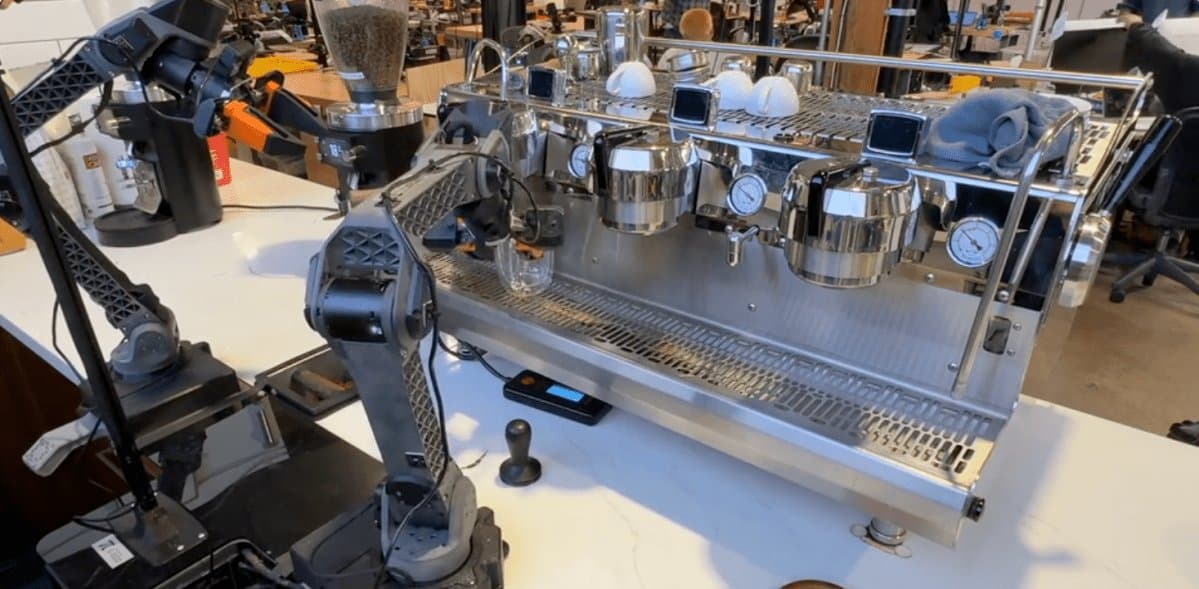
San Francisco-based robotics startup Physical Intelligence has unveiled π0.7, a model that demonstrates an ability to direct robots on tasks beyond their training data, potentially representing an early step toward more general robotic intelligence.
Physical Intelligence, a two-year-old San Francisco robotics startup, has announced π0.7, a model that claims to enable robots to perform tasks they weren't explicitly trained on. The company suggests this capability represents an "early sign" of generalization in robotic systems, a significant challenge in the field that has long limited real-world deployment of autonomous robots.
What Physical Intelligence claims is that their π0.7 model can take high-level task descriptions and translate them into executable robot behaviors, even for novel situations. This differs from traditional robotics approaches that require extensive task-specific training data and struggle with variations not present in the training set.
The technical details remain somewhat sparse in the announcement, but the core innovation appears to be in how the model represents and manipulates physical actions. Rather than learning specific motor patterns for specific objects, π0.7 seems to learn more abstract principles of manipulation that can be applied flexibly across different scenarios and objects.
"This isn't about teaching a robot to pick up a specific cup in a specific way," explained Sasha Levine, co-founder of Physical Intelligence. "It's about teaching the robot the concept of 'picking up' that can be applied to various objects in various contexts."
What might actually be new here is the approach to combining reinforcement learning with simulation-based training. The company appears to have developed a method for transferring knowledge from simulated environments to the physical world more effectively than previous approaches. This has been a persistent challenge in robotics, where the "sim-to-real gap" often prevents promising simulation results from translating to actual physical performance.
The model's performance metrics haven't been fully disclosed, but the company has shared some preliminary results where robots successfully completed tasks in novel configurations with approximately 75% success rates, compared to 40-50% for previous approaches. These numbers, while preliminary, suggest a meaningful improvement in generalization capabilities.
However, significant limitations remain. The tasks demonstrated so far are relatively simple - primarily involving object manipulation in structured environments. The model hasn't been tested in more complex, unstructured environments that would be necessary for widespread real-world deployment. Additionally, the computational requirements for real-time operation remain substantial, limiting practical applications.
"This is an interesting development, but we should be cautious about overinterpreting the results," said Dr. Ken Goldberg, a robotics professor at UC Berkeley who was not involved in the research. "Generalization in robotics is notoriously difficult, and what we're seeing might be clever task decomposition rather than true generalization."
The broader context here is the ongoing effort to create more capable robotic systems that can operate effectively in human environments. Current industrial robots excel at repetitive tasks in controlled settings but struggle with the variability and unpredictability of everyday environments. Improving generalization could unlock applications in logistics, home assistance, elder care, and disaster response.
Physical Intelligence was founded in 2024 by Sasha Levine and Dmitry Kalenichenko, both with backgrounds in AI and robotics. The company has raised approximately $65 million in funding from investors including Lux Capital and Radical Ventures.
The π0.7 model represents one approach to the generalization problem, but it's far from a complete solution. As robotics researchers continue to work on these challenges, we can expect incremental improvements rather than sudden breakthroughs. The true test will come when these systems can reliably operate in the complex, unstructured environments of the real world.
For those interested in exploring the technology further, Physical Intelligence has published a technical report outlining their approach, though full implementation details remain limited. The company has also open-some components of their framework on GitHub, allowing other researchers to build upon their work.
Comments
Please log in or register to join the discussion