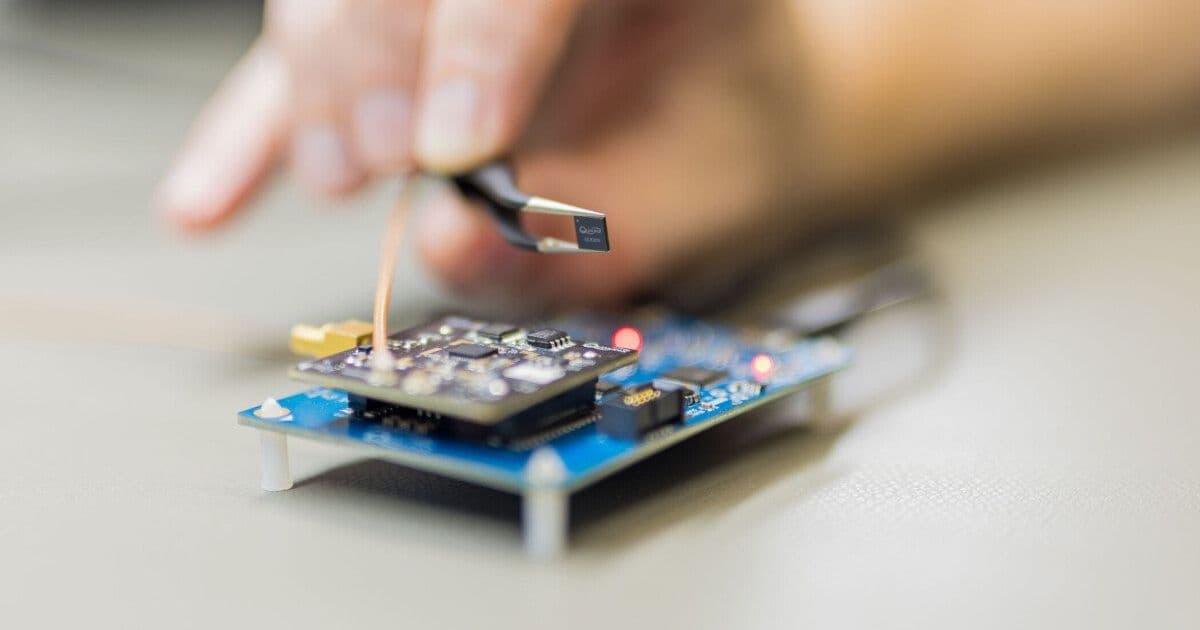
A Delft spin-off says it has produced security-critical satnav chips entirely within the EU, but the fab doing the work is owned by a US company. The case shows how the European Chips Act defines sovereignty by where production happens, not who owns the plant.
Dutch semiconductor startup Qualinx, a spin-off from Delft University of Technology, says it has demonstrated an end-to-end semiconductor fabrication flow that stays inside Europe from design through to finished silicon. The claim arrives alongside the tape-out of its QLX3xx family, a set of ultra-low-power Global Navigation Satellite System (GNSS) systems-on-chip aimed at aerospace, defense, and critical infrastructure customers.
The wrinkle, and the reason this story matters beyond a product announcement, is that Qualinx is fabless. It designs chips and contracts the actual manufacturing to someone else. In this case that someone is GlobalFoundries, an international firm headquartered in the United States. So the company billing itself as a proof point for European sovereign manufacturing is leaning on an American-owned foundry to make its parts. That tension is exactly where the regulatory questions live.
What the regulation actually requires
The relevant framework here is the European Chips Act, which entered force in September 2023. Its goal is to roughly double the EU's share of global semiconductor production capacity to 20 percent by 2030, backed by public and private funding mobilized through the act and member-state subsidies. The act does not condition support on the nationality of a company's ownership. It conditions support on where the manufacturing, and the associated process steps, physically take place.
That distinction is the whole point of the Qualinx case. GlobalFoundries is using its Dresden fab to establish what both companies describe as a European manufacturing flow, funded in part through the Chips Act. The compliance requirement being satisfied is locational: every step of the production process, from mask services through wafer production, occurs within the EU, and no sensitive design data leaves the region. Ownership of the parent company sits outside the test.
"This first secure product demonstrates that a fully European manufacturing path, from mask services to wafer production, is already a reality today," said Qualinx CEO Tom Trill.
For anyone responsible for supply-chain assurance in regulated sectors, the practical reading is that data residency and process residency are the controls that count under the current regime. If you are sourcing chips for defense or critical infrastructure work, the questions to put to a supplier are concrete: Where are the masks produced? Where is the wafer fabricated? Where is design data stored and processed during the run, and who has access? A US-headquartered foundry running a closed, EU-resident flow can satisfy those controls in a way that a fully European-owned firm using an Asian fab cannot.
The process node, and why it may not matter
The QLX3xx will be built on GlobalFoundries' FDX fully depleted silicon-on-insulator process, understood to be a 12nm node. That is well behind the leading edge. TSMC's 2nm N2 process is now in mass production. But the compliance and policy debate in Europe has increasingly questioned whether cutting-edge capacity is the right target at all.
The Center for European Policy Analysis (CEPA) has pointed out that European chip demand is concentrated in the automotive and industrial sectors, which depend on mature 28/22nm technology rather than bleeding-edge silicon. From a procurement and risk standpoint, a secure, auditable mature-node flow inside the EU may be more useful to the bulk of European buyers than a sovereign fab chasing the smallest transistors.
A second regulatory wave is coming
The timing connects to a broader policy shift. The European Commission's Digital Sovereignty package proposes a Chips Act 2.0, including funding for a sovereign "AI chip factory." Member states have been pressing Brussels for a rethink of the original act, and US firms have so far captured a large share of the subsidies disbursed under it. Compliance teams in the semiconductor supply chain should expect the definitions around sovereignty, trusted manufacturing, and data residency to be revisited and likely tightened as that successor framework takes shape.
The history here is not encouraging for purely national champions. The UK once had its own processor company in Bristol-based Inmos, maker of the Transputer, fabricated at Newport Wafer Fab in South Wales. That plant was later sold to US chip firm Vishay Intertechnology. Ownership of strategic fabs has a way of drifting across borders, which is precisely why the Chips Act anchors its requirements to process location rather than corporate flag.
"We are demonstrating that Europe can rely on a secure, end-to-end semiconductor manufacturing flow that meets the highest requirements of aerospace and defense," said GlobalFoundries SVP and general manager Dr Manfred Horstmann, calling the Qualinx partnership the first operational milestone.
For now, the Qualinx milestone is a useful test case for how European sovereignty rules work in practice. The chips are designed in Delft and fabricated in Dresden, the data stays in the EU, and the regulatory boxes are ticked, even though a US company owns the building where the wafers come out. Whether Chips Act 2.0 keeps that definition or narrows it is the question that procurement and compliance officers in regulated industries should be watching.
Comments
Please log in or register to join the discussion