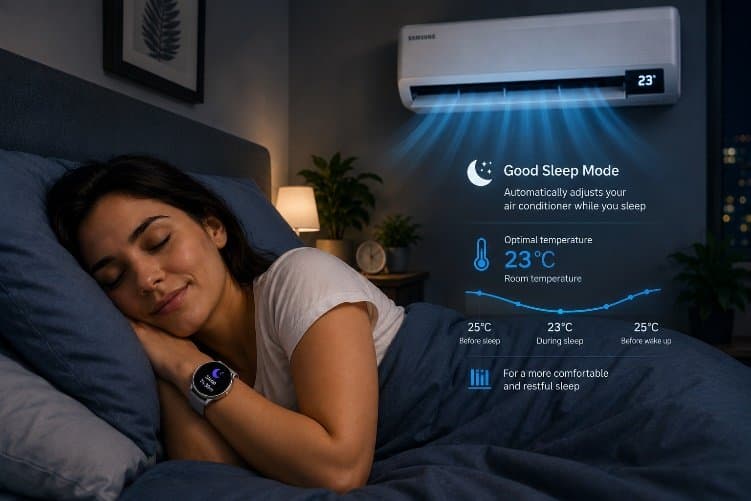
Samsung expands its smart home ecosystem with WindFree Wearable Good Sleep, a feature that automatically adjusts air conditioning based on sleep stages detected by Galaxy devices.
Maintaining the ideal temperature throughout the night has long been a challenge for sleepers, with traditional thermostats unable to adapt to the body's changing needs as we progress through different sleep stages. Samsung addresses this gap with its new "WindFree Wearable Good Sleep" feature, creating a seamless connection between wearable devices and home climate control.
What's New: The Sleep-Air Conditioning Connection
Samsung's latest innovation creates an automated bridge between its wearable ecosystem and home air conditioning systems. The WindFree Wearable Good Sleep feature detects when users transition from wakefulness to sleep and automatically activates specialized AC modes. Once the system identifies sleep onset, it triggers both "WindFree Cooling" and "Good Sleep" modes on compatible air conditioners.
The technical implementation relies on the advanced sleep tracking capabilities already present in Samsung's Galaxy Watch series and the Galaxy Ring. These devices use a combination of sensors including accelerometers, heart rate monitors, and proprietary algorithms to identify sleep stages with remarkable accuracy. When the device detects the onset of sleep, it communicates this information through the SmartThings app to the connected Bespoke AI WindFree 2026 air conditioner.
What makes this implementation particularly noteworthy is its progressive temperature adjustment throughout the night. Rather than maintaining a static temperature, the system automatically modifies cooling parameters based on detected sleep stages. Light sleep, deep sleep, and REM sleep each have different temperature requirements for optimal rest, and Samsung's solution adapts accordingly without user intervention.
How It Compares: Samsung's Ecosystem Advantage
Samsung's approach to sleep climate control represents a significant advancement over previous solutions in several ways. While other smart home systems have offered scheduled temperature adjustments or simple presence-based triggers, Samsung's integration with actual sleep stage detection represents a more sophisticated approach.
Compared to standalone sleep tracking apps that merely provide data without environmental control, Samsung's solution creates a closed-loop system where data directly influences the sleep environment. This stands in contrast to competitors like Google's Nest or Apple's HomeKit, which offer climate control but lack the deep integration with wearable sleep tracking that Samsung provides.
The specificity of Samsung's implementation also deserves attention. While some systems might offer basic "sleep mode" that simply adjusts temperature by a few degrees, the WindFree Wearable Good Sleep feature appears to use more granular data. The likely implementation considers factors like sleep stage transitions, body temperature fluctuations, and even breathing patterns to make micro-adjustments throughout the night.
From a hardware perspective, the Bespoke AI WindFree 2026 air conditioners represent the latest in Samsung's cooling technology. These units feature specialized "WindFree" technology that disperses air through 15,000 micro-holes, creating a gentle, draft-free cooling experience rather than the focused, potentially disruptive airflow of traditional units. This is particularly important during sleep, where even minor air currents can disrupt rest.
Who It's For: Samsung Ecosystem Deep Dives
The WindFree Wearable Good Sleep feature clearly targets Samsung's most dedicated ecosystem users. To implement this solution, consumers need multiple compatible components:
- A Galaxy Watch (likely the Watch6 series or newer) or the Galaxy Ring
- The SmartThings app installed on a Galaxy smartphone
- A Galaxy smartphone for integration and control
- One of the new Bespoke AI WindFree 2026 air conditioners
This requirement for complete Samsung ecosystem ownership creates both a barrier to entry and a cohesive user experience. For those already invested in Samsung's wearable and smart home products, this feature represents a natural extension of their existing setup rather than a new purchase decision.
The ideal user profile includes someone who:
- Values sleep optimization and has previously used sleep tracking
- Already owns multiple Samsung devices across categories
- Has the budget for premium smart home appliances
- Seeks automation without manual intervention
- Experiences temperature-related sleep disruptions
For potential adopters, the setup process appears straightforward: pair the wearable device with the SmartThings app, connect the compatible air conditioner, and enable the WindFree Wearable Good Sleep feature. Samsung's documentation suggests the system handles the calibration automatically, detecting the user's typical sleep patterns and adjusting accordingly over time.
Practical Considerations and Limitations
While the WindFree Wearable Good Sleep feature presents an innovative solution, several practical considerations should be noted. First, the ecosystem requirement means this solution won't work with non-Samsung devices, limiting its appeal to those who prefer mixed-brand smart home environments.
Second, the feature's effectiveness depends on the accuracy of the sleep tracking. While Samsung's wearables have generally received positive reviews for sleep monitoring, individual results may vary based on factors like sleep position, device fit, and personal physiology.
Third, the Bespoke AI WindFree 2026 air conditioners represent a premium product line, likely positioned at the higher end of the market. Pricing details aren't yet available, but Samsung's previous Bespoke models have typically carried premium price points compared to standard AC units.
For those interested in exploring this feature, Samsung's official website provides more information about the WindFree Wearable Good Sleep implementation and the Bespoke AI WindFree 2026 air conditioner specifications. The SmartThings app documentation also likely contains setup instructions for those ready to implement this sleep optimization solution.
As smart home technology continues to evolve, integrations like Samsung's sleep-focused climate control represent the frontier of personalized environmental automation. By creating a system that responds to biological needs rather than static schedules, Samsung may be setting a new standard for sleep optimization technology.
Comments
Please log in or register to join the discussion