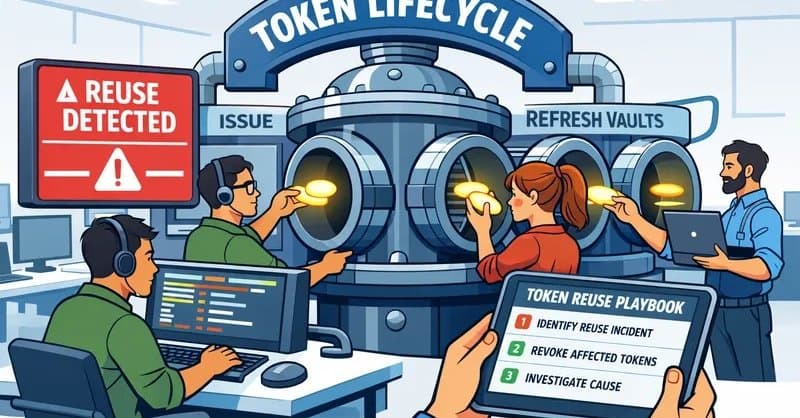
Access tokens, refresh tokens, revocation, and key rotation only work when they are designed as a lifecycle, not as isolated authentication features.
Problem
The DEV Community article on secure token lifecycle management is really about a failure mode many teams discover late: tokens become distributed authorization state, but they are often treated like signed strings that can be forgotten until they expire. That design works during demos. It fails under credential theft, password resets, device loss, signing key exposure, replay, and incident response.
A JWT access token validated locally by a resource server is attractive because it avoids a network call to the authorization server. That is the scalability win described by RFC 7519, compact claims that can be signed and checked without central coordination. The cost is that local validation also means local ignorance. If the user changes a password, an admin disables an account, or a refresh token family is compromised, a resource server that only checks signature and exp will continue accepting a token until its lifetime ends.
That is not a theoretical gap. In production, this shows up as sessions that survive account recovery, stolen refresh tokens that can be replayed, access tokens accepted after grant revocation, and incident responders waiting for clocks to run out because the system has no fast invalidation path. The longer the access token lifetime, the larger the blast radius. The more resource servers exist, the harder revocation becomes. The more caches sit between authorization and enforcement, the more consistency becomes the central design question.
The article’s practical advice is sound: short-lived access tokens, rotating refresh tokens, strict claim validation, revocation endpoints, introspection where needed, key hygiene, monitoring, and incident runbooks. The deeper lesson is that token management is a distributed systems problem. You are choosing between latency, availability, central control, operational complexity, and consistency. Security teams often phrase this as identity hygiene. Platform teams experience it as cache invalidation with attackers in the loop.
Solution Approach
A sensible token architecture starts by separating token roles. Access tokens should be short-lived authorization credentials. Refresh tokens should be longer-lived session credentials with server-side state, rotation, reuse detection, and explicit revocation. ID tokens should remain identity assertions for OpenID Connect clients, not general-purpose API credentials. Machine-to-machine credentials need their own issuance and rotation model because they do not have the same device, user, or session semantics.
For access tokens, the core claims need strict validation: iss, sub, aud, exp, iat, nbf where applicable, jti, scope, and client identity such as azp. RFC 8725 is the reference point for JWT safety, including algorithm validation and avoiding ambiguous interpretation. The resource server should not accept whatever algorithm the token header requests. It should have an allowlist. It should validate issuer and audience exactly. It should reject tokens with missing or stale temporal claims. It should treat jti as an operational identifier, useful for tracing, revocation, and forensic work.
The TTL decision is the first major trade-off. A five-minute access token limits replay but increases refresh traffic and failure sensitivity around the authorization server. A sixty-minute access token lowers load and improves tolerance to transient auth outages, but it gives attackers more time after theft and makes policy changes slower to enforce. Many systems choose 5 to 15 minutes for external APIs, then tune based on user experience, risk, and traffic shape. Internal services may tolerate longer lifetimes, but only if the network, workloads, and privilege model justify it.
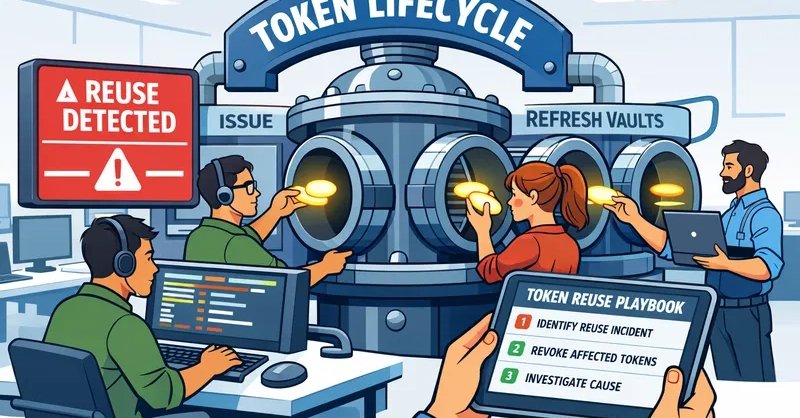
Refresh token rotation is where the lifecycle becomes more than expiration math. On every refresh, the authorization server should redeem the presented refresh token, mark it used, and issue a new refresh token. If the old token appears again outside a small retry grace window, the server should treat that as a compromise signal and revoke the entire token family. Auth providers such as Auth0 and Okta document this pattern because it turns silent persistence into a detectable event.
That detection property matters. Without rotation, a stolen refresh token is a durable credential. With rotation and family tracking, the attacker and the legitimate client race. If both use the same parent token, the second use reveals compromise. The system can then revoke descendants, force reauthentication, and alert operations. That is a better failure mode than hoping the user notices an active session on another device.
A practical refresh token table usually stores a token hash, not the raw token. It also stores user ID, client ID, token ID, parent token ID, family ID, issued time, last used time, expiration time, revocation status, device ID, IP address, and user agent. The raw refresh token belongs only on the client side. The server compares a hash at exchange time. Records should be marked revoked rather than deleted, because auditability is part of the control plane.
Revocation then needs multiple paths. The OAuth 2.0 Token Revocation spec, RFC 7009, defines a standard endpoint for clients to revoke tokens. That handles explicit logout, admin actions, and automated containment. For opaque tokens or resource servers that require current server-side policy, RFC 7662 token introspection lets the resource server ask the authorization server whether a token is active. For self-contained JWTs, a deny store keyed by token hash or jti can provide fast invalidation, although every resource server now needs access to that state or a local cache of it.
Key rotation is the blunt instrument. Tokens should carry a kid header, and authorization servers should publish signing keys through JWKS using metadata described by RFC 8414. Verifiers should cache keys, refresh on unknown kid, and tolerate planned overlap during normal rotation. If a signing key is suspected to be compromised, the operator can stop accepting tokens signed by that key. That action is effective, but broad. It may invalidate many users at once, so it needs to be tested before the emergency.
High-risk systems can add sender constraints. Bearer tokens have a simple weakness: possession is enough. DPoP, RFC 9449, and mTLS-bound tokens reduce the value of a stolen token by binding use to a private key or client certificate. This adds implementation cost and client compatibility constraints, but it changes the attacker’s job from copying a string to also controlling key material.
Monitoring closes the loop. Token systems should emit structured events for issuance, refresh, reuse detection, revocation, introspection, and key rotation. Useful alerts include reused refresh token parents, refresh attempts from distant regions within a short interval, resource servers accepting inactive tokens, sudden spikes in revocations, and unknown kid errors across many services. The OWASP JWT cheat sheet is a useful implementation checklist, but the operational layer needs dashboards and runbooks, not only library settings.
Trade-offs
Opaque tokens give the authorization server central control. Resource servers call introspection or a nearby cache, and revocation can take effect quickly. The trade-off is load, latency, and availability coupling. If introspection becomes a hard dependency for every request, the auth system sits on the critical path for the whole API fleet. Teams usually mitigate that with short introspection cache TTLs, local sidecars, regional replicas, or fallback rules, but each cache weakens immediate consistency.
Self-contained JWTs move validation to the edge. That scales well because resource servers verify signatures locally. The trade-off is stale authorization state. Once issued, the token is valid until expiration unless every verifier also checks a deny store, accepts near-real-time revocation signals, or uses very short lifetimes. This is a classic distributed systems exchange: fewer coordination points during normal traffic, more complexity during exceptional state changes.
Deny lists sound simple, but they become data systems. A deny entry needs a TTL matching the token’s remaining lifetime. Verifiers need low-latency access. The system needs to handle cache misses, partitions, and propagation delay. For a small monolith, a database-backed deny table may be enough. For a large API platform, the deny path may need Redis, regional replication, event streams, and clear behavior when the revocation store is unavailable.
Refresh rotation also carries cost. It adds writes to every refresh, requires transactional handling around parent and child tokens, and needs careful retry behavior. A mobile client with a flaky network may submit the same refresh request twice. A strict implementation might falsely classify that as theft. A lenient implementation might let replay slide. The usual compromise is a short grace window with idempotent response handling, tied to the same client and device metadata. Outside that window, reuse should be treated as hostile.
Short access token TTLs reduce attacker dwell time, but they increase refresh pressure. That pressure is manageable if the refresh endpoint is engineered like critical infrastructure: rate limited, horizontally scalable, backed by indexed token state, and isolated from slow downstream dependencies. If refresh depends on a fragile user profile service, an outage there becomes an authentication outage. Token issuance should use the minimum state required to make the authorization decision.
Revocation latency is the metric that tells the truth. A system can claim to support revocation, but if resource servers cache introspection for ten minutes and access tokens live for an hour, the effective revocation model is delayed. Teams should measure time from revocation request to enforcement across representative APIs. That measurement often exposes hidden caches, stale JWKS behavior, inconsistent middleware, or services that validate signatures but ignore audience.
The incident response side is where mature token systems separate themselves. A good runbook can revoke all refresh tokens for a user, client, device, token family, or signing key. It can force reauthentication for impacted sessions. It can rotate signing keys without breaking every verifier. It can answer which resource servers accepted a suspect token after compromise. NIST SP 800-61 provides the incident response framing, but the actual response depends on whether token events were logged with enough identifiers to reconstruct the chain.
The strongest design pattern is layered. Use short-lived JWT access tokens for scalable reads where a few minutes of staleness is acceptable. Use rotating, server-backed refresh tokens for session continuity and compromise detection. Use revocation endpoints for explicit invalidation. Use introspection or deny checks for high-risk APIs that need current policy. Use key rotation procedures that are rehearsed, not improvised. Use sender-constrained tokens where bearer semantics are too weak.
The article’s core message is practical: token security is not one setting. It is a lifecycle with issuance, validation, refresh, revocation, monitoring, and response. The architecture should assume that tokens will leak, clocks will skew, clients will retry, caches will lag, and incidents will happen outside business hours. A token system that survives those conditions is not just more secure. It is easier to operate under stress, which is usually where the real design is tested.
Comments
Please log in or register to join the discussion