
A surveillance vendor plans to give automatic license plate readers a second job: logging the Bluetooth and BLE signatures of phones, AirPods, and smartwatches passing by. The pitch is that a camera tracking cars can now help track the people inside them. The technical reality of what those radios actually leak is messier than the marketing suggests.
404 Media reports that Leonardo, the defense contractor behind the ELSAG line of automatic license plate readers, is developing an add-on called SignalTrace that would pair plate capture with passive collection of nearby wireless identifiers. The idea is straightforward to state and uncomfortable to think about: a roadside camera that already records every plate that drives past would also record the Bluetooth and Bluetooth Low Energy (BLE) advertisements leaking out of the cars, phones, earbuds, fitness bands, and tire-pressure sensors moving through its field of view.
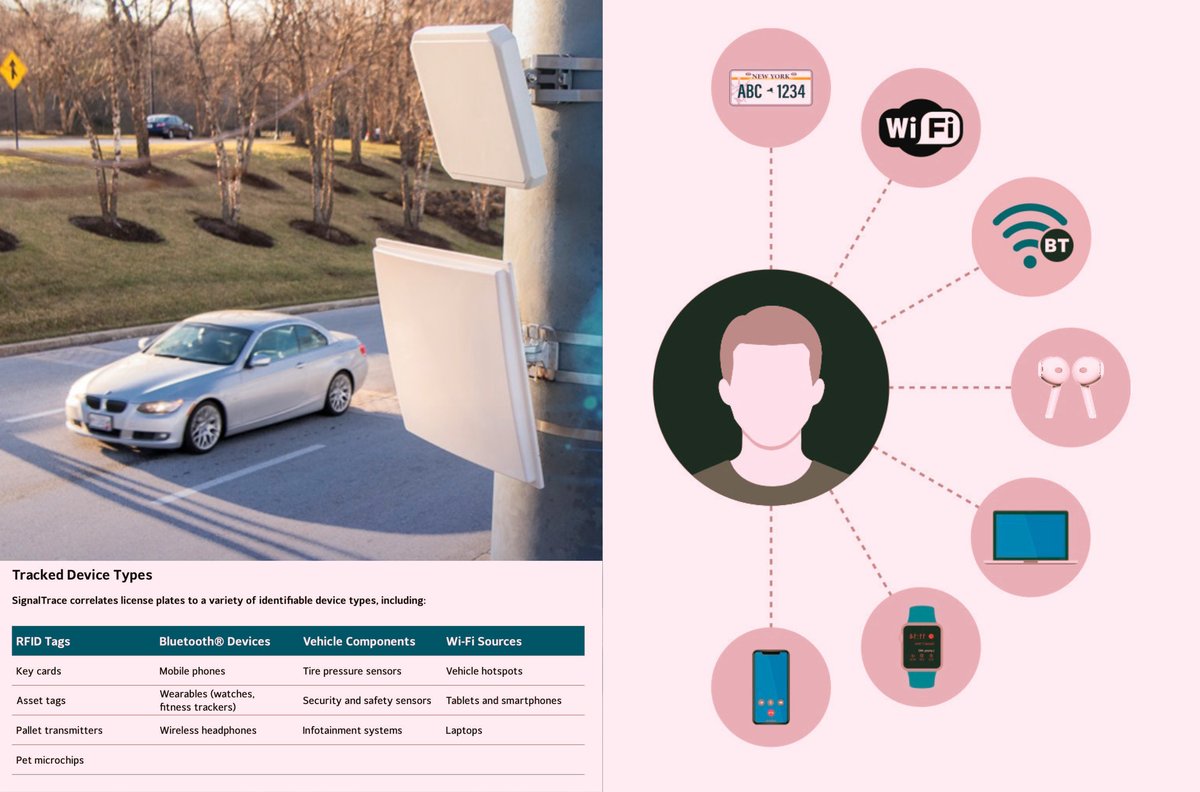
The claim is that this lets law enforcement move from tracking a vehicle to identifying the specific people in it. That is the part worth examining carefully, because the gap between "we captured a radio signal" and "we identified a person" is where most of the real engineering, and most of the overstatement, lives.
What an ALPR actually does today
A conventional ALPR is a camera plus an optical character recognition pipeline. It photographs vehicles, isolates the plate region, reads the characters, and writes a record: plate string, timestamp, GPS coordinates, and usually a full-frame image. Networks of these cameras, from Leonardo's ELSAG, Flock Safety, Motorola, and others, are now dense enough across the United States that aggregated reads can reconstruct a vehicle's movements over weeks. The data is the location history of a license plate.
The limitation, from a surveillance standpoint, is that a plate is tied to a registered vehicle, not to whoever is driving it. SignalTrace is an attempt to close that gap by listening for identifiers that travel with the person rather than the car.
What Bluetooth and BLE actually broadcast
This is where the substance is, so it is worth being precise about what these radios emit.
Classic Bluetooth and BLE devices announce themselves over the air. A BLE device sends out advertising packets on a set of channels, and those packets contain a device address along with optional payload data such as service UUIDs, device names, and manufacturer-specific fields. A passive receiver does not need to pair with anything to log this. It just listens. Building a sensor that captures these advertisements alongside a camera feed is not technically exotic; cheap commodity radios already do it, and researchers have used BLE advertisement collection for years to study foot and vehicle traffic.
The critical detail is the address. Bluetooth devices have a 48-bit MAC-style address, and a fixed, globally unique one would be a perfect persistent tracker. Apple, Google, and the Bluetooth SIG know this, which is why modern devices use MAC address randomization. iPhones, recent Android phones, AirPods, and most current wearables rotate their advertised address on an interval, often every 15 minutes or so, specifically to defeat passive long-term tracking. The advertised "random resolvable private address" is designed so that only a device you have already paired with can link the rotating addresses back to a single identity using a shared key.
So a naive reading, "the camera grabs your phone's permanent ID," is wrong for most current hardware. The address SignalTrace logs at one camera will usually not match the address the same phone broadcasts at a camera ten miles away an hour later.
Why randomization is not the end of the story
The harder truth is that randomization is leaky, and a system that combines radio capture with plate capture is positioned to exploit exactly those leaks.
Several well-documented weaknesses matter here:
- Stable payload fields. Randomization covers the address, but not always everything else in the advertisement. Some devices leak stable values in service data, manufacturer data, or device-name fields that survive an address rotation. Past research has shown that the contents of advertising packets can act as a fingerprint even when the address changes.
- Physical-layer fingerprinting. Individual radios have tiny, consistent imperfections in their carrier frequency, modulation, and timing. Academic work has demonstrated that these RF fingerprints can identify a specific chip across address rotations under the right conditions. This is far less reliable in the noisy real world than in a lab, but it is a known attack surface.
- Old and cheap devices. Plenty of fitness bands, medical devices, car infotainment systems, and tire-pressure sensors do not randomize at all and broadcast a fixed address indefinitely.
- Correlation through co-location. This is the one the camera pairing makes powerful. You do not need to crack randomization to be useful to an investigator if you can repeatedly observe the same plate co-occurring with the same set of BLE devices. Even rotating addresses, captured together with a plate read at the same instant, build a probabilistic link. See plate ABC123 arrive, log the cluster of devices present in that one-second window, and over enough sightings the statistical association between a vehicle and a set of personal devices becomes strong even without a stable identifier.
That last point is the real capability. SignalTrace's value to law enforcement is less "we read your phone's serial number" and more "we can tie the radios you carry to the car you ride in, and then track those radios independently." That framing is more defensible technically and arguably more concerning, because it works as a correlation engine rather than a single fragile lookup.
What is genuinely new versus repackaged
None of the underlying techniques are novel. Bluetooth sniffing for retail analytics, BLE-based crowd counting, and Wi-Fi probe-request tracking have all been deployed commercially and studied academically for over a decade. The shift here is integration and reach: attaching passive wireless collection to an already-pervasive, government-facing ALPR network with persistent storage and cross-camera aggregation.
The scale changes the privacy calculus. A single Bluetooth sensor in a store is a local nuisance. The same capability welded onto a national mesh of cameras that already log plate location histories, retained and queryable, is a categorically larger system. The capability is not a new physics result; it is an expansion of who is collecting, how persistently, and against whom.
The limitations worth holding onto
A skeptical read should keep a few things in view.
First, vendor descriptions of this kind of product routinely outrun the hardware. "Identify the driver" is a marketing sentence; the engineering delivers, at best, a probabilistic association that degrades with distance, speed, RF noise, address rotation, and the simple fact that a moving car spends a fraction of a second in a camera's range. Capturing a clean BLE advertisement from a vehicle at highway speed is not guaranteed.
Second, the legal posture is unsettled. Passive radio collection from the public airwaves sits in a different and murkier place than wiretapping, and whether this kind of bulk identifier capture requires a warrant is exactly the sort of question that tends to be litigated only after the systems are already deployed.
Third, defenses exist and are improving. Each round of OS-level randomization improvements raises the cost of persistent tracking, which is precisely why correlation-based approaches that lean on co-location rather than stable IDs are the more durable threat.
For the original reporting and Leonardo's plans, see 404 Media's coverage. For background on the address-randomization protections this kind of system pushes against, the Bluetooth SIG specifications describe how resolvable private addresses are supposed to work, and the Electronic Frontier Foundation's Atlas of Surveillance tracks where ALPR networks are already operating.
The honest summary is this: SignalTrace does not need to defeat Bluetooth privacy to be effective, and that is the uncomfortable part. By bolting a radio receiver onto a camera that already knows which car it is looking at, it turns the messy, leaky, supposedly-anonymized world of BLE advertisements into a usable correlation surface. The marketing promise of identifying a person is shaky. The practical capability of building durable associations between people's devices and the vehicles they travel in is not.
Comments
Please log in or register to join the discussion