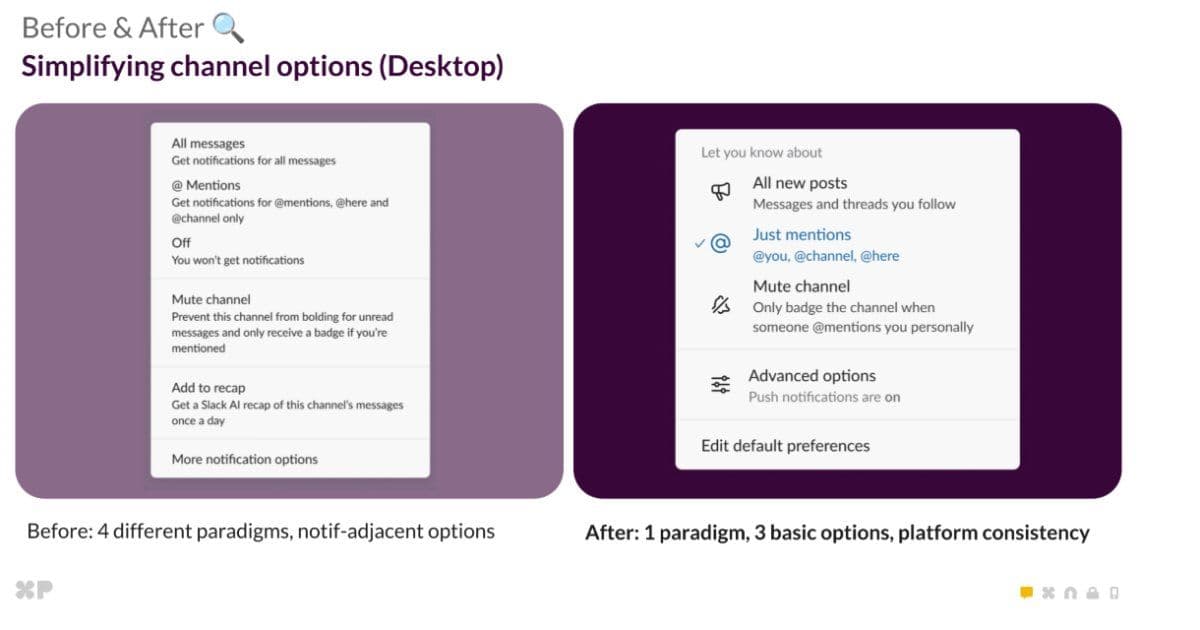
Slack has overhauled its notification architecture, replacing four legacy preference models with a unified system that simplifies user controls and improves cross-platform consistency, resulting in significantly higher engagement with notification settings.
Slack has rebuilt its notification system, introducing a unified architecture to improve consistency and user control across platforms. The redesign addresses long-standing issues with fragmented notification preferences and unpredictable behavior, which had become a significant source of user frustration and support overhead as the platform scaled.
According to Slack's engineering team, notification-related issues were among the most common drivers of customer support tickets. The root cause was an accumulation of multiple preference models with differing semantics, resulting in inconsistent behavior between desktop and mobile clients. Users often found it difficult to understand why they received certain notifications or missed others.
Frances Coronel, Senior Software Engineer at Slack, highlighted the challenge in a LinkedIn post, stating, "Notifications at Slack were one of our most complex, legacy-laden systems."
The New Architecture
The new system replaces four legacy preference paradigms with a simplified model centered on three options: all messages, mentions, or mute. A key architectural change separates notification intent from delivery. This decoupling distinguishes what activity generates a notification from how it is delivered, such as push alerts or in-app updates.
The approach enables scenarios where users can follow all activity within the application while limiting push notifications to high-priority events.
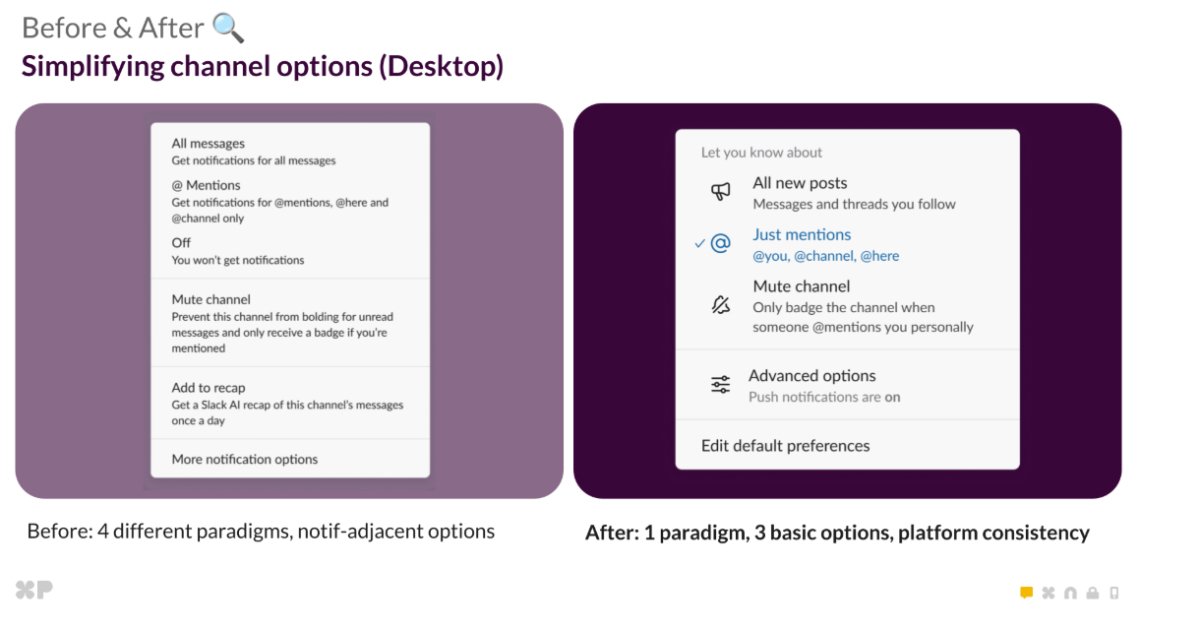
Before and After Simplifying Notifications (Source: Slack Blog Post)
Commenting on the redesign approach, Paweł Spychalski, Senior Full-Stack Developer, wrote in a LinkedIn post, "Simplification requires courage. The Slack team didn't add features; they removed complexity. They went from four preference systems to one."
Migration Strategy
To preserve existing user configurations, Slack avoided large-scale data migrations and instead introduced a read-time transformation layer. This layer maps legacy preferences into the new model while maintaining user intent. For example, prior configurations that disabled notifications are interpreted under the new system as limited visibility with push delivery disabled.
This approach allowed Slack to deploy the new architecture incrementally without disrupting user experience.
The redesign also introduces a hierarchical preference model that standardizes behavior across platforms. Desktop and mobile clients now share consistent logic and state definitions, reducing discrepancies that previously occurred when settings were configured on different devices. Achieving this required refactoring legacy mobile implementations and aligning frontend and backend representations of notification state.
Results and Impact
Slack reports that the new system resulted in a fivefold increase in user engagement with notification settings and a measurable reduction in notification-related support tickets. The company also observed that a majority of users adopted the default configuration focused on mentions and direct messages, suggesting improved alignment between system design and user expectations.
Advanced visibility options, such as badge indicators for unread messages, also recorded notable engagement. The company observed that the majority of users adopted the default configuration focused on mentions and direct messages, while more granular per-channel overrides were used less frequently, indicating improved alignment between default settings and user expectations.
The notification redesign reflects this principle by focusing on simplifying abstractions and improving consistency rather than incrementally extending legacy behavior.
Technical Takeaways
This architectural overhaul demonstrates several important principles for large-scale system redesign:
- Decoupling concerns: Separating notification generation from delivery enables more flexible user experiences
- Incremental migration: Using transformation layers instead of wholesale data migration reduces risk
- Simplicity over features: Reducing from four preference systems to one improved usability
- Cross-platform consistency: Standardizing behavior across devices reduces user confusion
- User-centric defaults: The success of the mentions-focused default suggests the team understood actual user needs
The Slack team's approach shows how addressing technical debt in core systems can have measurable business impact through reduced support costs and improved user engagement.
For engineering teams facing similar legacy system challenges, Slack's notification rebuild offers a practical blueprint: identify the core problem, simplify the model, preserve user intent during migration, and measure the results.
Comments
Please log in or register to join the discussion