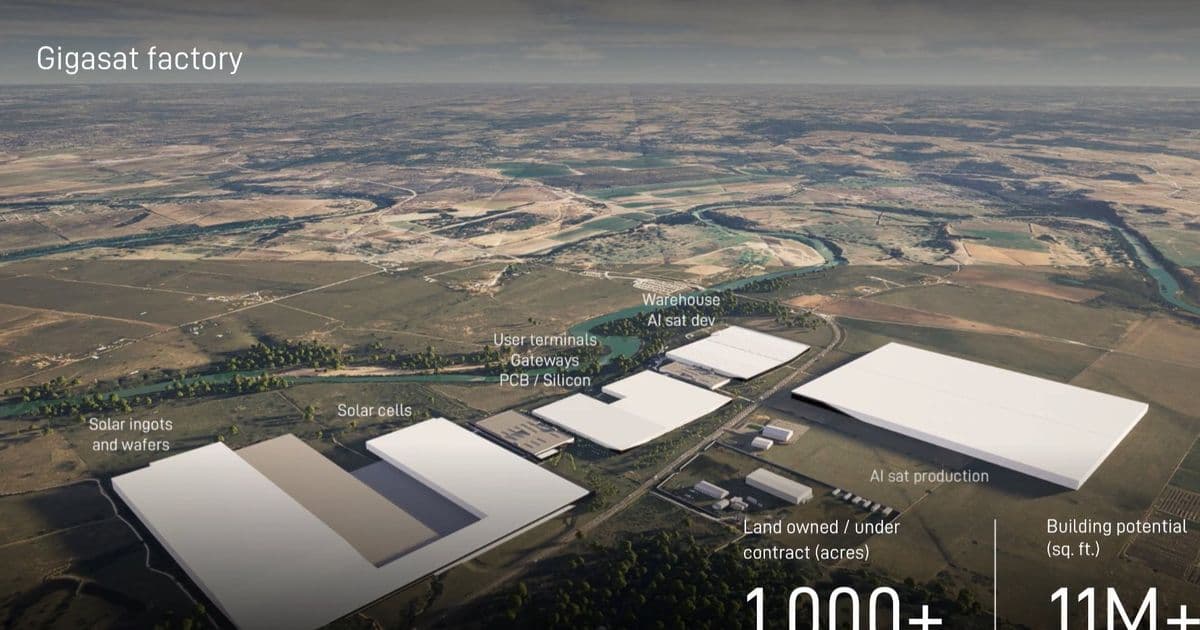
SpaceX is building a Bastrop, Texas megafactory ten times larger than its current Starfactory to mass-produce AI satellites, each carrying 150 kW of compute. The plan: an annualized rate of 1 GW of space-based AI capacity by the end of 2027, scaling tenfold per year toward a stated 100 GW target by 2030.
SpaceX has announced an 11-million-square-foot manufacturing complex in Bastrop, Texas, called Gigasat, dedicated entirely to building satellites that function as orbital data centers. In an internal interview posted to X on June 8, CEO Elon Musk laid out a production timeline that starts with complete "AI satellites" rolling off the line in 2027 and a target of 1 gigawatt of orbital AI compute capacity by the end of next year. From there, Musk wants to multiply that figure by an order of magnitude annually, a trajectory that would put SpaceX at 10 GW/year within two and a half years and 100 GW/year by roughly 2030.
The numbers are the story here, and they are aggressive enough to invite scrutiny at every step. To understand whether any of this is achievable, it helps to separate three distinct problems SpaceX is trying to solve at once: the satellite design, the factory that builds it, and the chip supply that feeds it.
The AI1 Satellite: 150 kW of Compute in Orbit
The centerpiece is a new satellite Musk calls AI1. It spans roughly 70 meters (about 230 feet), with the structure dominated by a large solar array generating power at a density of 250 W/m². The compute payload sits in the middle of the structure and peaks at 150 kilowatts. Cooling is handled by vertically oriented, double-sided radiators, the orbital equivalent of the heat-rejection problem that defines every terrestrial data center, except in vacuum there is no air or water to move heat into, only radiative dumping to deep space.
That 150 kW per satellite figure is the unit you have to keep multiplying. A single Nvidia GB200 NVL72 rack draws on the order of 120 kW, so one AI1 is, very roughly, a rack-and-change of compute hanging in low Earth orbit, powered entirely by sunlight and cooled by radiating into the dark.
The arithmetic of the headline goal follows directly. If each satellite carries 150 kW and SpaceX wants 1 GW of annualized capacity by late 2027, that implies launching on the order of more than 6,000 AI1 satellites in a single year. For scale, Starlink currently operates about 10,500 active satellites as of June 2026, a constellation built up over roughly seven years. SpaceX is proposing to launch a comparable count of much larger spacecraft annually.
Gigasat: Vertical Integration at an Unusual Scale
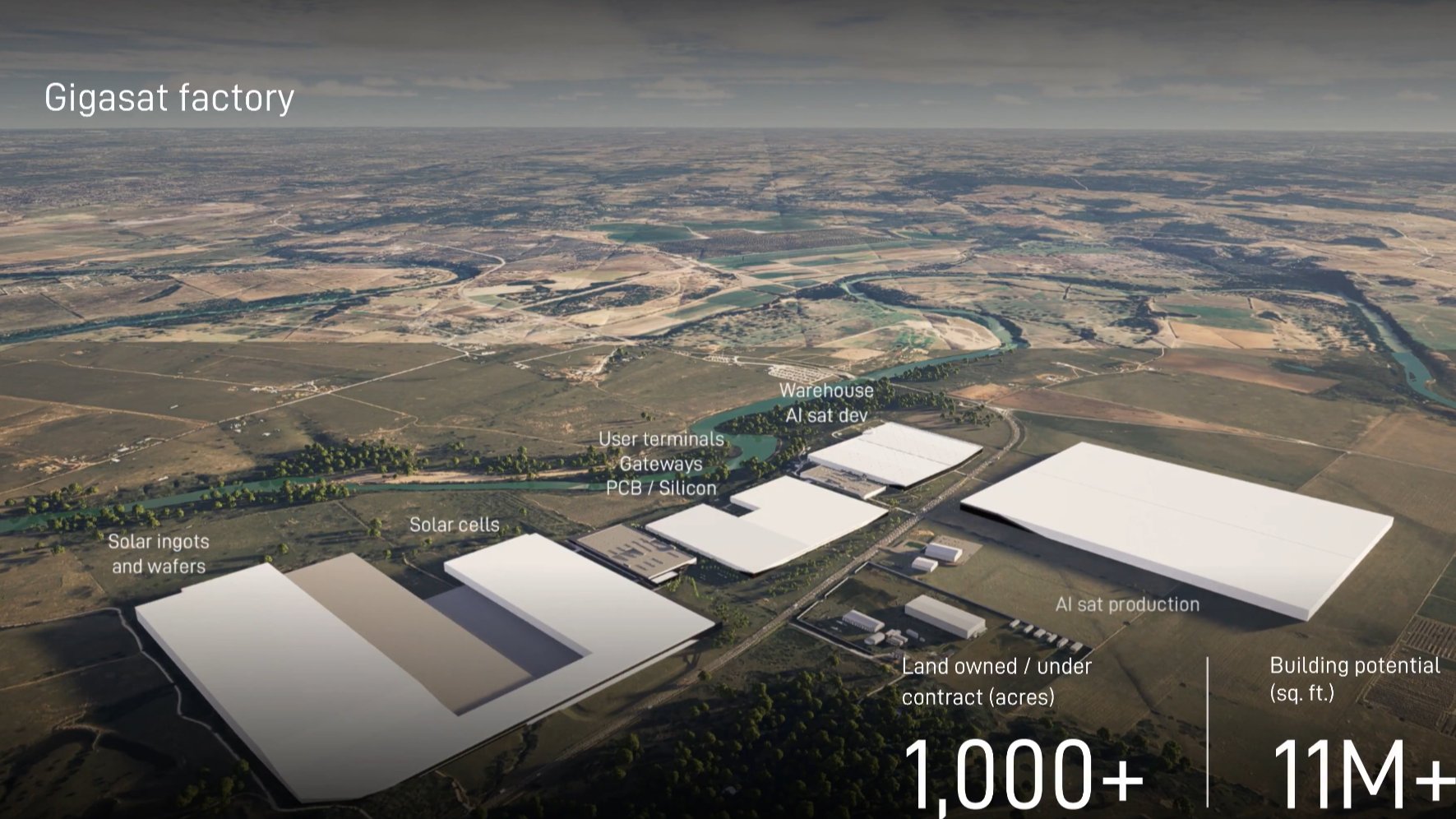
The factory itself is the part that looks most credible, and it is worth understanding why. At 11 million square feet on a 1,000-acre site, Gigasat is more than ten times larger than Starfactory, SpaceX's current largest spacecraft plant. The design philosophy is heavy vertical integration: rather than buying components from a supplier network, the campus is meant to produce solar ingots and wafers, finished solar cells, printed circuit boards, silicon-based electronic components, user terminals, gateways, and the AI1 satellites themselves, all in one place.
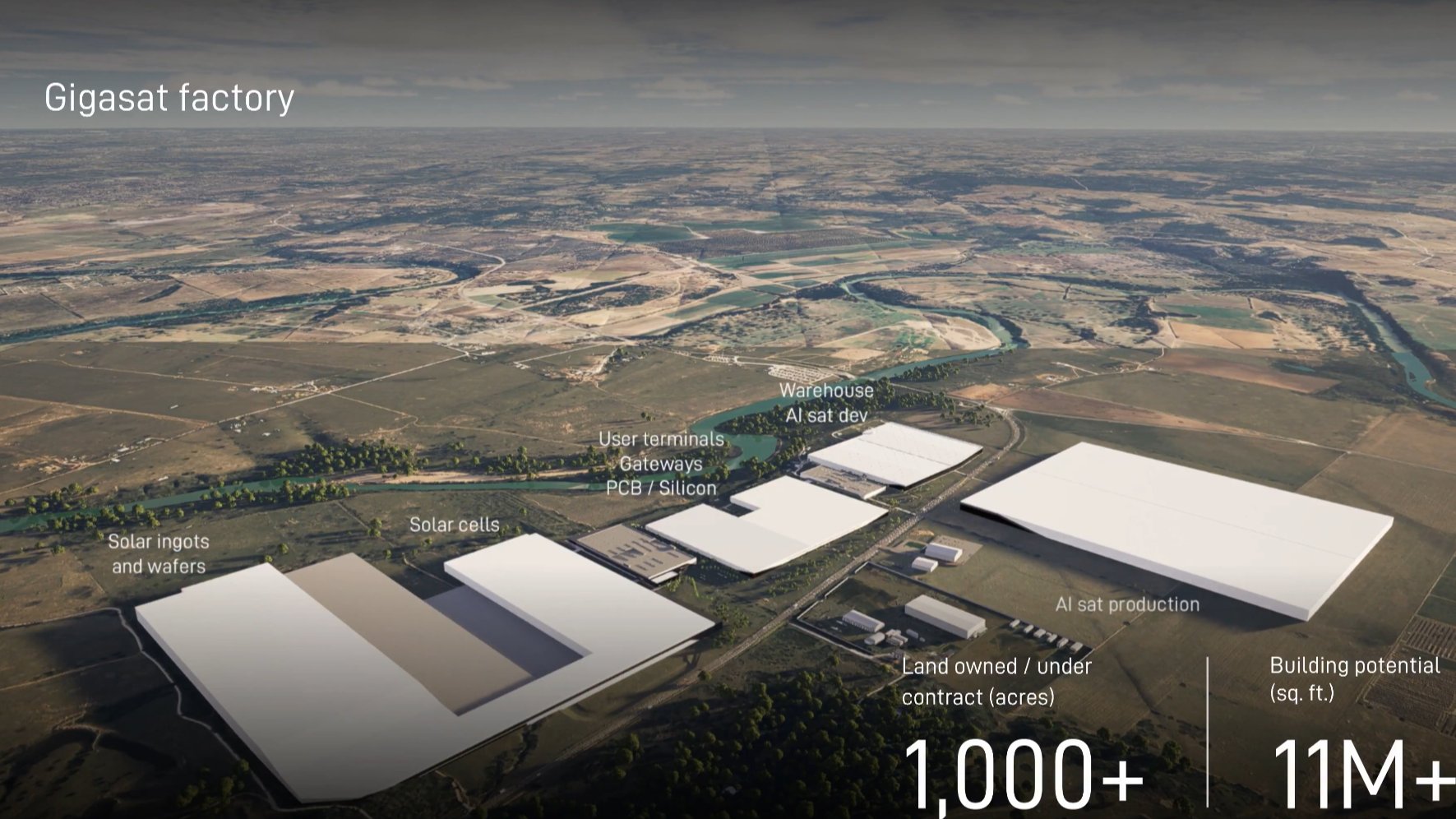
That single-campus approach matters for cost and throughput. Solar ingot and wafer growth, cell fabrication, and PCB assembly are mature, well-characterized manufacturing processes. According to Musk, the solar manufacturing buildings are already under construction, and the AI satellite production building is about to break ground. The site also folds in dedicated development and test facilities, warehousing, and logistics.
The reason a 2027 production start is plausible comes down to how much of this is conventional work. Manufacturing solar arrays, wiring harnesses, and satellite bodies at volume is something SpaceX already does for its Starlink V3 satellites. Gigasat is, in large part, the same competency scaled up rather than a leap into unproven physics. SpaceX is genuinely ahead of the field on orbital data center hardware for this reason.
Where the Plan Gets Hard: The Chips
The weak link is not the satellite bus or the solar panels. It is the compute payload. A gigawatt of AI accelerators per year is an enormous order, and 100 GW/year is in a different category entirely.
Put it in terrestrial terms. The largest AI data center anyone has publicly announced is Meta's Hyperion in Louisiana, designed to scale to 5 GW and house roughly 2 million GPUs at full buildout, at a cost north of $100 billion, with only its first 2 GW phase due by 2030. xAI's Colossus 2 in Memphis recently expanded to nearly 2 GW with about 555,000 GPUs for roughly $18 billion, currently the world's largest single-site AI installation. Against those benchmarks, 100 GW/year is approximately 20 Hyperions or 50 Colossus-2s built and launched every year.
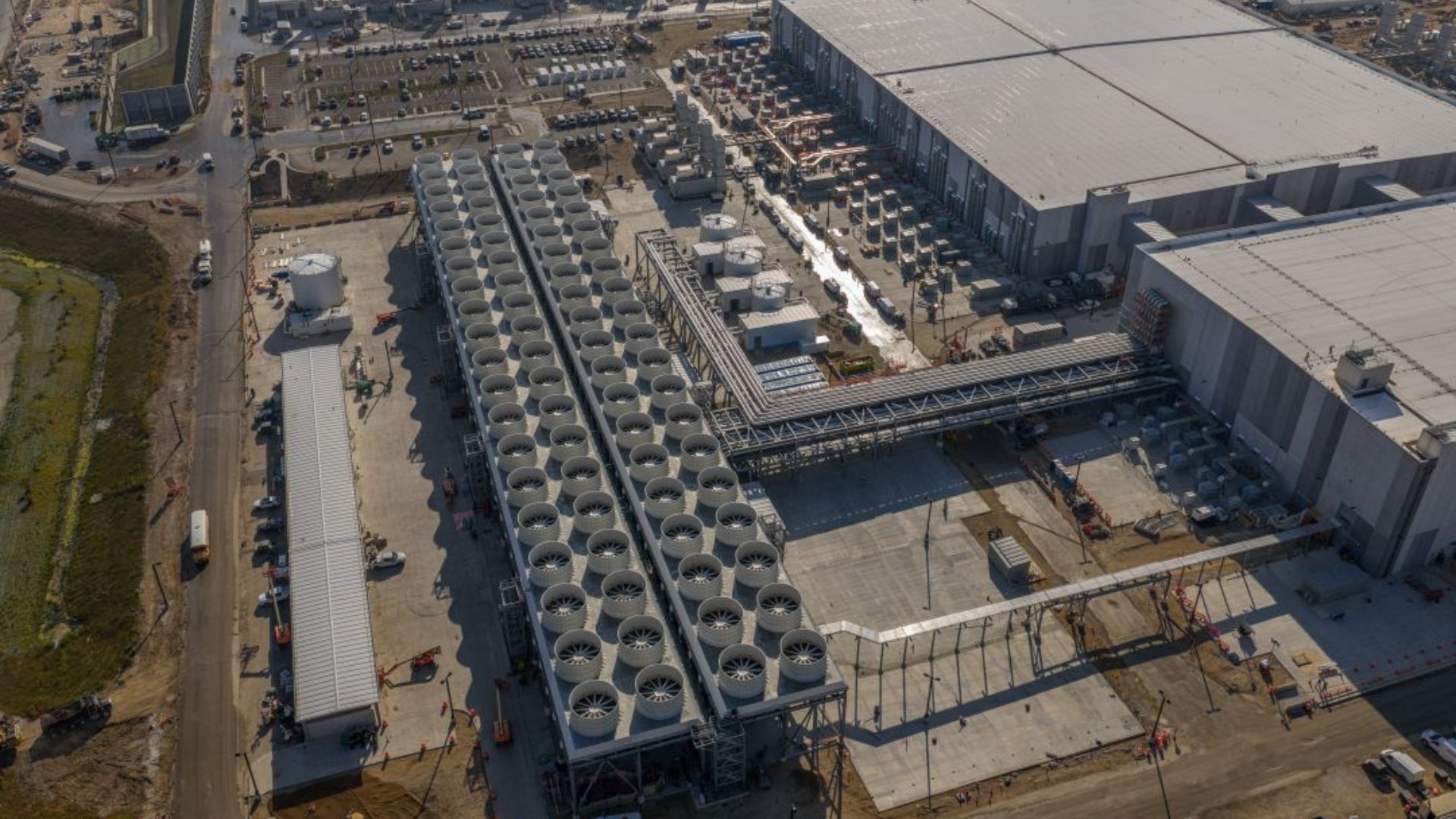
Supplying that many accelerators is where Musk's answer becomes its own moonshot. The proposed solution is Terafab, a joint SpaceX/Tesla/xAI venture in Austin aiming to fabricate 1 terawatt of compute per year, on the order of 100 to 200 million advanced chips, inside a 100-million-square-foot plant. The skepticism around that project is substantial and, frankly, earned. None of the three companies has ever fabricated a chip, and the plan reportedly starts at the bleeding-edge 2nm node, where even TSMC and Samsung, with decades of process development behind them, are still ramping yields. Building a leading-edge fab is not a problem you brute-force with floor space; it is a problem of process control, defect density, and tooling lead times measured in years.
Why Orbital Compute Is Being Taken Seriously
The strategic logic behind all of this is the power and cooling crunch on the ground. Terrestrial AI buildouts are running into hard limits on grid interconnection, water for cooling, and local energy supply, with multi-gigawatt campuses now straining regional utilities. An orbital data center sidesteps two of those constraints directly: power comes from continuous solar exposure, and waste heat radiates into space rather than into a watershed.
The trade-offs are equally real. Radiative cooling is far less efficient per unit area than liquid cooling on the ground, which is why AI1 devotes so much structure to radiators. Latency to and from orbit, radiation hardening of advanced silicon, in-orbit servicing, and the sheer launch cadence required all remain open questions. A 6,000-satellite annual launch rate, even for a company that has rewritten the economics of orbital launch, is a demanding figure.
Musk framed the targets as aspirational, saying the company will "try to do" a gigawatt-per-year annualized rate by the end of next year, then "aspirationally, scale that by an order of magnitude per year," reaching 10 GW within two and a half years and 100 GW within three and a half, with a one-day ambition of a terawatt per year contingent on progress in chip making. That last clause is the load-bearing one. The factory will likely get built, the satellites will likely fly, and the solar and structural manufacturing is on solid ground. Whether the compute exists to fill them at anything approaching these numbers depends almost entirely on a fab that does not yet exist, attempted by companies that have never made a chip, at the most demanding process node in the industry.
For now, Gigasat marks a concrete step toward orbital compute moving from concept to production line, and it puts SpaceX clearly in front of a race that other players have barely entered. The targets past the first gigawatt are best read as a direction of travel rather than a schedule.
Comments
Please log in or register to join the discussion