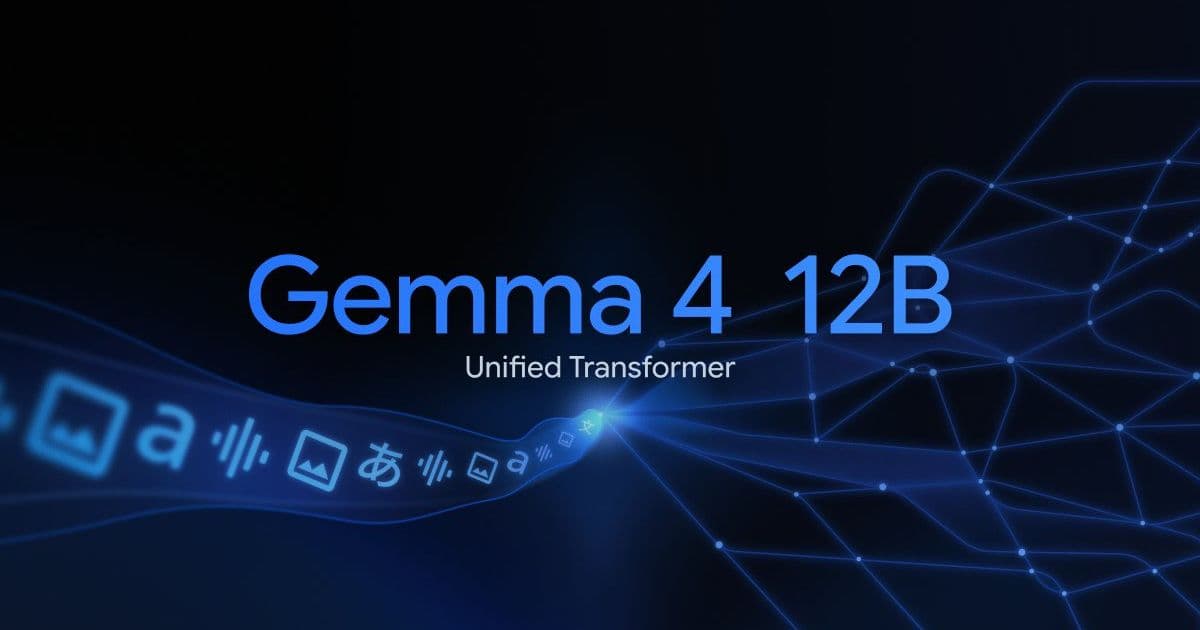
Google's new 12B model ditches the separate vision and audio encoders most multimodal systems rely on, feeding raw image and audio signals straight into the language backbone. The claimed payoff: performance close to the 26B MoE at under half the memory, small enough to run locally. Here's what that architecture actually buys you, and where the marketing outruns the evidence.
Google DeepMind released Gemma 4 12B on June 3, slotting it between the edge-focused E4B and the 26B Mixture of Experts model. The headline isn't the size. It's the architecture: Gemma 4 12B processes images and audio without dedicated encoders, pushing those inputs directly into the LLM backbone. That's a genuine departure from how most open multimodal models are built, and it's worth examining what the change does and doesn't accomplish.
What's claimed
The pitch has four parts. First, an encoder-free unified architecture that handles vision and audio natively. Second, reasoning benchmarks "nearing" the 26B MoE model. Third, local execution on consumer hardware with 16GB of VRAM or unified memory. Fourth, an Apache 2.0 license with broad tooling support. Google also notes this is its first mid-sized Gemma with native audio input, and that the Gemma 4 family has crossed 150 million downloads.
The model ships with Multi-Token Prediction (MTP) drafters for speculative decoding, which is a latency optimization rather than a capability claim. More on that below.
What's actually new
The architecture is the substantive part. A conventional multimodal model like LLaVA or the earlier Gemma vision variants runs images through a separate vision encoder (typically a SigLIP or CLIP-style tower), produces embeddings, and projects those into the language model's token space. Audio models do the same with a dedicated audio encoder, often a Conformer or Whisper-derived stack. These encoders are real parameters, real memory, and real latency sitting in front of the LLM.
Gemma 4 12B removes them. Per Google's description, vision now goes through "a lightweight embedding module consisting of a single matrix multiplication, positional embedding and normalizations," and the LLM backbone does the actual visual processing. Audio is even more stripped down: the raw signal is projected into the same dimensional space as text tokens, with no audio encoder at all.

If that holds up under scrutiny, it's the interesting result here. It means the transformer is learning to interpret pixel patches and audio frames using the same attention machinery it uses for text, rather than relying on a pretrained perception module to pre-digest the input. That's an architectural bet that a sufficiently capable LLM backbone can absorb perception, and it trades the inductive biases of a purpose-built encoder for fewer moving parts and lower memory overhead.
The practical consequence is the memory story. A separate vision tower can run hundreds of millions to over a billion parameters; an audio encoder adds more. Folding that work into the backbone and replacing the front-end with a matrix multiply is how you get a 12B multimodal model into 16GB. The claim that it lands at "less than half the total memory footprint" of the 26B MoE is consistent with that design.
How the encoder-free approach works
The mental model is straightforward. In a standard pipeline, an image is tokenized by a vision encoder into a fixed set of embeddings that already encode high-level features (edges, objects, spatial relations) learned during the encoder's own pretraining. The LLM receives a polished summary.
In the encoder-free setup, the LLM receives something much closer to raw input. The single matrix multiplication for vision is essentially a learned linear projection from patch space into the model's embedding dimension, plus position information so the model knows where each patch sits. The audio path skips even that intermediate structure, projecting the waveform representation straight into token space. The backbone's attention layers then have to do the perceptual heavy lifting that an encoder would normally handle.
The trade-off is real and cuts both ways. You save the encoder's parameters and the latency of running a second network. You also lose the encoder's specialized pretraining, which means the backbone has to be trained well enough to compensate. Whether it fully does is exactly the kind of thing benchmarks summarize and gloss over at the same time.

On the benchmark claims
"Nearing our 26B model" is the phrase doing the most work in the announcement, and it deserves the standard skepticism. "Nearing" is not "matching," and benchmark proximity on standard suites rarely translates linearly to the messy multimodal and agentic tasks people actually run. The announcement does not, in the material provided, name specific benchmarks or report the numbers, which is the first thing a practitioner wants to see. The developer documentation and model cards on Hugging Face and Kaggle are where the actual figures live, and they're where you should go before believing the framing.
The more credible part of the claim is the efficiency-per-capability ratio. A 12B model that gets within reach of a 26B MoE while halving memory is plausible precisely because MoE models carry a large parameter count they only partially activate per token. A dense 12B can be competitive on quality while being far simpler to deploy. That's a reasonable engineering outcome, not a miracle.
The drafter detail
MTP drafters are speculative decoding built in. The idea: a small, fast "drafter" predicts several future tokens at once, and the main model verifies them in a single forward pass, accepting the ones it agrees with. When acceptance rates are high, you get multiple tokens per expensive forward pass and throughput climbs. Shipping the drafters with the model means you get the latency benefit without bolting on a separate draft model yourself. It's a sensible inclusion for local inference where every token of latency is felt directly by the user.
Limitations and open questions
A few things to watch. The encoder-free approach is elegant on paper, but encoders exist because they work; removing them puts more burden on training quality and data. The audio-without-encoder design is the most aggressive choice here, and audio understanding from raw projections is harder to get right than the demo of offline transcription and translation suggests. The Eloquent app demo shows transcription, formatting, and translation running offline, which is a fair showcase, but controlled demos are not stress tests.
The "16GB" figure also depends heavily on quantization and context length. A 12B model at full precision does not fit in 16GB; the local-laptop story assumes 4-bit or similar quantization, and long multimodal contexts will pressure that budget fast. The local experience will vary a lot between a quantized GGUF in Ollama or LM Studio and a higher-precision deployment.
Finally, the agentic framing leans on the new Gemma Skills repository, a library meant to help agents build with the models. Skills libraries are useful scaffolding, but "agentic" remains a capability that depends far more on reliability under multi-step tool use than on any single model release. Treat that part of the announcement as direction, not delivered.
What to do with it
If you build local or edge multimodal applications, Gemma 4 12B is worth testing on your own data the day you can download it, specifically because the architectural change targets the exact bottleneck (encoder memory and latency) that makes on-device multimodal hard. The Apache 2.0 license and support across llama.cpp, MLX, vLLM, SGLang, and Unsloth for fine-tuning means you can evaluate it without licensing friction and adapt it if the base model falls short on your task.
The right posture is interested but unconvinced until the numbers and your own evals confirm the framing. The architecture is the real story; the benchmark adjectives are marketing until proven otherwise. Pull the weights, run your hardest multimodal cases, and check whether dropping the encoders cost you anything that matters for your workload.
Comments
Please log in or register to join the discussion