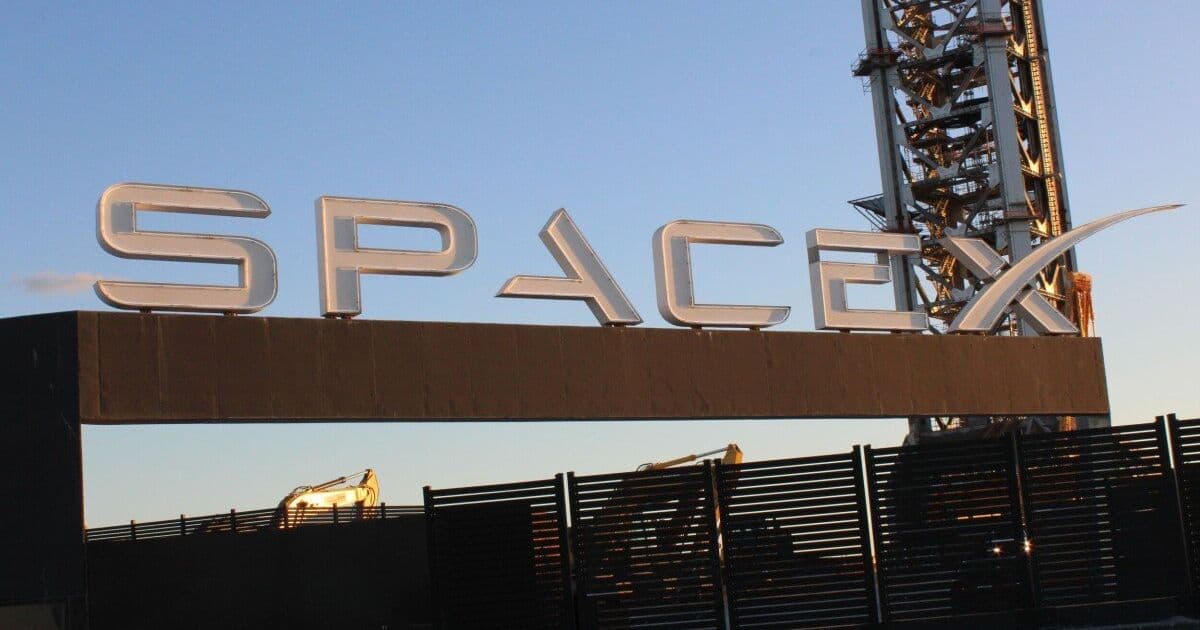
SpaceX priced the largest IPO in US history at $135 a share, raising $75 billion against a $4.9 billion annual loss. Behind the headline valuation sits a Form S-1 that reveals how much investors are betting on Starlink's data business, an unproven AI segment, and a regulatory framework that asks companies to disclose risk but never to prove it.
SpaceX has priced its initial public offering at $135 a share, raising $75 billion and valuing Elon Musk's rocket company at roughly $1.78 trillion. If underwriters exercise their option to buy additional stock, the total could climb to about $86 billion, which would make it the largest IPO in US history. The company confirmed in its filings that 555.6 million shares of Class A common stock were sold, with another 83.3 million held back for underwriters.
The number that should hold a reader's attention, though, is not the valuation. It is the loss. SpaceX reported a net loss of $4.9 billion on revenue of $18.7 billion in 2025. The IPO values the company at more than 90 times that revenue. For anyone trying to understand what just happened, the gap between those figures is the whole story, and the document that explains it deserves more scrutiny than the share price.
What happened
A company that loses money sold a slice of itself to the public for an amount that implies investors expect it to eventually dominate several markets at once. SpaceX divided its operations in its Form S-1 into three segments: Space, covering the Falcon 9 launch business and the still-developing Starship; Connectivity, which is the Starlink satellite internet service; and AI. Only Connectivity turns a profit, reporting $4.4 billion in 2025. The other two continue to absorb cash.
The offering was heavily oversubscribed. According to the Financial Times, orders exceeded available shares by more than three times. Retail investors ordered more than $100 billion of stock and were allocated between 20 and 25 percent of what sold. That detail matters, because it means a large share of the risk in this deal has been distributed to individual buyers rather than concentrated among institutions equipped to absorb it.
The legal basis
An IPO in the United States runs on a single regulatory principle: disclosure. The Securities and Exchange Commission does not decide whether SpaceX is a good investment or whether its $28.5 trillion estimate of its total addressable market, including $22.7 trillion in what it labels "Enterprise Applications," is plausible. The SEC's job under the Securities Act of 1933 is to require that a company tell prospective investors the truth about itself, including the risks, and then to let buyers make their own judgment.
That is why the Form S-1 exists, and why its risk-factor section is the part worth reading before the marketing language. The system assumes that if a company honestly states it loses billions of dollars a year, that its profitable segment depends on a single product line, and that its most valuable plans remain unbuilt, then an informed market can price those risks. The regulator polices the accuracy of the disclosure, not the wisdom of the bet.
This is a meaningful distinction for the people putting in money. A document that discloses risk is not a document that mitigates it. The legal protection on offer is the right to have been told, not the right to be made whole if the projections fail. When SpaceX states that Starship "remains a work in progress" or that profitability in AI continues to elude it, those sentences are doing regulatory work. They convert future disappointment into something investors were warned about.
Impact on users and companies
The segment generating actual profit is Starlink, and that should interest anyone who cares about how personal data and communications infrastructure are governed. Starlink is not just a hardware business. It is a network operator that routes the internet traffic of millions of users across dozens of countries, many of which have weak or absent data protection regimes. A satellite constellation owned by a now-public company sits at the center of communications for users who frequently have no local regulator capable of holding it to account.
In the European Union, an operator carrying user traffic of this kind falls within the reach of the General Data Protection Regulation, which governs how personal data is processed, where it is transferred, and what rights individuals retain over it. In the United States, state laws such as the California Consumer Privacy Act impose disclosure and deletion obligations on companies handling resident data. A publicly traded Starlink will face sharper questions about cross-border data flows, government data requests, and lawful interception than a privately held one, because public companies attract regulatory attention and shareholder litigation that private ones can often sidestep.
The AI segment raises a parallel set of concerns that the financial framing tends to obscure. Training and operating large AI systems consumes vast quantities of data, and the provenance and consent status of that data is exactly the territory that European and US regulators have begun to police more aggressively. A company that has now told public markets it intends to build a profitable AI business has also told regulators where to look.
Then there is the structural worry. SpaceX has pitched itself, in its own filing, as an integrated provider spanning launch, connectivity, and computing, with ambitions extending to space-based datacenters. Concentrating launch capacity, satellite internet, and AI compute inside one firm is the kind of vertical integration that competition authorities watch closely, because a single point of control over infrastructure tends to translate into a single point of leverage over the users and businesses that depend on it.
What changes
The most immediate change is transparency. As a public company, SpaceX must file quarterly and annual reports, disclose material events, and submit to the ongoing reporting obligations of a listed entity. For researchers, journalists, and regulators, this is a genuine gain. Claims that previously lived in pitch decks now have to appear in audited filings, and the gap between Musk's public statements and the company's actual financial position becomes measurable in a way it was not before.
The valuation also creates pressure. A company priced at 90 times revenue has to grow into that number, and the means of doing so, expanding Starlink's subscriber base, monetizing AI, and eventually delivering Starship, all involve handling more data, occupying more spectrum, and operating in more jurisdictions. Each of those moves invites regulatory engagement. Investors are betting on growth; the regulatory consequence of that growth is more oversight, not less.
For individual investors specifically, the lesson sits in the structure of the deal. Roughly a quarter of the shares went to retail buyers, and the disclosure regime that protects them works only if they read what was disclosed. The S-1 states plainly that the company loses money and that its grandest plans are unproven. Those are not hidden details. They are the legally required warnings, and the protection they offer is exactly as strong as the attention paid to them.
Musk himself could become a paper trillionaire depending on how the stock trades, a figure that would climb further if SpaceX delivers on a human settlement on Mars or orbital datacenters. Whether any of that arrives is a question the SEC pointedly does not answer. The regulator guarantees only that buyers were told what they were buying. Everything after that belongs to the market, and to the long history of promises around Musk that have struggled to survive contact with reality.
Comments
Please log in or register to join the discussion