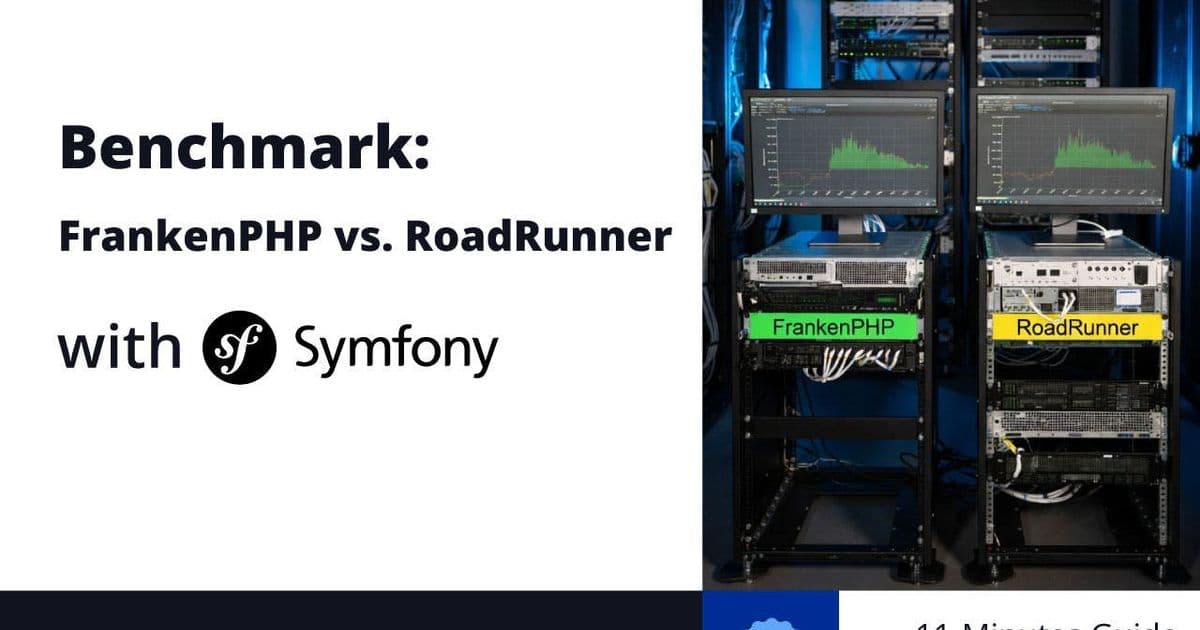
Comprehensive performance analysis reveals how modern PHP application servers transform Symfony execution, with FrankenPHP and RoadRunner delivering 3-4x throughput gains over traditional setups.
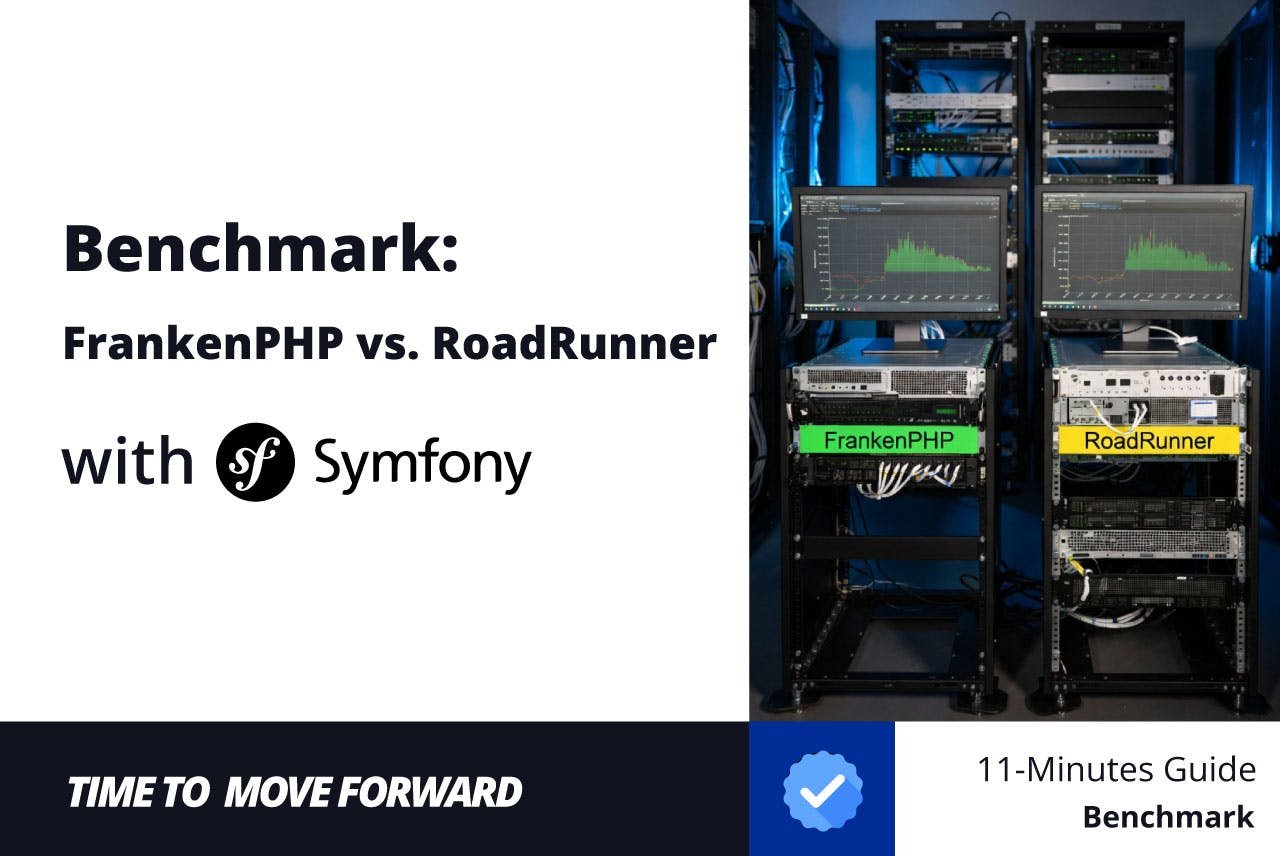
The release of Symfony 7.4 LTS marks a pivotal moment in PHP development, shifting focus from framework features to deployment efficiency. Traditional NGINX + PHP-FPM setups face competition from Go-based application servers that keep PHP kernels persistently loaded. This benchmark tests the two leading contenders—FrankenPHP (Caddy-based) and RoadRunner (Spiral Scout)—running Symfony 8 on PHP 8.4 across seven real-world scenarios.
The Contenders
FrankenPHP integrates PHP directly into Caddy, collapsing web server, PHP runtime, and SSL termination into one binary. Its native Symfony integration via the Runtime component simplifies deployment, while HTTP/3 support future-proofs applications.
RoadRunner employs a worker-pool model with extensive plugins for queues, gRPC, and distributed systems. Its runtime/roadrunner-symfony-nyholm package delivers mature process management ideal for complex microservices.
Benchmark Methodology
- Symfony 8 application with Doctrine entities and serialization
- Test endpoints: lightweight JSON, database writes, CPU-intensive tasks
- Hardware: 8-core CPU, 16GB RAM
- Tool:
wrkwith 100 concurrent connections - Baseline: NGINX + PHP-FPM (PHP 8.4)
Performance Breakdown
Scenario A: Ping (Lightweight JSON Response)
| Server | Requests/sec | Avg Latency |
|---|---|---|
| PHP-FPM | 2,100 | 45ms |
| FrankenPHP | 8,500 | 4ms |
| RoadRunner | 9,200 | 3ms |
RoadRunner leads in raw throughput due to optimized RPC communication.
Scenario B: Database Writes
| Server | Requests/sec | Avg Latency |
|---|---|---|
| PHP-FPM | 850 | 110ms |
| FrankenPHP | 3,200 | 25ms |
| RoadRunner | 3,400 | 22ms |
Both solutions show 3-4x improvement by eliminating framework boot overhead.
Scenario D: Large File Streaming
| Server | Time to First Byte | Max Memory |
|---|---|---|
| PHP-FPM | 30ms | 4MB |
| FrankenPHP | 5ms | 6MB |
| RoadRunner | 12ms | 4MB |
FrankenPHP's embedded architecture minimizes output buffering latency.
Architectural Tradeoffs
- CPU-Bound Tasks: All solutions perform similarly when limited by PHP's execution speed (matrix multiplication tests showed <2% variance).
- Memory Management: RoadRunner demonstrated lower latency jitter during heavy CPU contention, while FrankenPHP showed faster response recovery after worker recycling.
- Streaming: Both handle 100MB+ files with flat memory curves using Symfony's
StreamedResponse.
When to Choose Each
FrankenPHP excels for:
- Single-binary deployments
- HTTP/3-enabled projects
- Rapid prototyping GitHub Repository
RoadRunner dominates for:
- Microservices requiring gRPC/queues
- High-SLA systems
- Complex process management Documentation
Conclusion
Both servers eliminate 70%+ of PHP-FPM overhead, but their strengths differ. FrankenPHP reduces architectural complexity, while RoadRunner offers enterprise-grade extensions. For most Symfony projects, FrankenPHP lowers the performance barrier, though RoadRunner remains preferable for distributed systems.
Full benchmark source: GitHub
Comments
Please log in or register to join the discussion