Gigabyte stuffed a desktop RTX 5060 Ti into something that fits in a camera bag. On Windows it just works. On Linux it's a flashback to the worst nights of Hackintosh troubleshooting. Either way, it points at a future the eGPU has been promising since the late 2000s.
The idea of an external graphics card is older than most people remember. As far back as 2007, ASUS shipped the XG Station, a clunky box meant to give laptops a graphics transplant through an ExpressCard slot. It flopped. The bandwidth wasn't there, the software wasn't there, and the laptops it served weren't powerful enough to justify the hassle. For nearly two decades, the eGPU has been a recurring promise that never quite arrives: the machine you carry stays light, and the muscle waits for you at your desk.
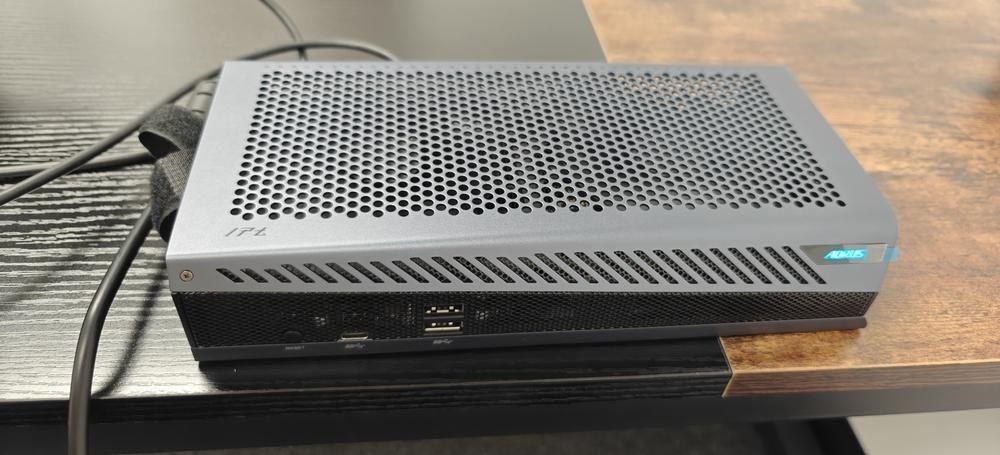
The Gigabyte AORUS RTX 5060 Ti AI Box is the closest I've seen anyone get to delivering on that promise without an asterisk the size of a power supply. It's hot. It's a little heavy. And on Linux, my computing weapon of choice, it was genuinely hard to set up. But I love that it exists, and I think it matters more than its modest spec sheet suggests.
What it actually is
Strip away the marketing, and the AI Box is a desktop GPU living in a case roughly the size of a beefy Thunderbolt dock. The card inside is a real Nvidia RTX 5060 Ti, the same silicon that earned gamer raspberries when it launched. The original 5060 was seen as underpowered and stingy on memory. The Ti still got the side-eye, but the bump to 16GB of RAM made it suddenly interesting to creatives and to the growing crowd running local language models on their own machines.
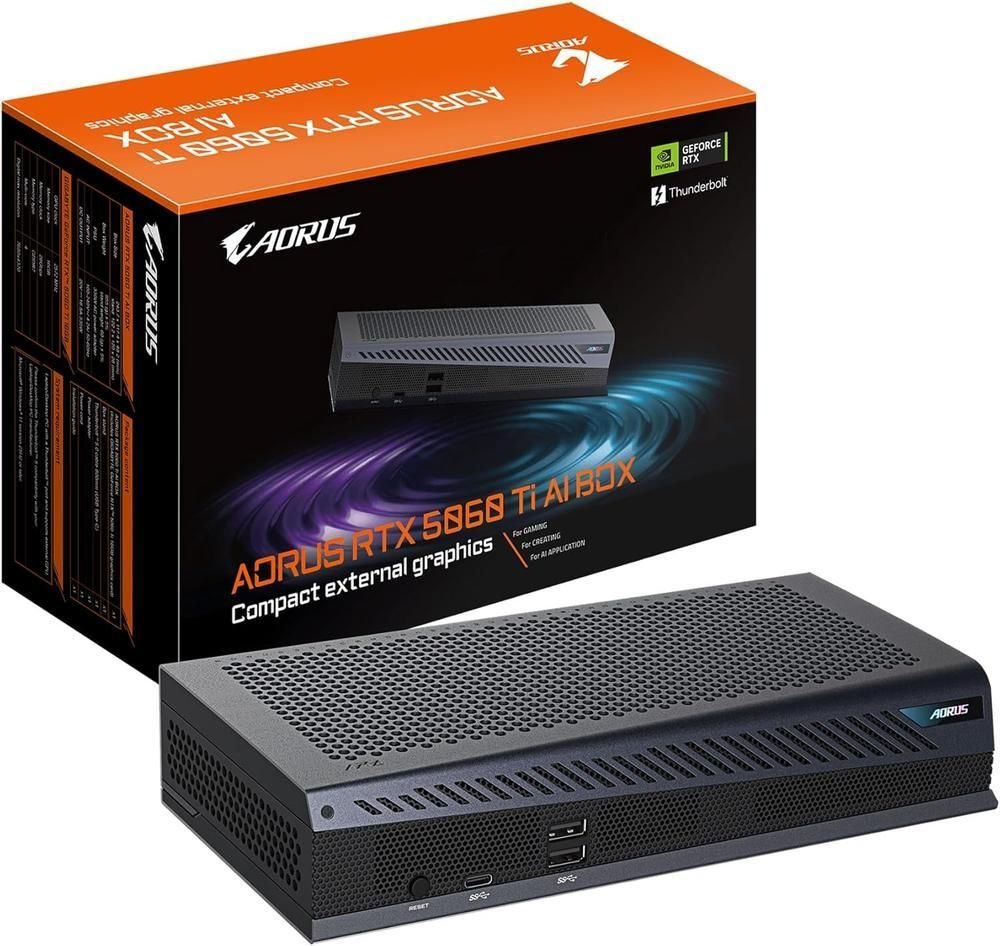
Part of why this miniaturization is even possible comes down to the card's design. Unlike most GPUs, it's built for an eight-lane PCIe Gen 5 connection rather than the usual 16-lane arrangement. PCIe has gotten fast enough that halving the lanes no longer cripples a card like this, and the practical upshot is that once you pull off the fans, the board itself is genuinely small. A user on the eGPU.io forums pointed out that the device is essentially a GPU on a tiny PCIe card plugged into an adapter, which means a future card in the same family might be swappable. That's a rare thing in a sealed consumer box.
Context is everything with this card. Dropped into a desktop built for someone grinding through Black Myth: Wukong, the 5060 Ti feels like the weak end of the lineup. Strapped to a laptop that only occasionally loads Steam, it feels like a small miracle. My HP Envy has dedicated Intel Arc graphics, and they're fine, but they don't live in the same universe as this thing.
Portability is the whole point
The AI Box ships without a proper case, which is the one design decision I'd push back on. I improvised by gutting a camera bag, pulling out the dividers, and dropping the box inside. It works surprisingly well, and I eventually settled on a Koolertron waterproof DSLR bag that tucks into a Chrome messenger bag without complaint.
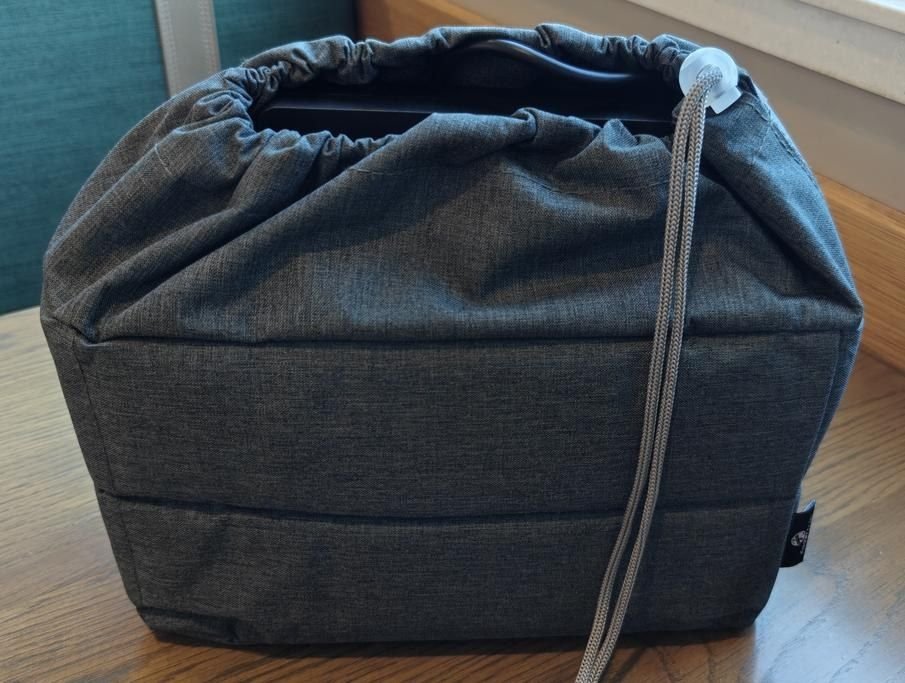
You could carry this into a Panera and get looks like you're hauling around a car battery. But that portability turned out to be the feature I didn't know I wanted. At $699, it isn't much more than a standalone 5060 Ti, and unlike the cheap open-air eGPU adapters that assume you've got a spare power supply lying around and don't mind your card flapping in the breeze, this one is self-contained. It's the unusual case where you get more value by ignoring upgradeability and treating it as a finished appliance.
Setting it up on Linux, or, a tour of self-inflicted pain
I'm not going to sugar-coat it. If you buy an eGPU to run on Linux right now, you are volunteering for suffering. As a former Hackintosher, I have a high tolerance for this kind of thing, and the freezes I hit whenever the driver came online dragged me straight back to the worst nights of debugging kexts in Clover.
The driver situation on Linux hasn't settled. That hasn't stopped people from trying, most notably developer Andrew Obersnel, whose nvidia-driver-injector project patches Nvidia's driver and runs it inside a Docker container. It's a clever workaround, but it was written for the more powerful 5090 AI Box, the same family with different requirements. I was also running Bazzite DX, an immutable distro, which complicates everything because you can't just splatter files across the filesystem the old way.
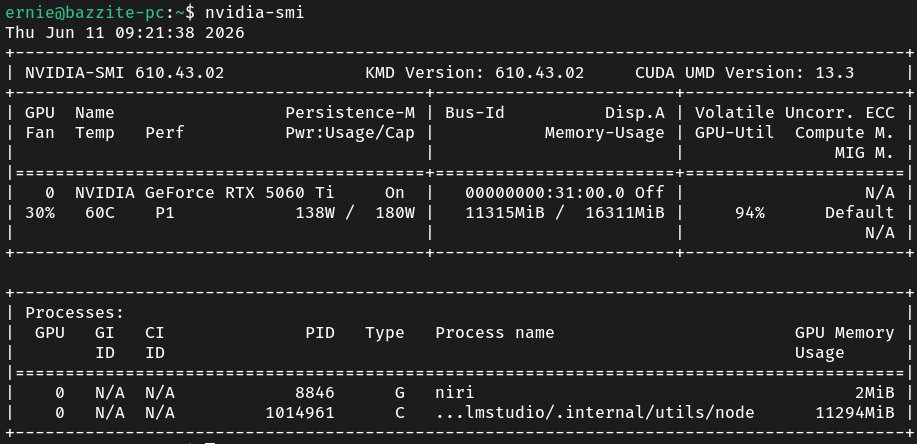
Getting it working was pure gruntwork, the kind of debugging where an LLM earns its keep by making sense of dense error output. It took a few hours, and then the next Bazzite update landed and forced me to rebuild the whole thing. A little more LLM-assisted grinding got me back on track, but the lesson stands: this is not a plug-and-play device on Linux. It even has a habit of starving other Thunderbolt devices of bandwidth, occasionally knocking out my keyboard, mouse, and webcam to feed its appetite.
Windows 11, by contrast, was boring in the best way. I plugged it in, installed Nvidia's drivers, and was off. The card can also theoretically run on Apple Silicon thanks to newly sanctioned drivers from TinyGrad, and I tried it on my M1 Air. I hit a wall, though a slightly older card reportedly would have worked. I'll try again in six months.
The speed trials
My real use case is local LLMs plus a little extra horsepower for creative software like Affinity. So I ran a land-speed test in LM Studio. Using Qwen 3 VL 4B, a model small enough to fit entirely on the laptop's Intel Arc chip, the laptop's own GPU produced about 14 tokens per second. The eGPU hit 118, with headroom to spare. The newer Gemma4 12B managed around 35 tokens per second, and a distilled Qwen 3.5 trained on DeepSeek 4 landed near 60.
The limits of local models are easy to find, and they're often factual rather than mechanical. I gave them a very Tedium-flavored prompt asking for a story about Conor Oberst beating Tim Kasher in an Omaha trivia game. Most knew Oberst fronted Bright Eyes. None correctly named Kasher's band: one guessed The Decemberists, another The National. The answer, for the record, is Cursive, or The Good Life if you're a real one. Local models live further from the facts than their server-rack cousins, and you plan around that.
Affinity was the pleasant surprise. After a fresh install and a little troubleshooting, it ran beautifully in Vulkan mode, about as smooth as Krita. And yes, I played a game. The 2016 Doom hit 70fps at 4K medium and neared 100fps at 1440p ultra. Not bad, though I fought resizable BAR issues and frequent freezes when routing a DisplayPort cable through the box itself. I blame driver immaturity and my own missteps more than the hardware.
Why this one matters
The eGPU has always struggled to find its moment the way mini PCs eventually did. It's a tool for bringing a stationary task to a portable system, and the technical tradeoffs are real. Thunderbolt is slower than a direct PCIe slot, and to get the best out of the card you really want an external monitor, since looping the signal back through the laptop tanks performance.
This isn't the first breakaway box. But it's a rare one: a desktop GPU in an enclosure smaller than a standard desktop GPU card, and built on Nvidia silicon rather than the AMD cards that dominated earlier attempts. AMD is fine, but it's behind on machine learning even after its ROCm improvements. Honestly, I think Intel should be shipping an eGPU of its own, given how price-competitive Arc has gotten and how much better it tends to behave on Linux.
There's a real chance eGPUs become a bridge device as laptops turn more GPU-forward. That shift already played out in the Mac world, and Nvidia's move into ARM laptops with 5070-class graphics could push it onto the PC side. Those machines will be powerful and, for a good while, expensive, the kind of mid-four-figure workstation-class hardware that even enthusiasts might pass on at first. An eGPU that plugs into a Thunderbolt port and gets a normal laptop most of the way there is a genuinely good compromise, especially if local LLMs keep working their way into daily tasks.
When I unboxed this thing, I assumed the appeal would be raw performance. It turned out to be the portability, the fact that I can carry serious compute in a camera bag and summon it wherever I land. The XG Station tried to make this case in 2007 and the world wasn't ready. Eighteen years later, the hardware finally caught up. The software, at least on Linux, still has some growing up to do, and I hope we see a dozen more boxes like this that treat Linux as a first-class citizen rather than an afterthought.
Comments
Please log in or register to join the discussion